Skip to content
Epomedicine

Mnemonics, Simplified Concepts & Thoughts

Epomedicine

Mnemonics, Simplified Concepts & Thoughts

myeloid differentiation aml

Concept of Acute Myeloid Leukemia (AML) FAB Classification

Epomedicine, Aug 23, 2016Mar 10, 2018

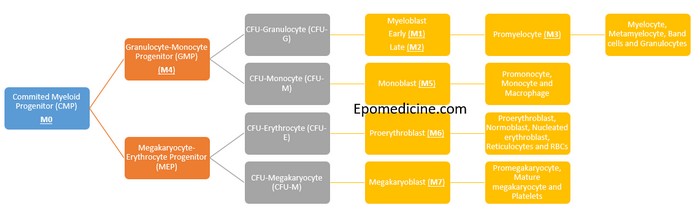
There is no need of mnemonics to remember the FAB classification of Acute Myeloid Leukemia (AML); just remember the process myeloid differentiation. A simple schematic diagram with few intermediate processes and stimulating factors eliminated will meet our purpose here.
myeloid differentiation aml

The cells belonging to the myeloid lineage are:

  1. Granulocytes: Neutrophils, Eosinophils and Basophils
  2. Monocytes and Macrophages
  3. Erythrocytes (RBCs)
  4. Megakaryocytes (Platelets)

In French-American-British (FAB) classification of AML, it is classified from M0 to M7. The scheme takes into account:

  • The degree of maturation (M0 to M3)
  • The lineage of leukemic blast (M4 to M7)
  1. M0 – undifferentiated progenitor cells
  2. M1 to M3 – myelocytes (granulocyte precursors)
  3. M4 to M5 – monocyte precursors
  4. M6 – erythrocyte precursors
  5. M7 – platelet precursors

Simplified FAB classification of AML

  1. M0 – Undifferentiated
  2. M1 – Myeloblastic without maturation
  3. M2 – Myeloblastic with maturation (Commonest type)
  4. M3 – Promyelocytic
  5. M4 – Myelomonocytic (Naegeli type)
  6. M5 – Monocytic (Schilling type)
  7. M6 – Erythroleukemia (Di Gulielmo’s disease)
  8. M7 – Megakaryocytic

AML Concepts in Concise

1. FAB used 30% blasts to delineate chronic myeloid leukemia (CML) from Blast crisis and AML. WHO revised classification uses the presence of ≥20% myeloblasts in the bone marrow or peripheral blood for the diagnosis of AML.

2. Mo, M1 and M2:

  • <3% blasts are MPO positive in M0 and ≥3% blasts are MPO positive in M1
  • <10% maturation beyond myeloblasts = M1
  • >10% mauration beyond myeloblasts = M2
  • Auer rods:
    • M0 – None
    • M1 – 50%
    • M2 – 70%
    • M3 – 100%
  • t(8:21) is pressent in M2

3. M3:

  • Most cases have t(15:17) – results in disruption of Retinoic Acid Receptor (RAR) required for myeloblast maturation.
  • All-trans-retinoic acid is hence, used for treatment of Acute Promyelocytic Leukemia (APL).
  • DIC is seen in 5-10% cases due to prothrombotic release of Auer rods.

4. M4: >20% monocytic precursors (<20% in M2)

  • Myeloperoxidase positive (Myeloblastic) + Auer rod positive (Monoblastic) + Non-specific esterase positive (Monoblastic)

5. M5:

  • >80% monocytic precursors
  • Gum infiltration and hyperplasia
  • High lysozyme level
  • Auer rod negative + Non-specific esterase positive

6. M6:

  • ≥50% erythroid precursors and ≥20% blasts in nonerythroid component
  • Also known as Di Gulielmo’s disease or Syndrome

7. M7:

  • Rapid myelofibrosis due to release of PDGF.
  • Resistant to treatment
  • GATA1 mutations is seen in those associated with Down’s Syndrome.
  • GpIIb/IIIa or vWF positive

8. Ara-C (Cytarabine) is used for the treatment of CML except M3, in which all-trans retinoic acid is used.

9. Remission criteria:

  • Complete remission = Bone marrow blasts <5%, No auer rods
  • Complete blood count recovery = ANC >1000/microlitre and Platelets ≥1,00,000/microlitre
  • Partial remission = ≥50% fall in blasts over pretreatment values

10. M8:

  • There is no M8 in FAB classification, but some authors have proposed rare deno-vo Acute Basophilic Leukemia as M8.
  • Facebook
  • Twitter
PGMEE, MRCS, USMLE, MBBS, MD/MS HematologyInternal medicinePathology

Post navigation

Previous post
Next post

Related Posts

PGMEE, MRCS, USMLE, MBBS, MD/MS

Medical Ethics : Mnemonics

Nov 21, 2020Nov 21, 2020

4 D’s of Medical Negligence Duty Deviation/Dereliction Damage Direct cause 4 Core Principles of Medical Ethics Mnemonic: BAN Justice Beneficence Autonomy Non-maleficence Justice Some even add “Veracity or Truthfulness” and “Confidentiality” to make 6 Ethical Principles. BRAIN of Informed Consent Benefits Risks Alternatives Indications Nature 5 Cs of the Exceptions…

Read More
PGMEE, MRCS, USMLE, MBBS, MD/MS gastric glands

Gastric Acid Secretion in Parietal cells: Mechanism

Jun 16, 2023Jun 16, 2023

Key player: H+/K+ ATPase or “proton pump” (in canalicular membrane of parietal cells) a. Hydrogen ions are generated within the parietal cell from dissociation of water. The hydroxyl ions formed in this process rapidly combine with carbon dioxide to form bicarbonate ion, a reaction catalyzed by carbonic anhydrase. b. Bicarbonate…

Read More
PGMEE, MRCS, USMLE, MBBS, MD/MS complement protective mechanism

Complement Pathway – Explained

Jun 5, 2016Dec 8, 2022

The complement system is composed of about 20 different proteins released into the blood after production in the liver. They interact in coordinated and regulated way to produce biologically active protein products. ACTIVATION OF COMPLEMENT CASCADE The complement cascade can be activated in 3 ways: C3 and C3 CONVERTASE All of…

Read More

Comments (2)

  1. Surekha Thakur says:
    Jun 5, 2018 at 2:49 pm

    Thanks a lot

    Reply
  2. Dr Premchand Mahajan says:
    Dec 1, 2022 at 10:46 am

    Precisely summarised information.
    Keep it up.

    Reply

Leave a Reply Cancel reply

Your email address will not be published. Required fields are marked *

This site uses Akismet to reduce spam. Learn how your comment data is processed.

Epomedicine. Concept of Acute Myeloid Leukemia (AML) FAB Classification [Internet]. Epomedicine; 2016 Aug 23 [cited 2026 Sep 13]. Available from: https://epomedicine.com/medical-students/concept-acute-myeloid-leukemia-aml-fab-classification/.

Pre-clinical (Basic Sciences)

Anatomy

Biochemistry

Community medicine (PSM)

Embryology

Microbiology

Pathology

Pharmacology

Physiology

Clinical Sciences

Anesthesia

Dermatology

Emergency medicine

Forensic

Internal medicine

Gynecology & Obstetrics

Oncology

Ophthalmology

Orthopedics

Otorhinolaryngology (ENT)

Pediatrics

Psychiatry

Radiology

Surgery

RSS feed: Ask Epomedicine Ask Epomedicine

  • What to study for Clinical examination in Orthopedics?
  • What is the mechanism of AVNRT?

Epomedicine weekly

  • About Epomedicine
  • Contact Us
  • Author Guidelines
  • Submit Article
  • Editorial Board
  • USMLE
  • MRCS
  • Thesis
©2026 Epomedicine | WordPress Theme by SuperbThemes