Skip to content
Epomedicine

Mnemonics, Simplified Concepts & Thoughts

Epomedicine

Mnemonics, Simplified Concepts & Thoughts

goodsall rule

Goodsall’s rule : Mnemonic

Epomedicine, Apr 17, 2020Oct 1, 2020

Synonym: Goodsall-Salmon’s law

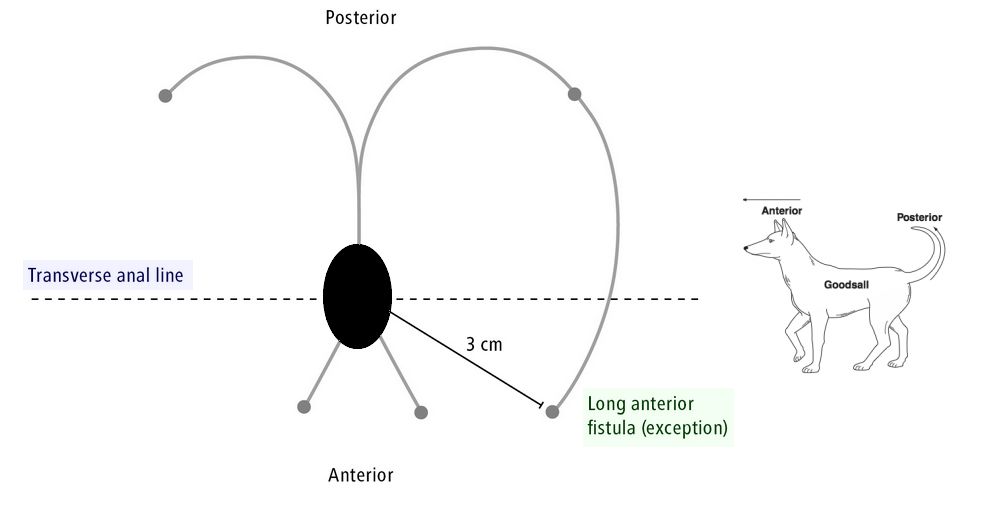
In anal fistula, goodsall’s rule predicts the type of track and location of internal opening.

An anterior external opening is more likely to have a straight track while a psoteriorly placed external opening is more likely to have a curved track.

Mnemonic: Think of a dog with a straight nose anteriorly and a curved tail posteriorly.
goodsall rule

However, exception exists. With the patient lying supine, an imaginary transverse, or “trans-anal” line is drawn through the ischial tuberosities. The exception to Goodsall’s rule occurs when the external opening lies anterior to the line but >3 cm from the anal verge. In this case, the tract tends to follow the rule for posterior external openings with an indirect,curved path that ends at the posterior midline (similar to posterior fistula).
  • Facebook
  • Twitter
PGMEE, MRCS, USMLE, MBBS, MD/MS Gastrointestinal systemGeneral Surgery

Post navigation

Previous post
Next post

Related Posts

PGMEE, MRCS, USMLE, MBBS, MD/MS diastema

Few Etiology Mnemonics

Sep 30, 2019Oct 13, 2019

YELLOW NAILS N: Non pitting Lymphedema A: Autoimmune disorders (thyroiditis, rheumatoid arthritis) I: Infections (Pneumonia, AIDS) L: Lung disorders (pleural effusions and bronchiectasis) S: Serious: Malignancy (mycosis fungoides, laryngeal carcinoma, bronchial carcinoma, breast cancer, endometrial cancer, gallbladder cancer, NH Lymphoma) DIASTEMA causes (see Terry Thomas “sign”) D: Developmental cyst orofacial line I:…

Read More
PGMEE, MRCS, USMLE, MBBS, MD/MS

Pathophysiology of Osteomyelitis

Aug 15, 2020Jul 23, 2022

Osteomyelitis is defined as an inflammation of the bone (single portion or numerous regions, like marrow, cortex, periosteum and surrounding soft tissue) caused by an infecting organism (usually monomicrobial but polymicrobial can occur, especially in diabetic foot). Definitions, Criteria and Classifications of different types of Osteomyelitis have been discussed in…

Read More
PGMEE, MRCS, USMLE, MBBS, MD/MS prostate arteries

Prostate Anatomy – Clinical correlate

Aug 15, 2016Aug 18, 2016

Anatomy of Prostate The embryology and detailed gross and microscopic anatomy of the prostate has already been discussed earlier. Read the anatomy of prostate. Benign Prostatic Hyperplasia (BPH) Occurs exclusively in transition zone (progressively enlarges with age). Median lobe of the gland enlarges upward and encroaches sphincter vesicae, located at…

Read More

Comments (2)

  1. Muhammad waqas khan says:
    Sep 30, 2020 at 5:33 pm

    Why is this 3 cm necessary for anal fistula classification and why anteriorly placed anal fistula take curved posterior position when it is greater than 3cm of anal margin

    Reply
    1. Epomedicine says:
      Oct 1, 2020 at 3:49 am

      Anococcygeal raphe is a fibrous median raphe in the floor of the pelvis, which extends between the coccyx and the margin of the anus. This prevents fistula from directly opening in the midline posterior anal orifice. Cutaneous openings which lie anterior, or ventral, to transverse anal line typically are connected to the anal canal via a radial tract. The reason for exception of long anterior fistula opening posteriorly might be because of these often being high transsphincteric and suprasphincteric fistulas, which have their internal openings and primary abscesses located posteriorly and penetrate the external anal sphincter.

      Reply

Leave a Reply Cancel reply

Your email address will not be published. Required fields are marked *

This site uses Akismet to reduce spam. Learn how your comment data is processed.

Pre-clinical (Basic Sciences)

Anatomy

Biochemistry

Community medicine (PSM)

Embryology

Microbiology

Pathology

Pharmacology

Physiology

Clinical Sciences

Anesthesia

Dermatology

Emergency medicine

Forensic

Internal medicine

Gynecology & Obstetrics

Oncology

Ophthalmology

Orthopedics

Otorhinolaryngology (ENT)

Pediatrics

Psychiatry

Radiology

Surgery

RSS Ask Epomedicine

  • What to study for Clinical examination in Orthopedics?
  • What is the mechanism of AVNRT?

Epomedicine weekly

  • About Epomedicine
  • Contact Us
  • Author Guidelines
  • Submit Article
  • Editorial Board
  • USMLE
  • MRCS
  • Thesis
©2026 Epomedicine | WordPress Theme by SuperbThemes