Skip to content
Epomedicine

Mnemonics, Simplified Concepts & Thoughts

Epomedicine

Mnemonics, Simplified Concepts & Thoughts

myeloid differentiation aml

Concept of Acute Myeloid Leukemia (AML) FAB Classification

Epomedicine, Aug 23, 2016Mar 10, 2018

There is no need of mnemonics to remember the FAB classification of Acute Myeloid Leukemia (AML); just remember the process myeloid differentiation. A simple schematic diagram with few intermediate processes and stimulating factors eliminated will meet our purpose here.
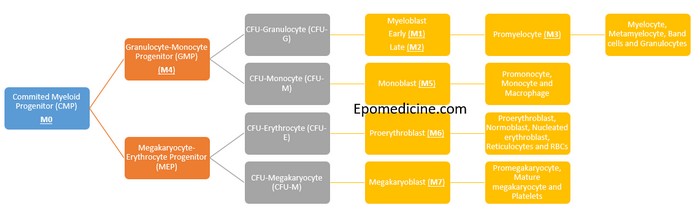
myeloid differentiation aml

The cells belonging to the myeloid lineage are:

  1. Granulocytes: Neutrophils, Eosinophils and Basophils
  2. Monocytes and Macrophages
  3. Erythrocytes (RBCs)
  4. Megakaryocytes (Platelets)

In French-American-British (FAB) classification of AML, it is classified from M0 to M7. The scheme takes into account:

  • The degree of maturation (M0 to M3)
  • The lineage of leukemic blast (M4 to M7)
  1. M0 – undifferentiated progenitor cells
  2. M1 to M3 – myelocytes (granulocyte precursors)
  3. M4 to M5 – monocyte precursors
  4. M6 – erythrocyte precursors
  5. M7 – platelet precursors

Simplified FAB classification of AML

  1. M0 – Undifferentiated
  2. M1 – Myeloblastic without maturation
  3. M2 – Myeloblastic with maturation (Commonest type)
  4. M3 – Promyelocytic
  5. M4 – Myelomonocytic (Naegeli type)
  6. M5 – Monocytic (Schilling type)
  7. M6 – Erythroleukemia (Di Gulielmo’s disease)
  8. M7 – Megakaryocytic

AML Concepts in Concise

1. FAB used 30% blasts to delineate chronic myeloid leukemia (CML) from Blast crisis and AML. WHO revised classification uses the presence of ≥20% myeloblasts in the bone marrow or peripheral blood for the diagnosis of AML.

2. Mo, M1 and M2:

  • <3% blasts are MPO positive in M0 and ≥3% blasts are MPO positive in M1
  • <10% maturation beyond myeloblasts = M1
  • >10% mauration beyond myeloblasts = M2
  • Auer rods:
    • M0 – None
    • M1 – 50%
    • M2 – 70%
    • M3 – 100%
  • t(8:21) is pressent in M2

3. M3:

  • Most cases have t(15:17) – results in disruption of Retinoic Acid Receptor (RAR) required for myeloblast maturation.
  • All-trans-retinoic acid is hence, used for treatment of Acute Promyelocytic Leukemia (APL).
  • DIC is seen in 5-10% cases due to prothrombotic release of Auer rods.

4. M4: >20% monocytic precursors (<20% in M2)

  • Myeloperoxidase positive (Myeloblastic) + Auer rod positive (Monoblastic) + Non-specific esterase positive (Monoblastic)

5. M5:

  • >80% monocytic precursors
  • Gum infiltration and hyperplasia
  • High lysozyme level
  • Auer rod negative + Non-specific esterase positive

6. M6:

  • ≥50% erythroid precursors and ≥20% blasts in nonerythroid component
  • Also known as Di Gulielmo’s disease or Syndrome

7. M7:

  • Rapid myelofibrosis due to release of PDGF.
  • Resistant to treatment
  • GATA1 mutations is seen in those associated with Down’s Syndrome.
  • GpIIb/IIIa or vWF positive

8. Ara-C (Cytarabine) is used for the treatment of CML except M3, in which all-trans retinoic acid is used.

9. Remission criteria:

  • Complete remission = Bone marrow blasts <5%, No auer rods
  • Complete blood count recovery = ANC >1000/microlitre and Platelets ≥1,00,000/microlitre
  • Partial remission = ≥50% fall in blasts over pretreatment values

10. M8:

  • There is no M8 in FAB classification, but some authors have proposed rare deno-vo Acute Basophilic Leukemia as M8.
  • Facebook
  • Twitter
PGMEE, MRCS, USMLE, MBBS, MD/MS HematologyInternal medicinePathology

Post navigation

Previous post
Next post

Related Posts

PGMEE, MRCS, USMLE, MBBS, MD/MS liporptoein receptors

Lipoprotein Metabolism Simplified

Jul 6, 2016Jul 30, 2018

Lipoproteins Composition of Lipoproteins: Non-polar core – mainly triglycerides and cholesteryl esters Single surface layer – amphipathic phospholipids and cholesterol Apoprotein or Apolipoprotein Class Abbreviation Density Protein Lipid content Electrophoretic mobility Chylomicrons CM lowest lowest highest (exogenous triacylglycerol) don’t migrate Very low density lipoproteins VLDL .. .. .. (endogenous triacylglycerol)…

Read More
PGMEE, MRCS, USMLE, MBBS, MD/MS dna replication

DNA Replication Explained With Zipper Model

Jan 25, 2017Jan 26, 2017

Imagine DNA as a zipper Prokaryotic DNA as a zipper with single slider (single origin of replication) and Eukaryotic DNA as a zipper with two sliders (multiple origin of replication). Zipper teeth: Purines and pyrimidine bases Complementary teeth pair: Complementary base pairs attached by hydrogen bonds Top stops: Origin of…

Read More
PGMEE, MRCS, USMLE, MBBS, MD/MS

Joint Lubrication Made Easy

Jan 20, 2024Jan 20, 2024

Boundary lubrication A monolayer of lubricant molecule (lubricin) adsorbed on each surface (boundary) of the joint prevents direct cartilage to cartilage (articular) contact Fluid-film lubrication Cartilage surfaces are separated by a fluid film 1. Hydrodynamic lubrication: 2. Squeeze film lubrication: 2. Elastohydrodynamic lubrication: Combination of hydrodynamic and squeeze film Mixed…

Read More

Comments (2)

  1. Surekha Thakur says:
    Jun 5, 2018 at 2:49 pm

    Thanks a lot

    Reply
  2. Dr Premchand Mahajan says:
    Dec 1, 2022 at 10:46 am

    Precisely summarised information.
    Keep it up.

    Reply

Leave a Reply to Surekha Thakur Cancel reply

Your email address will not be published. Required fields are marked *

This site uses Akismet to reduce spam. Learn how your comment data is processed.

Pre-clinical (Basic Sciences)

Anatomy

Biochemistry

Community medicine (PSM)

Embryology

Microbiology

Pathology

Pharmacology

Physiology

Clinical Sciences

Anesthesia

Dermatology

Emergency medicine

Forensic

Internal medicine

Gynecology & Obstetrics

Oncology

Ophthalmology

Orthopedics

Otorhinolaryngology (ENT)

Pediatrics

Psychiatry

Radiology

Surgery

RSS Ask Epomedicine

  • What to study for Clinical examination in Orthopedics?
  • What is the mechanism of AVNRT?

Epomedicine weekly

  • About Epomedicine
  • Contact Us
  • Author Guidelines
  • Submit Article
  • Editorial Board
  • USMLE
  • MRCS
  • Thesis
©2026 Epomedicine | WordPress Theme by SuperbThemes