Skip to content
Epomedicine

Mnemonics, Simplified Concepts & Thoughts

Epomedicine

Mnemonics, Simplified Concepts & Thoughts

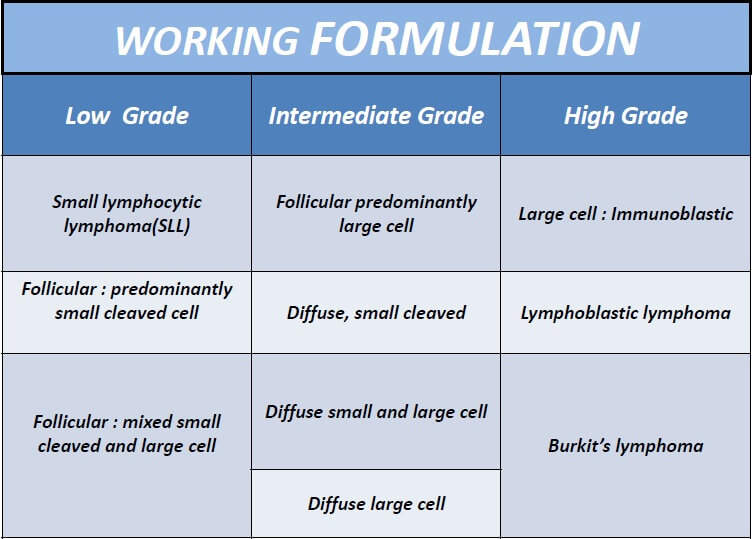
Working formulation of NHL (Mnemonic)

Epomedicine, Jan 16, 2019Feb 26, 2019

All follicular except large cell: Low grade

All diffuse: Intermediate grade

Blastic and non-cleaved: High grade
  • Facebook
  • Twitter
PGMEE, MRCS, USMLE, MBBS, MD/MS HematologyOncologyPathology

Post navigation

Previous post
Next post

Related Posts

PGMEE, MRCS, USMLE, MBBS, MD/MS lactational amenorrhea mechanism

Management of Puerperium

Apr 3, 2016

Normal puerperium has been already discussed earlier here. A) Immediately after labor within 1 hour Blood pressure and heart rate atleast every 15 minutes Monitor amount of vaginal bleeding Palpate fundus to ensure amount adequate contractions (if relaxed – massage uterus to enhance oxytocin release) B) 1st several hours 1….

Read More
PGMEE, MRCS, USMLE, MBBS, MD/MS lung segments xray

Silhouette and Cervico-thoracic sign

Oct 30, 2016May 24, 2019

Synonyms: Obscured margin sign, Loss of outline sign Silhouette refers to the shadow and derived it’s origin from shadow papercuts done by Etienne de Silhouette. Principle of Silhouette sign On a normal Chest X-ray the well-defined borders of the heart and the domes of the diaphragm are visualised because the adjacent…

Read More
PGMEE, MRCS, USMLE, MBBS, MD/MS

Boutonniere and Swan neck Deformity – Pathophysiology

Sep 5, 2021Sep 5, 2021

Understanding of the Boutonniere and Swan neck deformity requires clear concept of the finger extensor apparatus, which has been discussed here. The extrinsic extensor tendons trifurcate giving a central slip which attaches to the middle phalanx base and two lateral slips which join with lateral band (formed by intrinsic muscles…

Read More

Leave a Reply Cancel reply

Your email address will not be published. Required fields are marked *

This site uses Akismet to reduce spam. Learn how your comment data is processed.

Pre-clinical (Basic Sciences)

Anatomy

Biochemistry

Community medicine (PSM)

Embryology

Microbiology

Pathology

Pharmacology

Physiology

Clinical Sciences

Anesthesia

Dermatology

Emergency medicine

Forensic

Internal medicine

Gynecology & Obstetrics

Oncology

Ophthalmology

Orthopedics

Otorhinolaryngology (ENT)

Pediatrics

Psychiatry

Radiology

Surgery

RSS Ask Epomedicine

  • What to study for Clinical examination in Orthopedics?
  • What is the mechanism of AVNRT?

Epomedicine weekly

  • About Epomedicine
  • Contact Us
  • Author Guidelines
  • Submit Article
  • Editorial Board
  • USMLE
  • MRCS
  • Thesis
©2026 Epomedicine | WordPress Theme by SuperbThemes