Skip to content
Epomedicine

Mnemonics, Simplified Concepts & Thoughts

Epomedicine

Mnemonics, Simplified Concepts & Thoughts

internal carotid artery

Internal Carotid Artery – Segments and Branches

Epomedicine, Feb 13, 2017

7 segments of Internal Carotid Artery

We have already discussed a mnemonic to remember the course of Internal Carotid Artery with the help of 2 horizontal “S” under the topic of Circle of Willis.

  • C1 – Cervical segment
  • C2 – Petrous (horizontal) segment
  • C3 – Lacerum segment
  • C4 – Cavernous segment
  • C5 – Clinoid segment
  • C6 – Ophthalmic (supraclinoid) segment
  • C7 – Communicating (terminal) segment

Mnemonic: Except for the C7, odd numbered segments do not have branches.
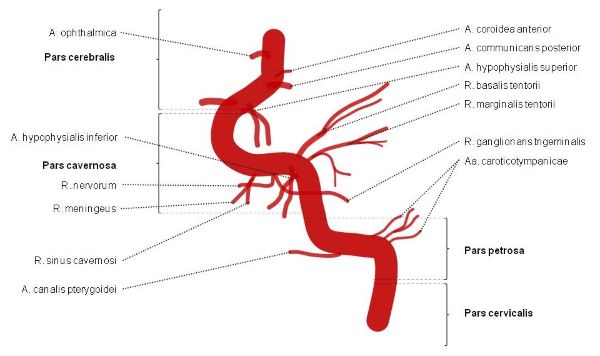
internal carotid artery

Branches of Internal Carotid Artery

Segment C2

These supply the nose and ear.

  1. Vidian artery
  2. Caroticotympanic artery

Segment C4

These supply the trigeminal ganglion, pituitary and meninges.

  1. Inferolateral trunk: supplies trigeminal ganglion
  2. Meningohypophyseal trunk: supplies meninges and pituitary (through inferior hypophyseal artery)

Segment C6

These supply the pituitary, eye, orbit and nose.

  1. Superior hypophyseal artery
  2. Ophthalmic artery

Segment C7

These supply brain as a part of circle of willis.

  1. Posterior communicating artery
  2. Anterior choroidal artery
  3. Terminal branches: Middle cerebral artery and Anterior cerebral artery

Mnemonic:

  1. 1st supplies the parts of head – nose and ear.
  2. Then supplies the covering of brain and pituitary.
  3. Then supplies the eyes.
  4. At last supplies the brain.

Mnemonic for branches: A VIP’S COMMA

  • A: Anterior choroidal artery (C7)
  • V: Vidian artery (C2)
  • I: Inferolateral trunk (C4)
  • P: Posterior communicating artery (C7)
  • S: Superior hypophyseal artery (C6)
  • C: Caroticotympanic artery (C2)
  • O: Ophthalmic artery (C6)
  • M: Meningohypophyseal trunk (C4)
  • M: Middle cerebral artery (C7)
  • A: Anterior cerebral artery (C7)

Brain structures supplied by Internal Carotid Artery

1. Cerebral hemispheres

2. Eye, optic nerve, optic chiasma and optic tract

3. Midbrain through anterior choroidal artery

4. Thalamus and internal capsule through posterior communicating artery

5. Pituitary gland and hypothalamus

6. Meninges of the skull base
39 shares
  • Facebook36
  • Twitter
PGMEE, MRCS, USMLE, MBBS, MD/MS AnatomyCardiovascular systemNervous system

Post navigation

Previous post
Next post

Related Posts

PGMEE, MRCS, USMLE, MBBS, MD/MS gastric glands

Gastric glands and cells

Jul 15, 2018Jun 16, 2023

Anatomically, stomach can be divided into 3 parts from above to below: Gastric pits deepen as we move below from cardiac to pyloric glands. Mucus secreting cells: Present in all 3 glands – cardiac, fundic and pyloric but predominate in cardiac and pyloric glands. Pyloric glands have 1 more cell…

Read More
PGMEE, MRCS, USMLE, MBBS, MD/MS

Injection site swelling after vaccination in Infants

Mar 11, 2021Mar 11, 2021

Swelling and pain at injection site after vaccination is a frequently observed problem by parents and is often of concern to them. These type of reactions are generally observed after intramuscular vaccine and vaccine containing aluminium component. DPT as pentavalent is a frequent vaccine after which infants develop swelling. Types…

Read More
PGMEE, MRCS, USMLE, MBBS, MD/MS

How to present a Journal Club?

Aug 25, 2020Aug 25, 2020

A journal club is a group of individuals who meet regularly to critically evaluate recent articles in scientific literature. It is a part of postgraduate medical education aimed at improving the skills of critically appraising the journal articles. Critical appraisal is the process of systematically examining research evidence to assess…

Read More

Leave a Reply Cancel reply

Your email address will not be published. Required fields are marked *

This site uses Akismet to reduce spam. Learn how your comment data is processed.

Pre-clinical (Basic Sciences)

Anatomy

Biochemistry

Community medicine (PSM)

Embryology

Microbiology

Pathology

Pharmacology

Physiology

Clinical Sciences

Anesthesia

Dermatology

Emergency medicine

Forensic

Internal medicine

Gynecology & Obstetrics

Oncology

Ophthalmology

Orthopedics

Otorhinolaryngology (ENT)

Pediatrics

Psychiatry

Radiology

Surgery

RSS Ask Epomedicine

  • What to study for Clinical examination in Orthopedics?
  • What is the mechanism of AVNRT?

Epomedicine weekly

  • About Epomedicine
  • Contact Us
  • Author Guidelines
  • Submit Article
  • Editorial Board
  • USMLE
  • MRCS
  • Thesis
©2026 Epomedicine | WordPress Theme by SuperbThemes