Skip to content
Epomedicine

Mnemonics, Simplified Concepts & Thoughts

Epomedicine

Mnemonics, Simplified Concepts & Thoughts

Normal Hip Development

Dr. Sulabh Kumar Shrestha, MS Orthopedics, Dec 23, 2025Dec 23, 2025

4-6 weeks of gestation:

  • Limb buds appear and elongate
  • Hip joint is a single cartilaginous analage

By 7 weeks of gestation:

  • Apoptotic cleft appears between cartilaginous femur and acetabulum
  • Earliest time during which a hip dislocation may occur

By 11 weeks of gestation:

  • Infantile configuration of hip joint is achieved
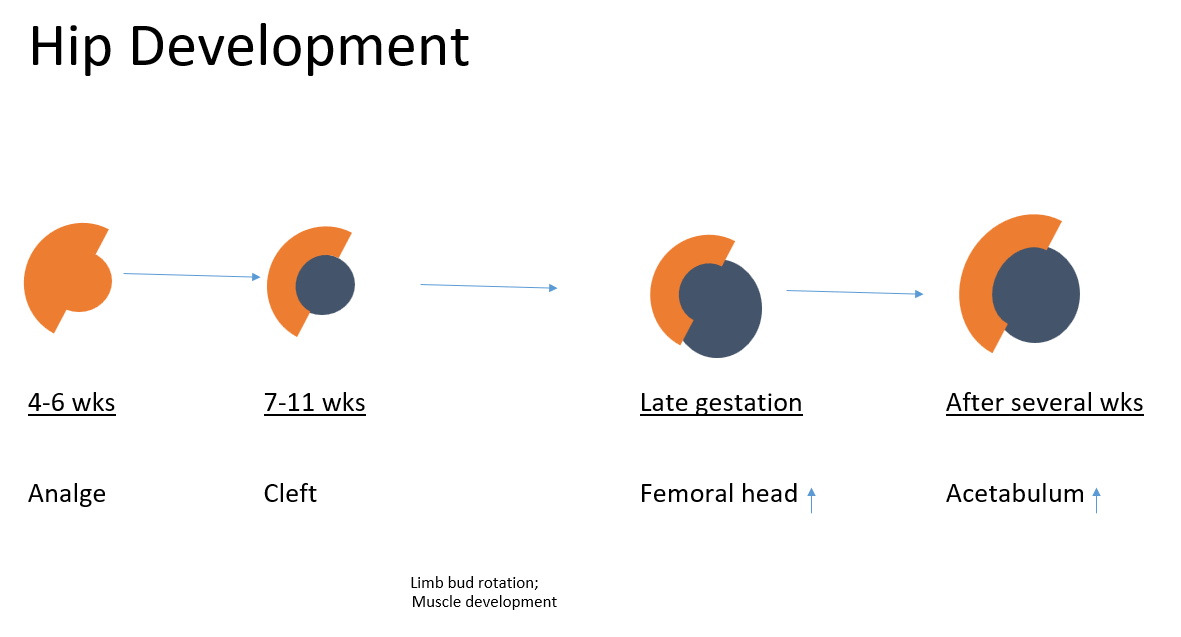
hip development

Late gestation:

  • Femoral head growth is faster than acetabulum growth, resulting in under-coverage of the femoral head (<50% covered)

Postnatal:

  • Acetabulum develops faster than femoral head, progressively improving the coverage

The acetabulum is deepened by the natural pressure from the developing femoral head on the acetabulum. Hips in newborns with developmental dysplasia are not just normal hips with capsular laxity; they are structurally abnormal.

Femoral anteversion: Increase with increasing fetal age, measuring on average 45 degrees at 36 weeks. Femoral anteversion then decreases in postnatal development.

Neck-shaft angle: Neck–shaft angle in fetal development appears to decrease with fetal age, ranging from approximately 145 at 15 weeks to 130 at 36 weeks. Following birth, the neck–shaft angle progressively decreases with age.

References:

  1. Lee MC, Eberson CP. Growth and development of the child’s hip. Orthop Clin North Am. 2006 Apr;37(2):119-32, v. doi: 10.1016/j.ocl.2005.12.001. PMID: 16638443.
  2. Modern Hip Preservation – New Insights In Pathophysiology And Surgical Treatment (Reinhold Ganz)
  3. Embryology of the Hip : Wheeless’ Textbook of Orthopaedics

dr. sulabh kumar shrestha
Dr. Sulabh Kumar Shrestha, MS Orthopedics

He is the section editor of Orthopedics in Epomedicine. He searches for and share simpler ways to make complicated medical topics simple. He also loves writing poetry, listening and playing music. He is currently pursuing Fellowship in Hip, Pelvi-acetabulum and Arthroplasty at B&B Hospital.
  • Facebook
  • Twitter
Fellowship Blog PGMEE, MRCS, USMLE, MBBS, MD/MS EmbryologyMusculoskeletal systemOrthopedics

Post navigation

Previous post
Next post

Related Posts

PGMEE, MRCS, USMLE, MBBS, MD/MS

Rheumatoid Arthritis – ACR 2021 Guidelines: Summary

Feb 21, 2023Feb 21, 2023

Among various methods of measuring disease activity in rheumatoid arthritis, we will be discussing Clinical Disease Activity Index (CDAI). CDAI = TJC(28) + SJC(28) + PGA(10) + EGA(10) Interpretation of CDAI: CDAI Score Range Disease Severity ≤ 2.8 Remission > 2.8 – 10.0 Low > 10.0 – 22.0 Moderate >…

Read More
PGMEE, MRCS, USMLE, MBBS, MD/MS

Proptosis : Mnemonic based Approach

Nov 13, 2020Nov 13, 2020

Proptosis refers to the forward displacement of the eyeball beyond the orbital margin with the patient looking straight ahead. The term “Exopthalmos” is reserved for bilateral proptosis or proptosis due to thyroid eye disease. Proptosis can be evaluated using a mnemonic 15 “P”s. A) Pseudoproptosis ruled out: 1. Enlarged globe:…

Read More
PGMEE, MRCS, USMLE, MBBS, MD/MS tourniquet

Bruner’s Ten Rules of Pneumatic Tourniquet Use

Oct 17, 2019Oct 18, 2019

APPLICATION: Apply only to a healthy limb or with caution to an unhealthy limb SIZE OF TOURNIQUET: Arm, 10 cm; leg, 15 cm or wider in large legs SITE OF APPLICATION: Upper arm; mid/upper thigh ideally PADDING: At least two layers of orthopaedic felt SKIN PREPARATION: Occlude to prevent soaking…

Read More

Leave a Reply Cancel reply

Your email address will not be published. Required fields are marked *

This site uses Akismet to reduce spam. Learn how your comment data is processed.

Shrestha SK. Normal Hip Development [Internet]. Epomedicine; 2025 Dec 23 [cited 2026 Jan 21]. Available from: https://epomedicine.com/fellowship-blog/normal-hip-development/.

Pre-clinical (Basic Sciences)

Anatomy

Biochemistry

Community medicine (PSM)

Embryology

Microbiology

Pathology

Pharmacology

Physiology

Clinical Sciences

Anesthesia

Dermatology

Emergency medicine

Forensic

Internal medicine

Gynecology & Obstetrics

Oncology

Ophthalmology

Orthopedics

Otorhinolaryngology (ENT)

Pediatrics

Psychiatry

Radiology

Surgery

RSS Ask Epomedicine

  • What to study for Clinical examination in Orthopedics?
  • What is the mechanism of AVNRT?

Epomedicine weekly

  • About Epomedicine
  • Contact Us
  • Author Guidelines
  • Submit Article
  • Editorial Board
  • USMLE
  • MRCS
  • Thesis
©2026 Epomedicine . All rights reserved.