Skip to content
Epomedicine

Mnemonics, Simplified Concepts & Thoughts

Epomedicine

Mnemonics, Simplified Concepts & Thoughts

anemia mcv-rdw

Understanding Red cell indices

Epomedicine, Feb 4, 2017

Rule of 3s

The measured hemoglobin concentration is 3 times the RBC count, and the calculated hematocrit is 3 times the Hb level. A significant deviation means artifacts in the value estimated or the RBCs are smaller or larger than the normal.

  • HCt = 3 X Hb
  • RBC count = Hb/3

The units

  1. Hematocrit: Percentage (%)
  2. MCV: fL (femtolitres i.e. 10^-15 litres)
  3. MCH: pg (picogram i.e. 10^-12 grams)
  4. MCHC: g/L

1 ml = 1000 cu.mm

1 L = 1000 ml

1 L = 1000000 cu.mm

Hb (g/dL) X 10 = Hb (g/L)
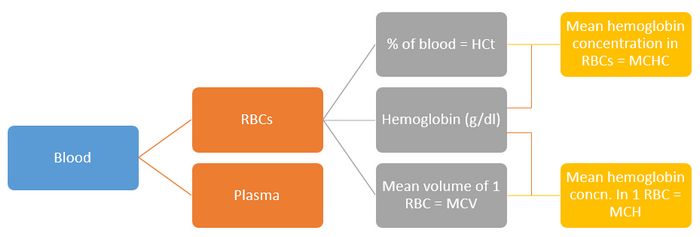
RBC indices

Hematocrit

In simple words, hematocrit is the percentage of your blood that is made up of Red Blood Cells (RBCs).

HCt = (Total blood volume – Total Plasma volume)/Total blood volume

Mean corposcular volume (MCV)

Mean volume of 1 RBC (Total RBC volume/Total number of erythrocytes or RBC)

MCV = (HCt X 10)/RBC count per Litre

Normal: 80-100 fL

Apply rules of 3 in the formula above: MCV = (3 X Hb X 10)/Hb/3 = 90. Hence, MCV is around 90 fL in average. Normal value is 90±10 fL.

HCt = MCV X RBC count X 0.1

Mean corposcular hemoglobin (MCH)

Mean hemoglobin concentration in 1 RBC (Hemoglobin concentration/Total number of erythrocytes or RBC)

MCH = (Hb X 10)/RBC count per Litre

Normal: 27-33 pg

Apply rules of 3 in the formula above: MCH = (3 X RBC count X 10)/RBC count = 30. Hence, MCH is around 30 pg in average. Normal value is 30±3 pg.

Mean corposcular hemoglobin concentration (MCHC)

Mean hemoglobin concentration in RBCs (Hemoglobin concentration/proportion of RBC)

MCHC = (Hb X 100)/HCt

Normal: 33-37 g/L

Apply rules of 3 in the formula above: (Hb X 100)/(3 X Hb) = 33. Hence, MCHC is around 33g/L in lower limit. Normal range is 35±2 g/L.

Interconversions

MCHC =  (MCH X 100)/MCV

MCH = (MCHC X MCV)/100

MCV = (MCH X 100)/MCHC

Red Cell Distribution Width (RDW)

Measure of anisocytosis (variability in RBC size) i.e. standard deviation of MCV

RDW = (Standard deviation of red cell volume X 100)/Mean cell volume

Normal range = 11 to 15%

Classification of Anemia based on MCV
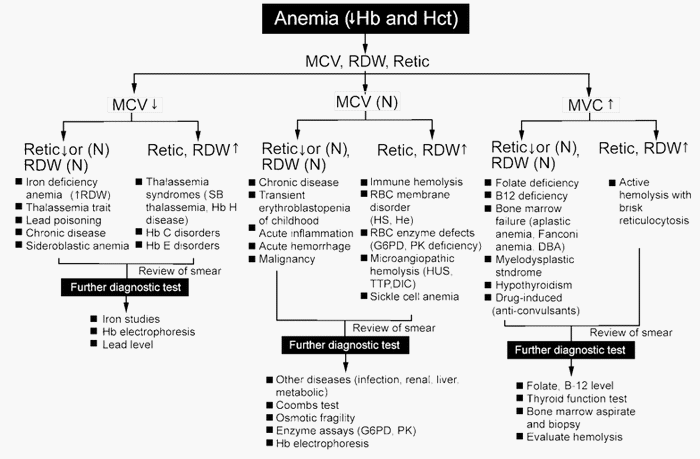
anemia mcv-rdw

MCV low (Microcytic)

Normal RDW

  • Thalasemmia trait
  • Anemia of chronic disease
  • HbH

High RDW

  • Iron deficiency
  • Beta-thalasemmia
  • Sickle/HbC trait

MCV normal (Normocytic)

Normal RDW

  • Normal
  • Anemia of chronic disease
  • Hemoglobinopathies
  • Hereditary spherocytosis
  • Transfusion
  • Chemotherapy
  • CLL, CML
  • Hemorrhage

High RDW

  • Mixed deficiency
  • Early iron or folate deficiency
  • Myelofibrosis
  • Sideroblastic anemia

MCV high (Macrocytic)

Normal RDW

  • Aplastic anemia
  • Pre-leukemia

High RDW

  • Folate deficiency
  • Vitamin B12 deficiency
  • Immune hemoglobin
  • Cold agglutinins
  • CLL
  • Facebook
  • Twitter
PGMEE, MRCS, USMLE, MBBS, MD/MS HematologyPathologyPhysiology

Post navigation

Previous post
Next post

Related Posts

PGMEE, MRCS, USMLE, MBBS, MD/MS salter harris classification

Salter Harris Classification for Physeal Fracture: Mnemonic

Oct 29, 2017Jun 20, 2024

In children, the growth plate (physis) is a zone of cartilate situated between the epiphysis and the metaphysis of long bones. Cartilage is weaker than bone and thus is a common site of fracture. The Salter-Harris classification consists of 5 different types of growth plate fractures based on the location…

Read More
PGMEE, MRCS, USMLE, MBBS, MD/MS

Shoulder Muscles Anatomy – Simplified

Nov 2, 2019Nov 2, 2019

Proximal humerus Insertion of Rotato Cuffs Mnemonic: SIT-S a. Greater tubercle: Supraspinatus, Infraspinatus, Teres minor b. Lesser tubercle: Subscapularis Attachment of Other muscles Anteriorly and posteriorly the muscles attach on each side of the depressions (groove and sulcus). a. Anteriorly: Insertion of 3 muscles Mnemonic: Lady between 2 Majors Crest…

Read More
PGMEE, MRCS, USMLE, MBBS, MD/MS

Lynch Syndrome (HNPCC) : Mnemonics

Jul 21, 2023Jul 30, 2023

Inheritance: Autosomal Dominant (AD) Cause: Microsatellite instability (MLH1, MSH2 mismatch repair gene mutation) Types: Amsterdam II Criteria for Diagnosis Mnemonic: 3-2-1-0 rule Colorectal cancers: More likely to be mucinous and right-sided Treatment: Total colectomy with ilio-rectal anastomosis Annual screening: Age 25 onwards or beginning no later than 5 years before…

Read More

Leave a Reply Cancel reply

Your email address will not be published. Required fields are marked *

This site uses Akismet to reduce spam. Learn how your comment data is processed.

Pre-clinical (Basic Sciences)

Anatomy

Biochemistry

Community medicine (PSM)

Embryology

Microbiology

Pathology

Pharmacology

Physiology

Clinical Sciences

Anesthesia

Dermatology

Emergency medicine

Forensic

Internal medicine

Gynecology & Obstetrics

Oncology

Ophthalmology

Orthopedics

Otorhinolaryngology (ENT)

Pediatrics

Psychiatry

Radiology

Surgery

RSS Ask Epomedicine

  • What to study for Clinical examination in Orthopedics?
  • What is the mechanism of AVNRT?

Epomedicine weekly

  • About Epomedicine
  • Contact Us
  • Author Guidelines
  • Submit Article
  • Editorial Board
  • USMLE
  • MRCS
  • Thesis
©2026 Epomedicine | WordPress Theme by SuperbThemes