Skip to content
Epomedicine

Mnemonics, Simplified Concepts & Thoughts

Epomedicine

Mnemonics, Simplified Concepts & Thoughts

anemia mcv-rdw

Understanding Red cell indices

Epomedicine, Feb 4, 2017

Rule of 3s

The measured hemoglobin concentration is 3 times the RBC count, and the calculated hematocrit is 3 times the Hb level. A significant deviation means artifacts in the value estimated or the RBCs are smaller or larger than the normal.

  • HCt = 3 X Hb
  • RBC count = Hb/3

The units

  1. Hematocrit: Percentage (%)
  2. MCV: fL (femtolitres i.e. 10^-15 litres)
  3. MCH: pg (picogram i.e. 10^-12 grams)
  4. MCHC: g/L

1 ml = 1000 cu.mm

1 L = 1000 ml

1 L = 1000000 cu.mm

Hb (g/dL) X 10 = Hb (g/L)
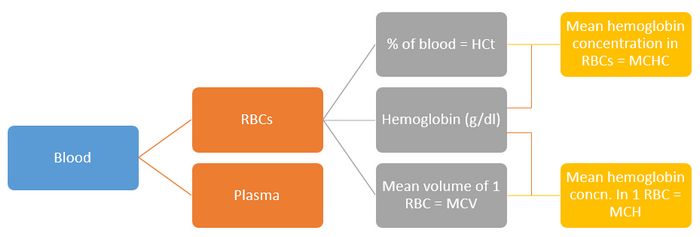
RBC indices

Hematocrit

In simple words, hematocrit is the percentage of your blood that is made up of Red Blood Cells (RBCs).

HCt = (Total blood volume – Total Plasma volume)/Total blood volume

Mean corposcular volume (MCV)

Mean volume of 1 RBC (Total RBC volume/Total number of erythrocytes or RBC)

MCV = (HCt X 10)/RBC count per Litre

Normal: 80-100 fL

Apply rules of 3 in the formula above: MCV = (3 X Hb X 10)/Hb/3 = 90. Hence, MCV is around 90 fL in average. Normal value is 90±10 fL.

HCt = MCV X RBC count X 0.1

Mean corposcular hemoglobin (MCH)

Mean hemoglobin concentration in 1 RBC (Hemoglobin concentration/Total number of erythrocytes or RBC)

MCH = (Hb X 10)/RBC count per Litre

Normal: 27-33 pg

Apply rules of 3 in the formula above: MCH = (3 X RBC count X 10)/RBC count = 30. Hence, MCH is around 30 pg in average. Normal value is 30±3 pg.

Mean corposcular hemoglobin concentration (MCHC)

Mean hemoglobin concentration in RBCs (Hemoglobin concentration/proportion of RBC)

MCHC = (Hb X 100)/HCt

Normal: 33-37 g/L

Apply rules of 3 in the formula above: (Hb X 100)/(3 X Hb) = 33. Hence, MCHC is around 33g/L in lower limit. Normal range is 35±2 g/L.

Interconversions

MCHC =  (MCH X 100)/MCV

MCH = (MCHC X MCV)/100

MCV = (MCH X 100)/MCHC

Red Cell Distribution Width (RDW)

Measure of anisocytosis (variability in RBC size) i.e. standard deviation of MCV

RDW = (Standard deviation of red cell volume X 100)/Mean cell volume

Normal range = 11 to 15%

Classification of Anemia based on MCV
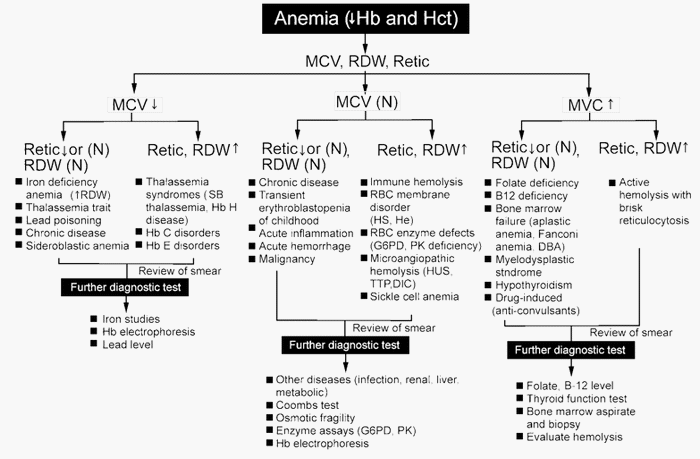
anemia mcv-rdw

MCV low (Microcytic)

Normal RDW

  • Thalasemmia trait
  • Anemia of chronic disease
  • HbH

High RDW

  • Iron deficiency
  • Beta-thalasemmia
  • Sickle/HbC trait

MCV normal (Normocytic)

Normal RDW

  • Normal
  • Anemia of chronic disease
  • Hemoglobinopathies
  • Hereditary spherocytosis
  • Transfusion
  • Chemotherapy
  • CLL, CML
  • Hemorrhage

High RDW

  • Mixed deficiency
  • Early iron or folate deficiency
  • Myelofibrosis
  • Sideroblastic anemia

MCV high (Macrocytic)

Normal RDW

  • Aplastic anemia
  • Pre-leukemia

High RDW

  • Folate deficiency
  • Vitamin B12 deficiency
  • Immune hemoglobin
  • Cold agglutinins
  • CLL
  • Facebook
  • Twitter
PGMEE, MRCS, USMLE, MBBS, MD/MS HematologyPathologyPhysiology

Post navigation

Previous post
Next post

Related Posts

PGMEE, MRCS, USMLE, MBBS, MD/MS lysosomal storage disorders

Lysosomal Storage Disorders Made Easy

Jan 22, 2017Jul 29, 2018

Among the common lysosomal storage disorders: Two of them are Mucopolysaccharidoses (Hunter and Hurler syndrome) Pompe’s disease is Glycogen Storage Disease. Others are Sphingolipidoses. Inheritance of Lysosomal Storage Diseases All are inherited as Autosomal Recessive (AR) condition except: Hunter syndrome (X-linked recessive) Fabry’s disease (X-linked recessive) Higher risk in Ashkenazi…

Read More
PGMEE, MRCS, USMLE, MBBS, MD/MS pth magnesium

Why mild hypomagnesemia causes hyperparathyroidism and severe hypomagnesemia causes hypoparathyroidism?

Feb 16, 2017Jul 29, 2023

You must have seen the statement in First Aid that says – low serum magnesium causes increase in Parathyroid hormone secretion and very low serum magnesium causes decrease in Parathyroid hormone secretion. Doesn’t this make you curious? Let’s explore the underlying mechanism in depth. How Calcium and Magnesium Mediated PTH…

Read More
PGMEE, MRCS, USMLE, MBBS, MD/MS

Paranasal sinus drainage in Nasal cavity : Mnemonic

Aug 4, 2023Aug 4, 2023

Lateral wall of nasal cavity has: Mnemonic: SPIN 1. Superior meatus: Posterior ethmoidal sinus 2. Inferior meatus: Nasolacrimal duct The sphenoidal sinus drains into spheno-ethmoidal recess (superior to superior concha). All others drain into middle meatus: Mnemonic: AM/FM

Read More

Leave a Reply Cancel reply

Your email address will not be published. Required fields are marked *

This site uses Akismet to reduce spam. Learn how your comment data is processed.

Pre-clinical (Basic Sciences)

Anatomy

Biochemistry

Community medicine (PSM)

Embryology

Microbiology

Pathology

Pharmacology

Physiology

Clinical Sciences

Anesthesia

Dermatology

Emergency medicine

Forensic

Internal medicine

Gynecology & Obstetrics

Oncology

Ophthalmology

Orthopedics

Otorhinolaryngology (ENT)

Pediatrics

Psychiatry

Radiology

Surgery

RSS Ask Epomedicine

  • What to study for Clinical examination in Orthopedics?
  • What is the mechanism of AVNRT?

Epomedicine weekly

  • About Epomedicine
  • Contact Us
  • Author Guidelines
  • Submit Article
  • Editorial Board
  • USMLE
  • MRCS
  • Thesis
©2026 Epomedicine | WordPress Theme by SuperbThemes