Skip to content
Epomedicine

Mnemonics, Simplified Concepts & Thoughts

Epomedicine

Mnemonics, Simplified Concepts & Thoughts

trigeminal sensory map

Trigeminal Nerve Simplified

Epomedicine, Jul 26, 2016Oct 26, 2017

Course of Trigeminal Nerve and Trigeminothalamic Pathway
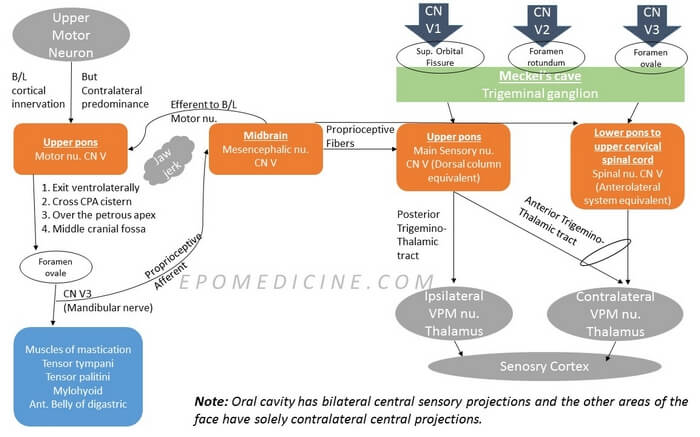
Trigeminal nerve course

Mandibular (CN V3) Division of Trigeminal Nerve
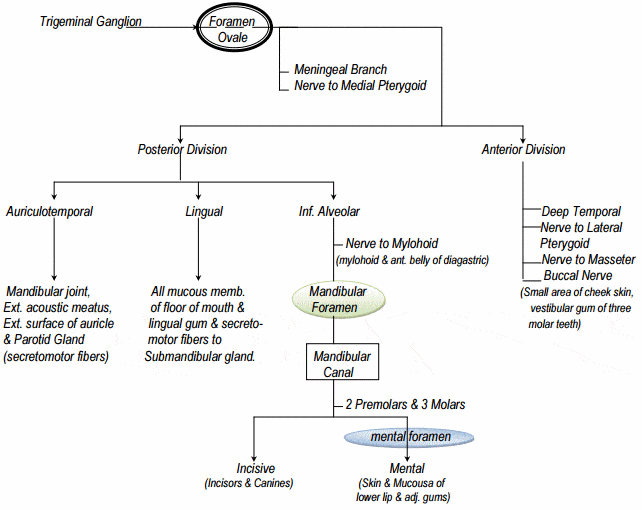
mandibular-trigeminal

Maxillary (CN V2) Division of Trigeminal Nerve
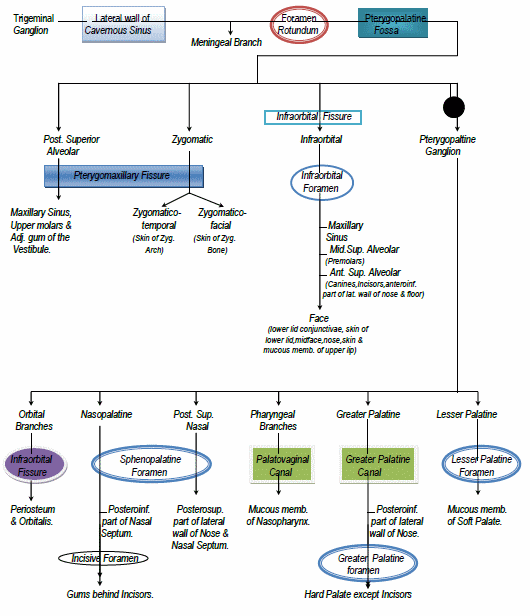
maxillary trigeminal

Ophthalmic (CN V1) Division of Trigeminal Nerve
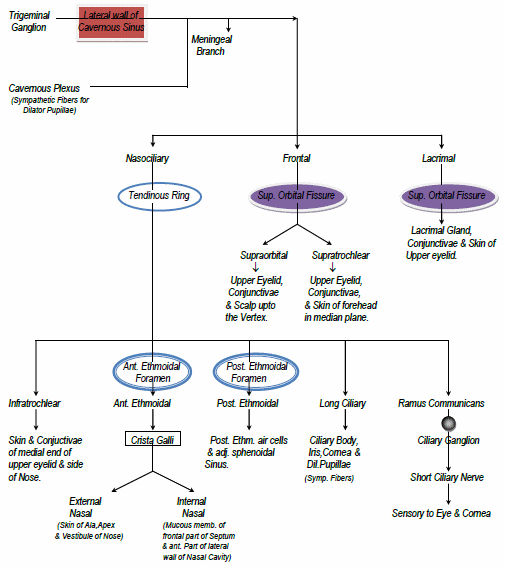
ophthalmic trigeminal

Sensory Map Of Trigeminal Nerve on Face
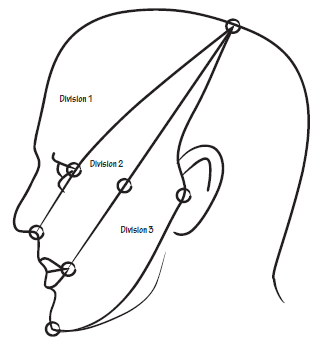
trigeminal sensory map

Area of Ophthalmic division: Line joining –

  1. Just behind the top of head
  2. Corner of eyes
  3. Tip of nose

Area of Maxillary division: Line joining –

  1. Same point as above in head
  2. Maxilla
  3. Angle of mouth

Area of Mandibular division: Line joining –

  1. Same point as above in head
  2. Tragus of ear
  3. Mentum

Important point to note:

Mandibular division neither covers the angle of mandible, nor the outer ear. These areas are often tested to differentiate neurologic and functional (non-neurologic symptoms) as Trigeminal nerve doesn’t have sensory supply to these regions. These regions are supplied by:

  • Outer ear: Cranial nerve VII, IX and X
  • Angle of Mandible: C2, C3

Lateral Pterygoids

While the other muscles of mastication closes the jaw, the lateral pterygoids open the jaw. Like, genioglossus of tongue, the fibers crosses and inserts to the angle of jaw on the opposite side. Hence, dysfunction of lateral pterygoid at one side leads to deviation of jaw in the same side due to the action of opposite lateral pterygoid.

In Upper Motor Neuron lesion:

  • They have bilateral cortical innervation with contralateral predominance.
  • Hence, there may be no visible deviation of jaw during clinical examination.
  • If deviation is seen: Deviation of jaw to the side contralateral to the UMN lesion
    • Deviation at one side → Dysfunction of lateral pterygoid in same side → Contralateral UMN lesion

In Lower Motor Neuron lesion:

  • Deviation of the jaw to the side ipsilateral to the LMN lesion.

Jaw Jerk

  1. Stimuli: Stretch applied by reflex hammer on relaxed jaw
  2. Sensory receptors: Muscle spindles of muscles of mastications
  3. Afferent: Proprioceptive fibers from CN V3
  4. Center: Mesencephalic nucleus of trigeminal nerve (Not the trigeminal ganglion)
  5. Efferent: Bilateral innervation to the motor nucleus of facial nerve
  6. Response: Closure of jaw
  • Facebook
  • Twitter
PGMEE, MRCS, USMLE, MBBS, MD/MS AnatomyNervous system

Post navigation

Previous post
Next post

Related Posts

Emergency Medicine

Aortic dissection

Aug 15, 2023Aug 15, 2023

Risk factors Mnemonic: ABCDE Pathophysiology Intimal tear allows blood to enter between intima-media space creating a false lumen. Blood may propagate proximal or distal to tear. Clinical features Investigations Classification and Management Stanford DeBakey Description Frequency Management Mnemonic: BAD Mnemonic: A for A; B for B A (Ascending aorta involved)…

Read More
PGMEE, MRCS, USMLE, MBBS, MD/MS

Fascia Lata and Tensor Fascia Lata

Jun 16, 2020Jun 16, 2020

Fascia lata and Tensor fascia lata althought different structures is often mistaken as the same by the students. Fascia Lata It is the fascial ‘stocking’ deep to the skin and superficial fascial and encloses the muscle of thigh. Proximally, its attachment can be traced around the pelvis and distally, it…

Read More
PGMEE, MRCS, USMLE, MBBS, MD/MS VDJ diversity

VDJ (Somatic) Recombination Made Easy

Jun 19, 2016

Many students feel that, this is one of the most difficult to explain topic in Immunology. Here, we will try to explain the process and clinical relevance of V(D)J or Somatic recombination in simple and interactive way. Question your mind Humans only have about 25,000 genes.  Since, an antibody made…

Read More

Leave a Reply Cancel reply

Your email address will not be published. Required fields are marked *

This site uses Akismet to reduce spam. Learn how your comment data is processed.

Pre-clinical (Basic Sciences)

Anatomy

Biochemistry

Community medicine (PSM)

Embryology

Microbiology

Pathology

Pharmacology

Physiology

Clinical Sciences

Anesthesia

Dermatology

Emergency medicine

Forensic

Internal medicine

Gynecology & Obstetrics

Oncology

Ophthalmology

Orthopedics

Otorhinolaryngology (ENT)

Pediatrics

Psychiatry

Radiology

Surgery

RSS Ask Epomedicine

  • What to study for Clinical examination in Orthopedics?
  • What is the mechanism of AVNRT?

Epomedicine weekly

  • About Epomedicine
  • Contact Us
  • Author Guidelines
  • Submit Article
  • Editorial Board
  • USMLE
  • MRCS
  • Thesis
©2026 Epomedicine | WordPress Theme by SuperbThemes