Skip to content
Epomedicine

Mnemonics, Simplified Concepts & Thoughts

Epomedicine

Mnemonics, Simplified Concepts & Thoughts

Brown sequard syndrome

Brown-Sequard Syndrome – Anatomical Basis

Epomedicine, Jul 25, 2016Sep 5, 2019

Definition of Brown Sequard Syndrome

Neurological syndrome resulting from spinal cord hemisection (damage to one lateral half of spinal cord).

Causes of Brown Sequard Syndrome

  1. Penetrating trauma
  2. Spinal fractures
  3. Spinal dislocation
  4. Disc herniation
  5. Vasculitis
  6. Radiation induced injury

Clinical Manifestations and Anatomical Basis of Brown Sequard Syndrome
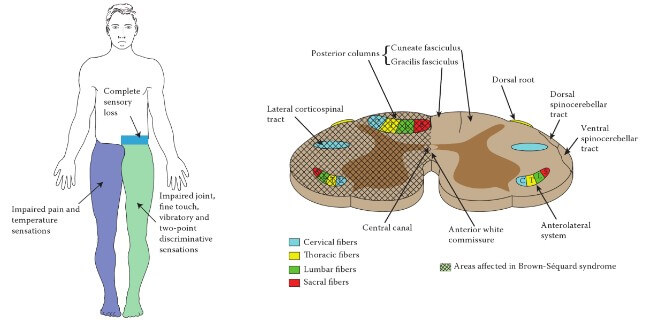
Brown sequard syndrome

1. Damage of Corticospinal tract below the level of pyramidal decussation:

  • Corticospinal tract crosses at the level of medulla – hence, the lesions below it will produce ipsilateral symptoms.
  • Ipsilateral Upper Motor Neuron Lesions below the level of injury

2. Damage of Lower Motor Neurons at the level of Injury:

  • Ipsilateral Lower Motor Neuron Lesions at the level of injury

3. Damage of Dorsal column below the level of sensory decussation:

  • Dorsal column crosses at the level of medulla – hence, the lesions below it will produce ipsilateral symptoms.
  • Ipsilateral loss of joint position sense, tactile discrimination, fine touch and vibratory sensations at and below the level of injury.
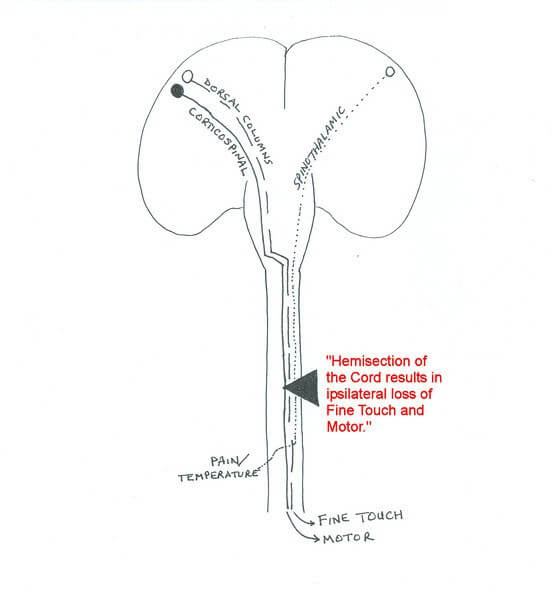
Brown Sequard Tracts

4. Damage of Spinothalamic tract:

  • The fibers of spinothalamic tract ascend or descend 1-2 spinal segments in Lissauer’s tract to immediately cross and ascend in opposite side.
  • Damage leads to contralateral loss of pain, temperature and crude touch sensation starting 1 or 2 segments below the level of lesion.

5. Destruction of posterior root and it’s entrance into spinal cord:

  • Band of cutaneous anesthesia at the level of injury

6. Damage of Hypothalamospinal pathway:

  • In lesions at and above T1 level.
  • Ipsilateral Horner’s syndrome.

Bladder and bowel dysfunction may also be present in Brown-Sequard Syndrome (hemisection). But, its presence often indicates bilateral involvement of the spinal cord.

Dissociated Anesthesia

  1. Ipsilateral loss of Dorsal column sensations
  2. Contralateral loss of Spinothalamic tract sensations

Why doesn’t ataxia occur in Brown Sequard Syndrome ?

The ventral and dorsal spino-cerebellar tract also ascend laterally through the spinal cord. So, in the hemisection of the cord it is also supposed to be damaged resulting in ataxia. But you must be wondering that ataxia is not mentioned in most of the textbooks.

Ataxia does indeed occur in Brown-Sequard Syndrome but is typically masked by the weakness and hemiplegia resulting from damaged corticospinal tract. 1Lipincott’s Illustrated Neuroscience By Claudia Krebs

Mnemonic: Bus STOP

Brown Sequard
Temperature Opposite Pain
17 shares
  • Facebook17
  • Twitter
PGMEE, MRCS, USMLE, MBBS, MD/MS AnatomyInternal medicineNervous systemPediatrics

Post navigation

Previous post
Next post

Related Posts

PGMEE, MRCS, USMLE, MBBS, MD/MS

Liver Anatomy : Mnemonics

May 13, 2024May 13, 2024

Ligaments Mnemonic: TV TFCL 1. True ligaments: 2. False ligaments (Peritoneal folds): Posteroinferior (Visceral) Surface of Liver Anatomical halves are separated by Ligamentum venosum and Ligamentum teres. Vascular halves are separated by IVC and Gall bladder. Caudate lobe and Quadrate lobe: Mnemonic: IVC are in one line Mnemonic: LGBTQ are…

Read More
PGMEE, MRCS, USMLE, MBBS, MD/MS

Surgical Anatomy of Diaphragm

Jan 20, 2024Jan 20, 2024

Diaphragm is a thoracoabdominal organ which is musculotendinous. It is the primary muscle of respiration.  Extension: There are 2 crura of diaphragm: 3 ligaments: Quadratus lumborum muscle is related to lateral arcuate whereas psoas muscle is related to medial arcuate ligament. The foramen of Morgagni shown in the above picture…

Read More
PGMEE, MRCS, USMLE, MBBS, MD/MS

Sciatic Nerve Variations around Piriformis Muscle

Jul 15, 2025Jul 15, 2025

Variations involving the relationship between the sciatic nerve and the piriformis muscle are commonly classified based on Beaton and Anson’s classification. Mnemonic: I Prefer Smart Anatomy For Perfect nerve-sparing Type Mnemonic Meaning Description Prevalence I I Inferior Undivided sciatic nerve passes below piriformis 87% II Prefer Piercing Peroneal pierces, tibial…

Read More

Comments (2)

  1. Hasan Saki says:
    Oct 6, 2017 at 3:18 pm

    Very nice explanation!!

    Reply
  2. G says:
    Feb 26, 2018 at 11:29 am

    I think the diagram may be wrong, as its showing contralateral loss of proprioception and ipsilateral pain loss.

    Reply

Leave a Reply Cancel reply

Your email address will not be published. Required fields are marked *

This site uses Akismet to reduce spam. Learn how your comment data is processed.

Epomedicine. Brown-Sequard Syndrome – Anatomical Basis [Internet]. Epomedicine; 2016 Jul 25 [cited 2026 Jun 5]. Available from: https://epomedicine.com/medical-students/brown-sequard-syndrome-anatomical-basis/.

Pre-clinical (Basic Sciences)

Anatomy

Biochemistry

Community medicine (PSM)

Embryology

Microbiology

Pathology

Pharmacology

Physiology

Clinical Sciences

Anesthesia

Dermatology

Emergency medicine

Forensic

Internal medicine

Gynecology & Obstetrics

Oncology

Ophthalmology

Orthopedics

Otorhinolaryngology (ENT)

Pediatrics

Psychiatry

Radiology

Surgery

RSS Ask Epomedicine

  • What to study for Clinical examination in Orthopedics?
  • What is the mechanism of AVNRT?

Epomedicine weekly

  • About Epomedicine
  • Contact Us
  • Author Guidelines
  • Submit Article
  • Editorial Board
  • USMLE
  • MRCS
  • Thesis
©2026 Epomedicine | WordPress Theme by SuperbThemes