Skip to content
Epomedicine

Mnemonics, Simplified Concepts & Thoughts

Epomedicine

Mnemonics, Simplified Concepts & Thoughts

ovaries regional nodes

TNM and FIGO Staging of Ovarian Carcinoma Simplified

Epomedicine, Aug 15, 2016Aug 23, 2020

FIGO has published a new classification for ovarian cancer. These new cancer staging rules will be incorporated into the 8th Edition of the UICC TNM Classification of Malignant Tumours, which is thought to be effective from 2017.

Cancer of the ovary has 3 major stages (I, II and III) and each stage is divided into A, B with or without C reflecting the T stage. Stage IV is divided into A and B reflecting M stage.

As the regional lymph nodes for the ovaries are outside the capsule, involvement of nodes correspond to peritoneal invasion by the primary tumor, i.e. T3=N1.

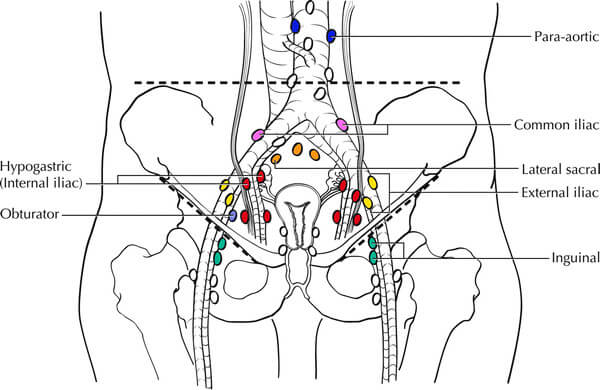
Sentinel nodes: Obturator and Internal Iliac nodes

Regional nodes: Para-aortic, Inguinal, External iliac, Renal hilar (left) and Paracaval (right)

Juxtaregional nodes: Common iliac, hypogastric and lateral sacral nodes

FIGO and TNM Staging

Stage I (T1) – Limited To Ovaries

  • A: 1 Ovary (capsule intact) or Fallopian tube
  • B: Both ovaries (capsule intact)
  • C: Capsule ruptured
    • 1 – Surgical spill
    • 2 – Capsule ruptured before surgery or tumour on surface of ovary or tube
    • 3 – Malignant cells in ascites or peritoneal washings

Stage II (T2) – Pelvic extension below pelvic brim or Primary peritoneal carcinoma

  • A: Uterus, fallopian tubes, ovary (ies)
  • B: Other pelvic tissues

Stage III (T3 and/or N1) – Beyond Pelvis and/or Lymph nodes

  • A: Retroperitoneal nodes only and/or Microscopic peritoneal metastases
    • 1 – Retroperitoneal lymph nodes only, i.e. T1/2 N1
    • 2 – Microscopic peritoneal metastasis, i.e. T3a
  • B: Macroscopic peritoneal metastasis ≤2 cm, i.e. T3b
  • C: Peritoneal metastasis >2 cm, i.e. T3c

Stage IV (M1) – Distant Metastases

  • A: Pleural effusion positive cytology
  • B: Parenchymal metastases

Note:

Implants on liver capsule: Stage III

True liver parenchymal metastases: Stage IV

5 year survival by Stage of Ovarian Cancer

The 5-year survival rate in descending order is:

  1. 80% for stage I disease
  2. 50% for stage II disease
  3. 30% for stage III disease
  4. 8% for stage IV disease.

Several other factors can affect prognosis such as histologic type, tumor grade, amount of residual disease after surgery, etc.
37 shares
  • Facebook37
  • Twitter
PGMEE, MRCS, USMLE, MBBS, MD/MS ObGynOncologyReproductive system

Post navigation

Previous post
Next post

Related Posts

PGMEE, MRCS, USMLE, MBBS, MD/MS

Blumensaat line

Jun 1, 2020Jun 1, 2020

Synonym: Intercondylar line, Blumensaat’s line Definition of Blumnesaat line It is the tangent drawn along the roof of intercondylar notch or fossa of the distal femur on the saggital or lateral view. Morphologic variations of Blumensaat line (Iriuchishima’s classification) Straight type (35%): appear more or less straight Small hill type…

Read More
PGMEE, MRCS, USMLE, MBBS, MD/MS vertebral-artery-mnemonic

Vertebrobasilar Arterial System and Syndromes Simplified

Jul 27, 2016Aug 1, 2016

Vertebral Artery I use the analogy of hand to remember the vertebral artery and it’s branches: Origin: Branch of subclavian arteries Course: Ascends through transverse foramina on C6 through C1 and enters posterior fossa through foramen magnum Continue up the ventral surface of medulla Converge at the ponto-medullary junction to form…

Read More
PGMEE, MRCS, USMLE, MBBS, MD/MS

Peptic Ulcer (Johnson) Classification

Sep 30, 2023Sep 30, 2023

Mnemonic: 1. 1 is Less 2. 2 is Two 3. 3 is Pre- 4. 4 is Door 5. 5 is 5 letter (NSAID) Type Mnemonic Location Acid hypersecretion Complications Surgery I (55%) Less Lesser curvature No Bleeding uncommon Distal gastrectomy with BI, BII or RY GJ anastomosis II (20%) Two…

Read More

Leave a Reply Cancel reply

Your email address will not be published. Required fields are marked *

This site uses Akismet to reduce spam. Learn how your comment data is processed.

Pre-clinical (Basic Sciences)

Anatomy

Biochemistry

Community medicine (PSM)

Embryology

Microbiology

Pathology

Pharmacology

Physiology

Clinical Sciences

Anesthesia

Dermatology

Emergency medicine

Forensic

Internal medicine

Gynecology & Obstetrics

Oncology

Ophthalmology

Orthopedics

Otorhinolaryngology (ENT)

Pediatrics

Psychiatry

Radiology

Surgery

RSS Ask Epomedicine

  • What to study for Clinical examination in Orthopedics?
  • What is the mechanism of AVNRT?

Epomedicine weekly

  • About Epomedicine
  • Contact Us
  • Author Guidelines
  • Submit Article
  • Editorial Board
  • USMLE
  • MRCS
  • Thesis
©2026 Epomedicine | WordPress Theme by SuperbThemes