Skip to content
Epomedicine

Mnemonics, Simplified Concepts & Thoughts

Epomedicine

Mnemonics, Simplified Concepts & Thoughts

Surgical landmarks for identification of facial nerve in Parotid surgery

Epomedicine, Dec 31, 2013

The facial nerve (CN VII) exits the skull base through the stylomastoid foramen situated posterolaterally to the styloid process and anteromedially to the mastoid process and enters the parotid gland to divide it into a large superficial lobe and a small deep lobe. The main trunk of facial nerve enters the parotid gland and divides into zygomaticotemporal and cervicofacial divisions at pes anserinus situated approximately 1.3 cm from stylomastoid foramen. Facial nerve paralysis is a daunting potential complication of parotid surgery and is widely reported. Knowledge of the key landmarks of the facial nerve trunk is essential for safe and effective surgical intervention in the region of the parotid gland.

Surgical landmarks to identify main trunk of facial nerve:

1. Tragal “pointer” (of Conley): facial nerve lies approximately 1 cm deep and slightly anterior and inferior to this “pointer”.

  • As the tragal cartilage is dissected free from the parotid fascia, it takses bluntlu pointed shape in its medial aspect, which is called the “pointer”.
  • It is regarded as the most important landmark.
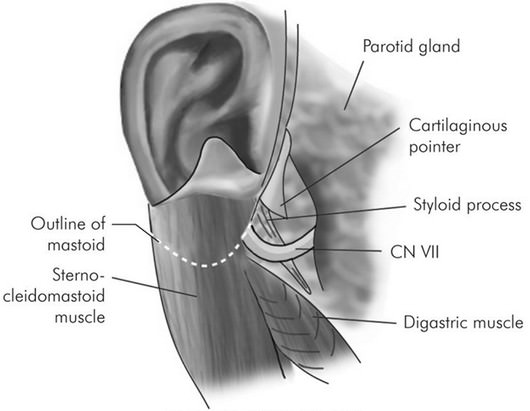
facial nerve parotidectomy

2. Tendon of posterior belly of digastric muscle: facial nerve lies approximately 1 cm deep to the media attachment of the posterior belly of digastric muscle to the digastric groove of mastoid bone.

  • During surgery, the tail of parotid gland is separated from the sternocleidomastoid muscle and the deep underlying posterior belly of digastric muscle, and then the gland is elevated and rotated off of the muscle.

3. Tympanomastoid suture/fissure: facial nerve lies 6-8 mm deep to this suture

  • The tympanomastoid suture is situated at the apex of vagino-mastoid angle or valley of nerve where the mastoid and the vaginal portion of tympanic ring of external ear canal (temporal bone) meets.

4.  Styloid process: lateral to styloid process

Note: 

a. If the proximal segment of facial nerve is obscured, retrograde dissection of 1 or more of the peripheral branches may be necessary to identify the main trunk.

  1. Ramus frontalis is located by a line from tragus to lateral canthus.
  2. Ramus buccalis is located by a line from the tragus towards alae of the nose parallel to the zygoma but 1 cm below.
  3. Ramus mandibularis is near the angle of mandible at a point 4-4.5 cm from the attachment of the lobule of pinna.

b. When necessary, the facial nerve can be identified in the mastoid bone by mastoidectomy and followed peripherally.

74 shares
  • Facebook74
  • Twitter
PGMEE, MRCS, USMLE, MBBS, MD/MS General SurgeryNervous systemOtorhinolaryngology

Post navigation

Previous post
Next post

Related Posts

PGMEE, MRCS, USMLE, MBBS, MD/MS

Dizziness : History and Examination

Oct 25, 2017

HISTORY Mnemonic: 4D-3E-2Fg-2H 1. Define “Dizziness”: Room is spinning/rocking/somersaulting – Vertigo Feel like “going to faint” – Near-syncope “Going to fall” or “Unsteady on feet” – Disequilibrium Feel like they’ve or are “left their body” or “floating/swimming” – Psychophysiologic dizziness 2. Duration of each episode: Seconds: BPPV Minutes: TIA or…

Read More
PGMEE, MRCS, USMLE, MBBS, MD/MS

Pulmonology Mnemonics

Sep 13, 2019Sep 16, 2019

TB SMEAR (+) CULTURE (–): 4 Ds D: DEAD: continued expectoration of dead organisms D: DEGENERATE: non-cultivable non-TB mycobacteria, unable to proliferate on a standard AFB culture D: DELAY: excessive > 5 days between collection & inoculation D: DRUGS: sufficient anti TB levels to suppress growth in vitro TB RISK FACTORS: SHE LOVED RICHES S: Silicosis…

Read More
PGMEE, MRCS, USMLE, MBBS, MD/MS gastric lymph node stations

TNM and Staging of Gastric Carcinoma Simplified

Aug 15, 2016Aug 16, 2023

Unique features of stomach in relation to TNM cancer classification 1. Cancer penetrates the muscular propria and invades the ligaments (gastrohepatic and gastrocolic, i.e. lesser and greater omentum respectively) subserosally without breeching the serosa. Gastric cancer invasion of the lesser and greater omentum is T3, not T4. Perforation of the…

Read More

Leave a Reply Cancel reply

Your email address will not be published. Required fields are marked *

This site uses Akismet to reduce spam. Learn how your comment data is processed.

Epomedicine. Surgical landmarks for identification of facial nerve in Parotid surgery [Internet]. Epomedicine; 2013 Dec 31 [cited 2025 Dec 6]. Available from: https://epomedicine.com/medical-students/surgical-landmarks-for-identification-of-facial-nerve-in-parotid-surgery/.

Pre-clinical (Basic Sciences)

Anatomy

Biochemistry

Community medicine (PSM)

Embryology

Microbiology

Pathology

Pharmacology

Physiology

Clinical Sciences

Anesthesia

Dermatology

Emergency medicine

Forensic

Internal medicine

Gynecology & Obstetrics

Oncology

Ophthalmology

Orthopedics

Otorhinolaryngology (ENT)

Pediatrics

Psychiatry

Radiology

Surgery

RSS Ask Epomedicine

  • What to study for Clinical examination in Orthopedics?
  • What is the mechanism of AVNRT?

Epomedicine weekly

  • About Epomedicine
  • Contact Us
  • Author Guidelines
  • Submit Article
  • Editorial Board
  • USMLE
  • MRCS
  • Thesis
©2025 Epomedicine . All rights reserved.