Skip to content
Epomedicine

Mnemonics, Simplified Concepts & Thoughts

Epomedicine

Mnemonics, Simplified Concepts & Thoughts

urinary bladder cancer tnm

TNM and staging of Urinary Bladder Cancer Simplified

Epomedicine, Aug 14, 2016

As discussed earlier in – TNM Classification and Cancer Staging Simplified, Urinary bladder is a hollow organ whose “T” classification resembles that of the gastrointestinal tract. Since, the regional lymph nodes of the urinary bladder also lie beyond the serosa like in colon and rectum, positive regional nodes are usually seen only with advanced tumors, i.e. T4=N1.  The regional lymph nodes are below the bifurcation of the common iliac arteries and above the inguinal ligament

TNM Classification
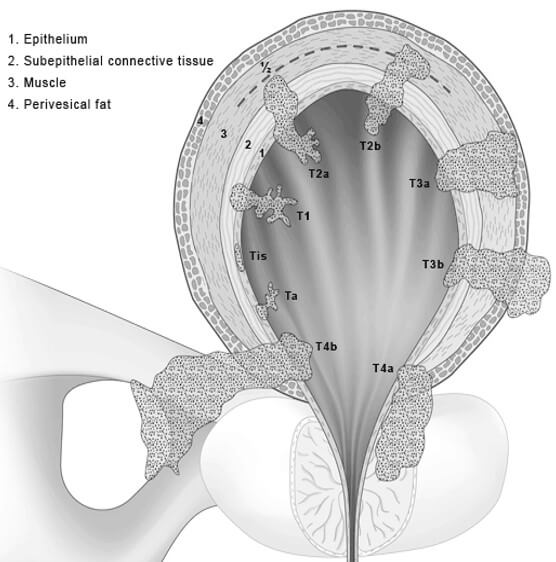
urinary bladder cancer tnm

Primary Tumor (T)

Progressive involvement of the layers of wall and beyond.

  • T1: Submucosa (Lamina propria or Subepithelial tissue)
  • T2: Muscularis propria
    • a: superficial (inner half)
    • b: deep (outer half)
  • T3: Perivesical fat or tissue
    • a: microscopically
    • b: macroscopically
  • T4: Invasion of adjacent structures
    • a: prostatic stroma, uterus, vagina
    • b: pelvic wall, abdominal wall

Regional Lymph Node (N)

  • N1: Single positive node in primary drainage regions (in true pelvis)
  • N2: Multiple positive nodes in primary drainage regions (in true pelvis)
  • N3: Common iliac nodes

AJCC staging for Bladder Cancer
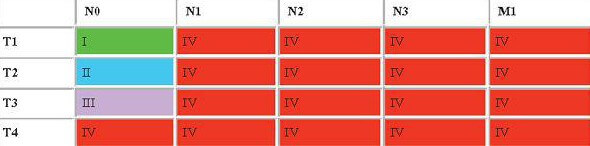
urinary bladder cancer staging matrix

T4b or N1-3 or M1 = Stage IV (~5% five year survival)

Stage I-III is N0M0 and corresponds to “T” classification:

  • T1N0M0 = Stage I (~88% five year survival)
  • T2N0M0 = Stage II (~63% five year survival)
  • T3 or 4a NoMo = Stage III (~46% five year survival)

General Principle of Management

  • Stage I: Conservatively resected transurethrally
  • Stage II: Partial cystectomies
  • Stage III: Total cystectomy and urethral diversion
  • Stage IV: No longer completely resectable.
25 shares
  • Facebook25
  • Twitter
PGMEE, MRCS, USMLE, MBBS, MD/MS General SurgeryOncologyRenal and Electroloyte

Post navigation

Previous post
Next post

Related Posts

PGMEE, MRCS, USMLE, MBBS, MD/MS

Timing of Wound Closure (Primary, Secondary, Tertiary)

Aug 26, 2020Aug 26, 2020

Before moving to the concept of wound closure, it is necessary to understand the pathophysiology behind different types of healing. We have covered stages of wound healing in general previously. There are three types of wound healing: Primary intention Secondary intention Tertiary intention Healing by primary intention occurs when the…

Read More
PGMEE, MRCS, USMLE, MBBS, MD/MS lymphedema risk reduction

Axillary Lymph Node Dissection

Dec 30, 2015

A) Indications: Clinical or radiological evidence of involvement of axillary nodes Microscopically positive sentinel node(s) due to metastasis from primary malignant tumor In sentinel node negative: 98 % accurate in predicting that the other nodes are negative In sentinel node positive: possibility of microscopic disease in any of the remaining lymph nodes is 15–30…

Read More
PGMEE, MRCS, USMLE, MBBS, MD/MS rib notching

Rib Notching

Feb 13, 2017

Normal Rib Notching A small notch near the costo-vertebral joint is normal, so pathologic rib notching is more likely if the notching is more lateral. Types of Pathological Rib Notching 1. Superior rib notching 2. Inferior rib notching (more common) Inferior Rib Notching (Roesler’s sign) Mechanism: Enlargement of one or…

Read More

Leave a Reply Cancel reply

Your email address will not be published. Required fields are marked *

This site uses Akismet to reduce spam. Learn how your comment data is processed.

Epomedicine. TNM and staging of Urinary Bladder Cancer Simplified [Internet]. Epomedicine; 2016 Aug 14 [cited 2025 Dec 6]. Available from: https://epomedicine.com/medical-students/tnm-staging-urinary-bladder-cancer-simplified/.

Pre-clinical (Basic Sciences)

Anatomy

Biochemistry

Community medicine (PSM)

Embryology

Microbiology

Pathology

Pharmacology

Physiology

Clinical Sciences

Anesthesia

Dermatology

Emergency medicine

Forensic

Internal medicine

Gynecology & Obstetrics

Oncology

Ophthalmology

Orthopedics

Otorhinolaryngology (ENT)

Pediatrics

Psychiatry

Radiology

Surgery

RSS Ask Epomedicine

  • What to study for Clinical examination in Orthopedics?
  • What is the mechanism of AVNRT?

Epomedicine weekly

  • About Epomedicine
  • Contact Us
  • Author Guidelines
  • Submit Article
  • Editorial Board
  • USMLE
  • MRCS
  • Thesis
©2025 Epomedicine . All rights reserved.