Skip to content
Epomedicine

Mnemonics, Simplified Concepts & Thoughts

Epomedicine

Mnemonics, Simplified Concepts & Thoughts

Bundle Branch Block : Mnemonic

Epomedicine, Aug 11, 2019Aug 11, 2019

If the QRS complex is wide (>0.12 s/>3 small squares), the ventricular activity may be arising from the ventricle conducting system. caused by a ‘bundle branch block’.

WiLLiaM MaRRoW (classic mnemonic)

Wi – V1
LL – LBBB
M – V6

M – V1
RR – RBBB
W – V6

ViLLheiM MaRRooN (more accurate)

V – V1
LL – LBBB
M – V6

M – V1
RR – RBBB
N – V6

With a Left bundle branch block (LBBB), you get W or more accurately V shaped complex (rS) in V1 and M shaped complex (R) in V6.

With a Right bundle branch block (RBBB), you get M shaped complex (rSR’) in V1 and W or more accurately N shaped complex (qRs) in V6.
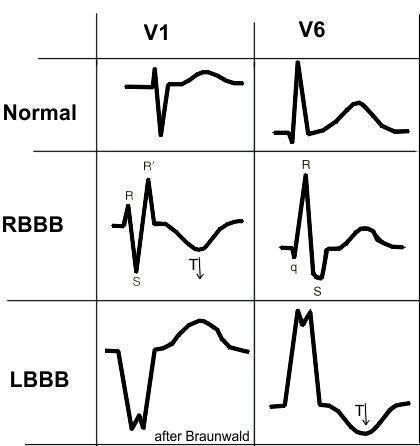
lbbb rbbb ecg

If LBBB is present, no comment can be made on the rest of the ST segment, and thus it may be a sign of acute MI.
18 shares
  • Facebook18
  • Twitter
PGMEE, MRCS, USMLE, MBBS, MD/MS Cardiovascular systemECGInternal medicine

Post navigation

Previous post
Next post

Related Posts

Applied Anatomy of Tympanic Membrane

Nov 16, 2013May 11, 2024

Synonyms: Ear drum, Myringa Definition: Tympanic membrane is a thin membrane that separates the external ear from the middle ear. Anatomy: Site: Located at medial end of the external auditory canal, separating it from the middle ear cavity Position: At an angle of 55° to the horizontal to the floor…

Read More
PGMEE, MRCS, USMLE, MBBS, MD/MS carpal bones ossification

Carpal Bones Ossification: Mnemonic

Oct 29, 2017

Roughly one center appears per year from the age of 1 year to 7 years, anti-clockwise in right hand and clock-wise in left hand looking from the anterior surface, i.e. from ulnar side to radial side. Pisiform, being a sesamoid bone it gets left behind and only develops years later. capitate: 1-3 months hamate:…

Read More

Basics of Fluid therapy

Nov 26, 2013

A. Anatomy and Physiology of Body Fluid Compartments: Remember the “60-40-20” rule of body water. 1. Total body water: 60% (50-70%) of Total Body Weight Greater in  lean individuals because fat contains little water Greatest percentage in newborns, then decreases with age 2. Intracellular fluid (ICF): 40% of Total Body…

Read More

Leave a Reply Cancel reply

Your email address will not be published. Required fields are marked *

This site uses Akismet to reduce spam. Learn how your comment data is processed.

Pre-clinical (Basic Sciences)

Anatomy

Biochemistry

Community medicine (PSM)

Embryology

Microbiology

Pathology

Pharmacology

Physiology

Clinical Sciences

Anesthesia

Dermatology

Emergency medicine

Forensic

Internal medicine

Gynecology & Obstetrics

Oncology

Ophthalmology

Orthopedics

Otorhinolaryngology (ENT)

Pediatrics

Psychiatry

Radiology

Surgery

RSS Ask Epomedicine

  • What to study for Clinical examination in Orthopedics?
  • What is the mechanism of AVNRT?

Epomedicine weekly

  • About Epomedicine
  • Contact Us
  • Author Guidelines
  • Submit Article
  • Editorial Board
  • USMLE
  • MRCS
  • Thesis
©2026 Epomedicine | WordPress Theme by SuperbThemes