Skip to content
Epomedicine

Mnemonics, Simplified Concepts & Thoughts

Epomedicine

Mnemonics, Simplified Concepts & Thoughts

tourniquet

Tourniquet Paralysis Syndrome

Epomedicine, Feb 27, 2021Feb 27, 2021

Synonym: Pressure paralysis

Mechanism: Direct extrinsic pressure (displacement of ranvier node) or axonal hypoxia on the nerves beneath the tourniquet and are related to the cuff pressure and duration of application.\

It is different from post tourniquet syndrome which caused due to combined effect of muscle ischemia, edema and microvascular congestion due to reactive hyperemia (to maintain acid-base balance) and return of blood following release of tourniquet leading to stiff, pale, weak, numb limbs.
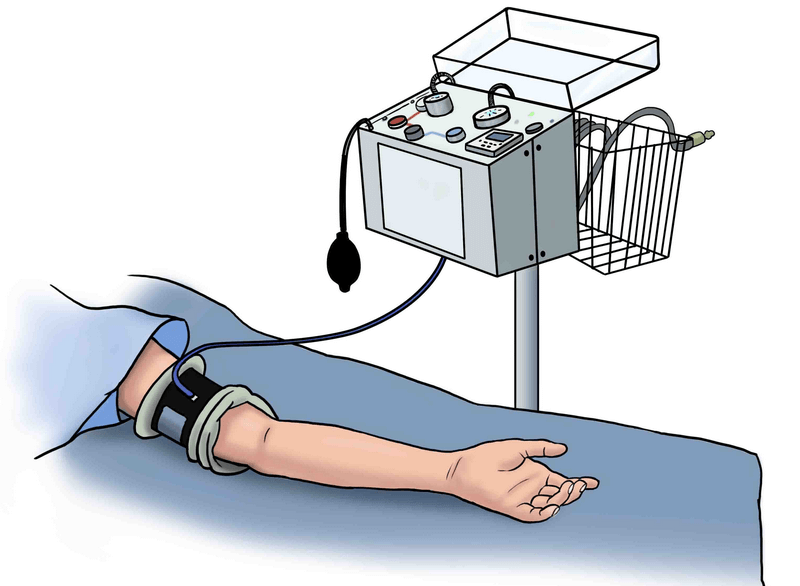
tourniquet

Characteristics:

Distal to the site of application of the tourniquet, there are disturbances in the function of one or all of the nerves. The constellation of signs are:

1. Motor paralysis with hypotonia or atonia but without appreciable atrophy.

2. Evidence of sensory dissociation:

  • Touch, pressure, vibration and position sense are usually absent.
  • Pain sensation is never lost (there may be delay in pain recognition in severe cases) and hyperalgesia is usually present.
  • Temperature sensation is usually not affected.
  • Paresthesia is absent (block of touch fibers). Tinel sign and Neuroma sign are absent.

The affected functions would correspond most likely to the larger fibers described by Erlanger and Gasser, the A fibers. The larger fibers would consequently collapse before the smaller ones. If the damage is severer, the fast or first pain fibers and some of the fibers conveying cold sensation can to some extent be impaired. As a rule they are not involved in the tourniquet syndrome.

3. Sympathetic fibers are not affected.

4. Color and temperature of skin are normal.

5. All peripheral pulses are present.

Most commonly involved nerves:

  1. Upper limb: Radial nerve > Ulnar nerve > Median nerve
  2. Lower limb: Sciatic nerve
Bruner’s Ten Rules of Pneumatic Tourniquet Use

Reference: MOLDAVER J. TOURNIQUET PARALYSIS SYNDROME. AMA Arch Surg. 1954;68(2):136–144. doi:10.1001/archsurg.1954.01260050138002

  • Facebook
  • Twitter
PGMEE, MRCS, USMLE, MBBS, MD/MS AnesthesiaMusculoskeletal systemOrthopedics

Post navigation

Previous post
Next post

Related Posts

PGMEE, MRCS, USMLE, MBBS, MD/MS Advance glaucomatous field defect

Understanding visual field defects in Glaucoma (Perimetry)

May 21, 2014May 21, 2014

Introduction Field of vision or Visual field is defined as the area that is perceived while fixating one central target. According to traquair’s analogy, visual field is “an island of vision surrounded by a sea of darkness”. It is a 3D hill – peak being fovea and at ground level,…

Read More
PGMEE, MRCS, USMLE, MBBS, MD/MS

Refeeding Syndrome : Mnemonics

Jul 1, 2024Jul 1, 2024

Risk factors Mnemonic: ABCD Pathophysiology Mnemonic: PPM Malnourished (depleted intracellular Phosphate, Potassium, Magnesium) → Refeeding → Increased glucose load → Insulin spikes → Drives PPM into cells → Hypophosphatemia (major abnormality), hypokalemia, hypomagnesemia Prevention If patient hasn’t not eaten for >5 days, aim to refeed at <50% energy and protein…

Read More
PGMEE, MRCS, USMLE, MBBS, MD/MS esr

ESR and CRP in Musculoskeletal infection

Aug 5, 2020Jan 27, 2022

ESR (Erythrocyte Sedimentation Rate) Usually elevated within 48-72 hours of the infection onset (less reliable in the first 48 hours of infection) Continues to rise for 3-5 days after institution of successful therapy and continuing rise beyond 4th-5th day of treatment can be an indication of treatment failure (not good…

Read More

Leave a Reply Cancel reply

Your email address will not be published. Required fields are marked *

This site uses Akismet to reduce spam. Learn how your comment data is processed.

Epomedicine. Tourniquet Paralysis Syndrome [Internet]. Epomedicine; 2021 Feb 27 [cited 2026 Jan 17]. Available from: https://epomedicine.com/medical-students/tourniquet-paralysis-syndrome/.

Pre-clinical (Basic Sciences)

Anatomy

Biochemistry

Community medicine (PSM)

Embryology

Microbiology

Pathology

Pharmacology

Physiology

Clinical Sciences

Anesthesia

Dermatology

Emergency medicine

Forensic

Internal medicine

Gynecology & Obstetrics

Oncology

Ophthalmology

Orthopedics

Otorhinolaryngology (ENT)

Pediatrics

Psychiatry

Radiology

Surgery

RSS Ask Epomedicine

  • What to study for Clinical examination in Orthopedics?
  • What is the mechanism of AVNRT?

Epomedicine weekly

  • About Epomedicine
  • Contact Us
  • Author Guidelines
  • Submit Article
  • Editorial Board
  • USMLE
  • MRCS
  • Thesis
©2026 Epomedicine . All rights reserved.