Skip to content
Epomedicine

Mnemonics, Simplified Concepts & Thoughts

Epomedicine

Mnemonics, Simplified Concepts & Thoughts

Thyroplasty : Mnemonics

Epomedicine, Dec 1, 2024Dec 1, 2024

Thyroplasty is the cutting and reshaping of thyroid cartilage in various ways.
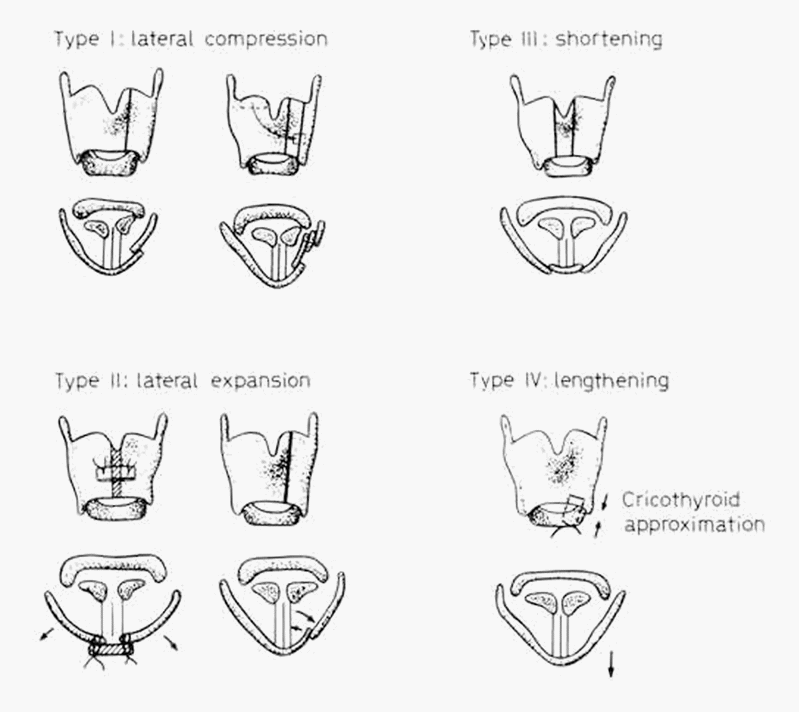
thyroplasty types
Isshiki, N. (1980). Recent Advances in Phonosurgery. Folia Phoniatrica et Logopaedica, 32(2), 119–154. doi:10.1159/000264334

Ishikki classificaiton – 4 types:

TypeMnemonicProcedureIndication
IMMedialization of cord (Approximation)Adductor palsy
IILLateralization of cord (Expansion)Abductor palsy
IIISShortening of cord (Relaxation)Puberphonia
IVLLengthening of cord (Tensioning)Androphonia

Just remember that type 1 is Medialization and type 3 is Shortening.

Another mnemonic: thyroPLaSTy

  1. Type I: Proximal or medialization
  2. Type II: Lateralization
  3. Type III: Shortening
  4. Type IV: Tensioning
  • Facebook
  • Twitter
PGMEE, MRCS, USMLE, MBBS, MD/MS OtorhinolaryngologyRespiratory system

Post navigation

Previous post
Next post

Related Posts

PGMEE, MRCS, USMLE, MBBS, MD/MS urinary buffers

Most Important Urinary Buffer: Phosphate or Ammonia?

Jan 27, 2017

There are multiple choice questions (mcq) which asks: What is the most important urinary buffer? And the choices include both the phosphate and ammonia. Different textbooks on physiology and biochemistry have different opinions. Some say that the most important is Phosphate and the others say Ammonia is more important. So,…

Read More
PGMEE, MRCS, USMLE, MBBS, MD/MS hyperkalemia ecg

Hyperkalemia Management – Mnemonic Approach

Oct 24, 2020Oct 24, 2020

Mnemonic: C BIG K D Calcium gluconate (Cardiac stabilizer) It is generally accepted that calcium should be given when there are ECG changes associated with hyperkalaemia. Calcium gluconate 10% 10-30 ml IV (1-3 gm) over 5-10 minutes (Can be repeated after 5 minutes if ECG changes persistent) 0.5 ml/kg in…

Read More
PGMEE, MRCS, USMLE, MBBS, MD/MS

Dermatomes : Mnemonic

Sep 18, 2021Sep 18, 2021

Note: C1 doesn’t have a sensory branch For the purpose of making learning easier, we divide the remaining dermatomal segments into 4 groups which will be accompanied by analogies and mnemonics. C2-C4 These supply the “hooded cape” region. C2: hood region abutting the trigeminal distribution C3: upper neck C4: lower…

Read More

Leave a Reply Cancel reply

Your email address will not be published. Required fields are marked *

This site uses Akismet to reduce spam. Learn how your comment data is processed.

Pre-clinical (Basic Sciences)

Anatomy

Biochemistry

Community medicine (PSM)

Embryology

Microbiology

Pathology

Pharmacology

Physiology

Clinical Sciences

Anesthesia

Dermatology

Emergency medicine

Forensic

Internal medicine

Gynecology & Obstetrics

Oncology

Ophthalmology

Orthopedics

Otorhinolaryngology (ENT)

Pediatrics

Psychiatry

Radiology

Surgery

RSS Ask Epomedicine

  • What to study for Clinical examination in Orthopedics?
  • What is the mechanism of AVNRT?

Epomedicine weekly

  • About Epomedicine
  • Contact Us
  • Author Guidelines
  • Submit Article
  • Editorial Board
  • USMLE
  • MRCS
  • Thesis
©2026 Epomedicine | WordPress Theme by SuperbThemes