Skip to content
Epomedicine

Mnemonics, Simplified Concepts & Thoughts

Epomedicine

Mnemonics, Simplified Concepts & Thoughts

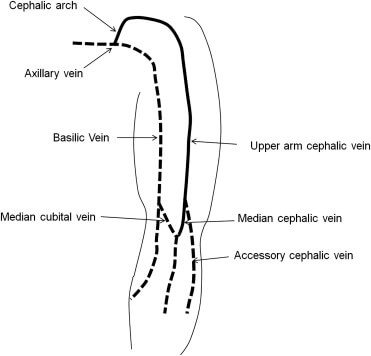
superficial vein forearm

Superficial Veins of Forearm : Mnemonic

Epomedicine, Jun 22, 2018

Origin: Dorsal venous network

The 1st 2 letters of the word “biceps” that being the muscle with which the vein is in relation, will give a mnemonic aid to retain the relative position of the basilic and cephalic veins. (B.I., Basilic Internal)

  • Basilic vein courses medially
  • Cephalic vein course laterally

superficial vein forearm

At the elbow these 2 veins are connected by median cubital vein.

Cephalic vein courses more cephalad.

In the arm, at the lower border of teres major, basilic vein moves deep, combines with the brachial veins (venae comitantes) to form axillary vein. Cephalic vein travels to shoulder in deltopectoral groove and enters the axilla via clavipectoral triangle to terminate into axillary vein.
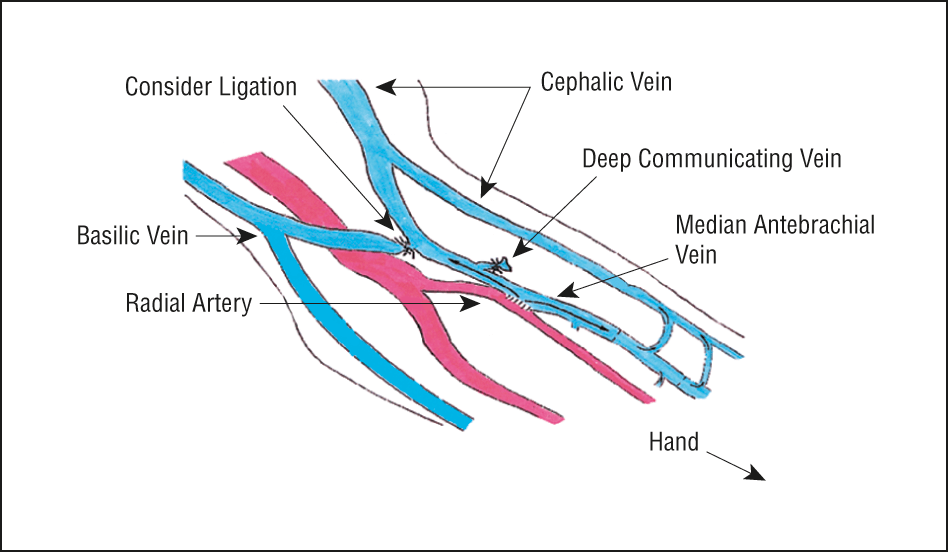
median antebrachial vein

In approximately 20% of people, the median antebrachial vein (median vein of the forearm) divides into a median basilic vein, which joins the basilic vein, and a median cephalic vein which joins the cephalic vein. In these cases, a clear “M” formation is produced by the cubital veins.

It is important to observe and remember that either the median cubital vein or the median basilic vein, which ever pattern is present, crosses superficial to the brachial artery, from which it is separated by the bicipital aponeurosis. These veins are good sites for drawing blood but are not ideal for injecting an irritating drug because of the danger of injecting it into the brachial artery.

Clinical correlation:

1. Cephalic vein has a tortuous course in shoulder and has acute junction with axillary vein. Hence, basilic vein is better for insertion of SVC catheter.

2. The median cubital vein is a common site of venepuncture. It is a superficial vein that is located anteriorly to the cubital fossa region. It is thought to be fixed in place by perforating veins, which arise from the deep venous system and pierce the bicipital aponeurosis. Its ease of access, fixed position and superficial position make the median cubital vein a good site for venepuncture in many individuals.
  • Facebook
  • Twitter
PGMEE, MRCS, USMLE, MBBS, MD/MS AnatomyCardiovascular system

Post navigation

Previous post
Next post

Related Posts

PGMEE, MRCS, USMLE, MBBS, MD/MS esr

ESR and CRP in Musculoskeletal infection

Aug 5, 2020Jan 27, 2022

ESR (Erythrocyte Sedimentation Rate) Usually elevated within 48-72 hours of the infection onset (less reliable in the first 48 hours of infection) Continues to rise for 3-5 days after institution of successful therapy and continuing rise beyond 4th-5th day of treatment can be an indication of treatment failure (not good…

Read More

Leprosy: Etiopathogenesis, Classification and Complications

Nov 19, 2013

Synonyms: Hansen’s disease, Kushta roga, Mezels Definition: Leprosy is a chronic granulomatous disease, caused by Mycobacterium leprae which affects prinicpally the skin and  peripheral nerves. Other commonly affected sites are the cooler parts of the body like mucosa of upper respiratory tract, anterior chamber of eyes and testes. The cooler…

Read More
PGMEE, MRCS, USMLE, MBBS, MD/MS

Palmar Aponeurosis or Fascia

Oct 3, 2022Feb 23, 2023

5 components a. Central aponeurosis It is triangular in shape with apex originating at the level of flexor retinaculum as a continuation of palmaris longus and thins and fans out distally. It has 3 dimensional fiber orientation: longitudinal, transverse and vertical 1. Longitudinal: Gives 4 pre-tendinous band (PTB) in the…

Read More

Leave a Reply Cancel reply

Your email address will not be published. Required fields are marked *

This site uses Akismet to reduce spam. Learn how your comment data is processed.

Epomedicine. Superficial Veins of Forearm : Mnemonic [Internet]. Epomedicine; 2018 Jun 22 [cited 2025 Dec 26]. Available from: https://epomedicine.com/medical-students/superficial-veins-of-forearm-mnemonic/.

Pre-clinical (Basic Sciences)

Anatomy

Biochemistry

Community medicine (PSM)

Embryology

Microbiology

Pathology

Pharmacology

Physiology

Clinical Sciences

Anesthesia

Dermatology

Emergency medicine

Forensic

Internal medicine

Gynecology & Obstetrics

Oncology

Ophthalmology

Orthopedics

Otorhinolaryngology (ENT)

Pediatrics

Psychiatry

Radiology

Surgery

RSS Ask Epomedicine

  • What to study for Clinical examination in Orthopedics?
  • What is the mechanism of AVNRT?

Epomedicine weekly

  • About Epomedicine
  • Contact Us
  • Author Guidelines
  • Submit Article
  • Editorial Board
  • USMLE
  • MRCS
  • Thesis
©2025 Epomedicine . All rights reserved.