Skip to content
Epomedicine

Mnemonics, Simplified Concepts & Thoughts

Epomedicine

Mnemonics, Simplified Concepts & Thoughts

retroperitoneal-structures

Retroperitoneal Organs : Mnemonic

Epomedicine, Jun 27, 2018May 13, 2024

Retroperitoneal organs are partly covered on one side with parietal peritoneum. They are immobile or fixed. The classification of retroperitoneal organs divides primary and secondary retroperitoneal organs due to the embryonic development –

  1. Primary retroperitoneal organs: Never had mesentery
  2. Secondary retroperitoneal organs: Initially intraperitoneal but lost their mesentery during development
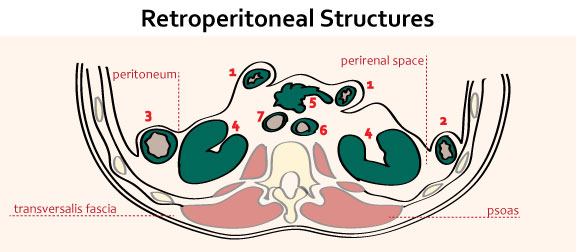
retroperitoneal-structures

Retroperitoneal structures

Mnemonic: SAD PUCKER

  1. Suprarental glands
  2. Aorta and Inferior venacava
  3. Duodenum (except 1st part)
  4. Pancreas (except tail)
  5. Ureters and bladder
  6. Colon (Ascending and Descending only), Cysterna chyli
  7. Kidneys
  8. Esophagus (Anterior and Left covered)
  9. Rectum (except upper 1/3)

Primary retroperitoneal structures

Mnemonic: SAUKER

  1. Suprarenal glands
  2. Aorta and inferior venacava
  3. Ureters and bladder
  4. Kidneys
  5. Esophagus
  6. Rectum

Secondary retroperitoneal structures

  1. Duodenum (descending and horizontal part)
  2. Pancreas (head, neck and body)
  3. Colon

Clinical significance

Kocher maneuver (access to retroperitoneum): Performed by first identifying the duodenum, and then making an incision in the peritoneum along its immediate lateral (right) aspect, allowing the duodenum and head of the pancreas to be separated from their peritoneal attachments and reflected 180 degrees medially (to the patient’s left) to gain access to retroperitoneal structures.

Extended Kocher maneuver: If greater exposure is required, the incision can then be extended caudally along the white line of Toldt, allowing the ascending colon to be reflected medially and more access to the more inferiorly lying retroperitoneal structures.

Retroperitoneal fibrosis:

  • Uncommon collagen vascular disease
  • Often presents initially with ureteric obstruction
  • Idiopathic (70%), Bening and malignant conditions, Medications

Eponymous signs of retroperitoneal hemorrhage:

  1. Grey-turner’s sign (flank ecchymosis): development of a hematoma along the lateral abdominal wall secondary to perirenal space bleeding tracking along with the quadratus lumborum
  2. Cullen’s sign (periumbilical ecchymosis): when retroperitoneal bleeding dissects along the falciform ligament anteriorly
  3. Fox’s sign (anteromedial thigh ecchymosis): from blood tracking along the psoas and iliacus muscles’ fascial planes
14 shares
  • Facebook14
  • Twitter
PGMEE, MRCS, USMLE, MBBS, MD/MS Anatomy

Post navigation

Previous post
Next post

Related Posts

PGMEE, MRCS, USMLE, MBBS, MD/MS Mapleson breathing system

Mapleson Breathing Circuit Made Easy

Oct 17, 2016

Anatomy of Mapleson Breathing Circuit Basically, a mapleson breathing circuit consists of following parts: 1. Face mask (towards patient end) 2. Reservoir bag (towards operator end) Accommodates fresh gas flow during expiration acting as a reservoir available for the following inspiration. Acts as a monitor of patient’s ventilatory pattern during…

Read More
PGMEE, MRCS, USMLE, MBBS, MD/MS

Joint Lubrication Made Easy

Jan 20, 2024Jan 20, 2024

Boundary lubrication A monolayer of lubricant molecule (lubricin) adsorbed on each surface (boundary) of the joint prevents direct cartilage to cartilage (articular) contact Fluid-film lubrication Cartilage surfaces are separated by a fluid film 1. Hydrodynamic lubrication: 2. Squeeze film lubrication: 2. Elastohydrodynamic lubrication: Combination of hydrodynamic and squeeze film Mixed…

Read More
PGMEE, MRCS, USMLE, MBBS, MD/MS ECG interval

ECG Guide for Surgeons

Dec 1, 2021Dec 1, 2021

There is an old saying that two surgeons and an ECG form a double-blind-study. Then, there’s a protocol for surgeons intended for humor: All spikes up: Operate All spikes down: Call Medics All spikes missing: Recently: Call Anesthetist A long time ago: Complete death certificate So, let’s think of heart…

Read More

Comments (3)

  1. Eddie mukwaya says:
    Jan 19, 2021 at 8:44 am

    I think most of the issues were tackled

    Reply
    1. RAM says:
      Jul 24, 2021 at 12:15 pm

      🙏

      Reply
  2. khidrtasiu says:
    Sep 27, 2021 at 8:25 am

    Why don’t you have an app please

    Reply

Leave a Reply Cancel reply

Your email address will not be published. Required fields are marked *

This site uses Akismet to reduce spam. Learn how your comment data is processed.

Pre-clinical (Basic Sciences)

Anatomy

Biochemistry

Community medicine (PSM)

Embryology

Microbiology

Pathology

Pharmacology

Physiology

Clinical Sciences

Anesthesia

Dermatology

Emergency medicine

Forensic

Internal medicine

Gynecology & Obstetrics

Oncology

Ophthalmology

Orthopedics

Otorhinolaryngology (ENT)

Pediatrics

Psychiatry

Radiology

Surgery

RSS Ask Epomedicine

  • What to study for Clinical examination in Orthopedics?
  • What is the mechanism of AVNRT?

Epomedicine weekly

  • About Epomedicine
  • Contact Us
  • Author Guidelines
  • Submit Article
  • Editorial Board
  • USMLE
  • MRCS
  • Thesis
©2026 Epomedicine | WordPress Theme by SuperbThemes