Skip to content
Epomedicine

Mnemonics, Simplified Concepts & Thoughts

Epomedicine

Mnemonics, Simplified Concepts & Thoughts

sciatic foramen

Structures passing through sciatic foramen and pudendal canal : Mnemonic

Epomedicine, Jun 30, 2018

sciatic foramen

Sacrospinous ligament converts greater sciatic notch into greater sciatic foramen.
Sacrotuberous ligament and sacrospinous ligament converts lesser sciatic notch into lesser sciatic foramen.
Pudendal canal is a fascial canal formed by splitting of the obturator fascia and is located on the lateral wall of ischiorectal fossa.

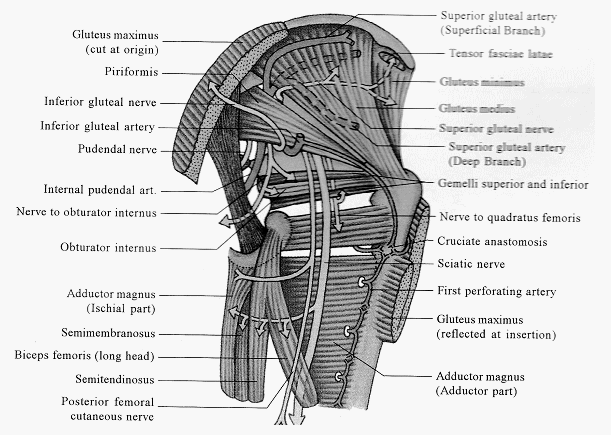
Structures passing thorugh greater sciatic foramen: S-SPIN-PIN

  1. Above pyriformis muscle: S
    • Superior gluteal artery and nerve
  2. Below pyriformis muscle: SPIN
    • Sciatic nerve
    • Posterior cutaneous nerve of thigh
    • Inferior gluteal artery and nerve
    • Nerve to quadratus femoris
    • Pudendal nerve
    • Internal pudendal vessels
    • Nerve to obturator internus

Structures passing through lesser sciatic foramen: PIN-T

The last 3 structures passing though the greater sciatic foramen also passes through the lesser sciatic foramen.

  1. Pudendal nerve
  2. Internal pudendal vessels
  3. Nerve to obturator internus
  4. Tendon of obturator internus

Structures passing through pudendal canal: PI

  1. Pudendal nerve
  2. Internal pudendal vessels
33 shares
  • Facebook33
  • Twitter
PGMEE, MRCS, USMLE, MBBS, MD/MS AnatomyObGyn

Post navigation

Previous post
Next post

Related Posts

PGMEE, MRCS, USMLE, MBBS, MD/MS cellular adaptations

Cellular Adaptations

Jun 17, 2016Aug 31, 2018

Hypertrophy, Hyperplasia, Atrophy and Metaplasia are the main four types of cellular adaptations. Adaptations are: Reversible changes In the number, size, phenotype, metabolic activity or functions of cells In response to the changes in the environment (stress).   Hypertrophy Definition: Increase in cell size Occurs in: non-dividing (permanent) cells: cardiac and…

Read More
PGMEE, MRCS, USMLE, MBBS, MD/MS

THA dislocation : WHAT mnemonic

May 28, 2021Oct 30, 2022

The incidence of THA dislocation is: Primary THA: 1-2% Revision THA: 5-7% Mnemonic: WHAT caused the total hip arthroplasty dislocation? Wear Types: Volumetric wear: proportional to r2 (diameter of head) Linear wear (related to penetration of femoral head into liner): smaller heads have higher linear wear Adhesive wear (most important):…

Read More
PGMEE, MRCS, USMLE, MBBS, MD/MS concentration effect

Concentration effect, Second gas effect and Diffusion hypoxia

Oct 20, 2016Oct 20, 2016

Concentration effect The higher the concentration of an inhaled anesthetic, the faster the alveolar concentration approaches the inhaled concentration. This is referred to as concentration effect and is clinically significant only in cases where gases are administered in high concentration: Nitrous oxide Xenon Ostwald’s blood gas solubility coefficient: ratio of…

Read More

Comments (3)

  1. Rajendran Ambiavagar says:
    Jul 3, 2020 at 1:46 am

    Excellent. From a retired urologist studying anatomy for fun!!

    Reply
  2. Athingahangwi Ramabulana says:
    Jul 27, 2020 at 9:32 pm

    Thank you so much for all the work here! I’m a 3rd year medical student and it’s soo helpful.

    Reply
  3. Harry says:
    May 2, 2021 at 9:59 am

    Thank you for this! I’m a physical therapy student and this mnemonic helped me

    Reply

Leave a Reply to Harry Cancel reply

Your email address will not be published. Required fields are marked *

This site uses Akismet to reduce spam. Learn how your comment data is processed.

Pre-clinical (Basic Sciences)

Anatomy

Biochemistry

Community medicine (PSM)

Embryology

Microbiology

Pathology

Pharmacology

Physiology

Clinical Sciences

Anesthesia

Dermatology

Emergency medicine

Forensic

Internal medicine

Gynecology & Obstetrics

Oncology

Ophthalmology

Orthopedics

Otorhinolaryngology (ENT)

Pediatrics

Psychiatry

Radiology

Surgery

RSS Ask Epomedicine

  • What to study for Clinical examination in Orthopedics?
  • What is the mechanism of AVNRT?

Epomedicine weekly

  • About Epomedicine
  • Contact Us
  • Author Guidelines
  • Submit Article
  • Editorial Board
  • USMLE
  • MRCS
  • Thesis
©2026 Epomedicine | WordPress Theme by SuperbThemes