Skip to content
Epomedicine

Mnemonics, Simplified Concepts & Thoughts

Epomedicine

Mnemonics, Simplified Concepts & Thoughts

jugular foramen

Structures passing through Jugular foramen : Mnemonic

Epomedicine, Jun 29, 2018

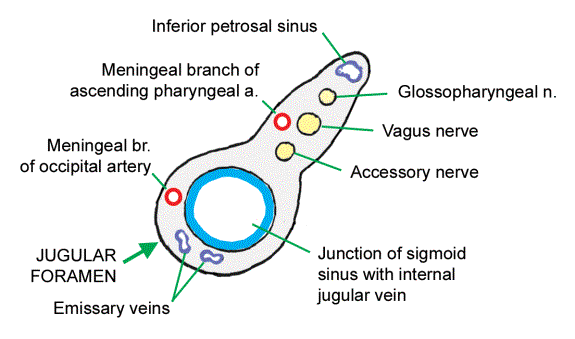
Mnemonic: IPS 9,10,11 MAP JOE
jugular foramen

Anterior part: IPS

  1. Inferior Petrosal Sinus

Middle part: 9, 10, 11 MAP

  1. CN IX
  2. CN X
  3. CN XI
  4. Meningeal br. of Ascending Pharyngeal artery

Posterior part: JOE

  1. Jugular vein (internal; lower end of sigmoid sinus)
  2. Occipital artery
  3. Emissary vein

Vernet’s syndrome (Jugular foramen syndrome)

  • Unilateral paresis of 9, 10 and 11 cranial nerves together
  • Results in ipsilateral paresis of sternocleidomastoid and trapezius muscle, dysphonia, homolateral vocal cord paralysis, and loss of taste sensation from ipsilateral posterior 1/3 of tongue, uvula, larynx and pharynx
  • Cause:
    • Trauma
    • Tumor (Glomus tumors, meningioma, acoustic neuroma, metastatic CP angle tumors)
    • Inflammation
25 shares
  • Facebook25
  • Twitter
PGMEE, MRCS, USMLE, MBBS, MD/MS Anatomy

Post navigation

Previous post
Next post

Related Posts

PGMEE, MRCS, USMLE, MBBS, MD/MS psychiatry symbol

Definition of terms in Psychiatry

Nov 15, 2020Nov 15, 2020

1. Speech: Ideas, thoughts, feelings expressed through language 2. Emotion: Complex phenomenon involving reactions in 3 different components: Feeling experienced by subject (joy, sadness, anger) Behavioral (expressive component) Autonomic and endocrine component 3. Affect: Objective outward expression of the immediate cross-section emotion at a given time 4. Mood: Sustained pervasive…

Read More
PGMEE, MRCS, USMLE, MBBS, MD/MS

Ligaments of Pelvis

Oct 3, 2020Oct 3, 2020

Inherent stability of the pelvis is provided by ligaments. The 3 groups of ligaments are: 1. Sacrum to Pelvis: Sacroiliac ligamentous complex: is divided into posterior (short and long) and anterior ligaments. Posterior ligaments provide most of the stability. Sacrotuberous ligament: runs from the posterolateral aspect of the sacrum and the…

Read More
PGMEE, MRCS, USMLE, MBBS, MD/MS

Regression Analysis for Medical Students and Doctors

Mar 25, 2026Mar 25, 2026

Regression is a statistical tool used mainly to study the association between: Uses: Types of regression based on outcome variable (y): Remember the “NOIR” mnemonic for the types of variable. Types of regression based on number of independent variables (x): Regression vs Correlation: Correlation measures the strength of the association…

Read More

Leave a Reply Cancel reply

Your email address will not be published. Required fields are marked *

This site uses Akismet to reduce spam. Learn how your comment data is processed.

Pre-clinical (Basic Sciences)

Anatomy

Biochemistry

Community medicine (PSM)

Embryology

Microbiology

Pathology

Pharmacology

Physiology

Clinical Sciences

Anesthesia

Dermatology

Emergency medicine

Forensic

Internal medicine

Gynecology & Obstetrics

Oncology

Ophthalmology

Orthopedics

Otorhinolaryngology (ENT)

Pediatrics

Psychiatry

Radiology

Surgery

RSS Ask Epomedicine

  • What to study for Clinical examination in Orthopedics?
  • What is the mechanism of AVNRT?

Epomedicine weekly

  • About Epomedicine
  • Contact Us
  • Author Guidelines
  • Submit Article
  • Editorial Board
  • USMLE
  • MRCS
  • Thesis
©2026 Epomedicine | WordPress Theme by SuperbThemes