Skip to content
Epomedicine

Mnemonics, Simplified Concepts & Thoughts

Epomedicine

Mnemonics, Simplified Concepts & Thoughts

sciatic foramen

Structures passing through sciatic foramen and pudendal canal : Mnemonic

Epomedicine, Jun 30, 2018

sciatic foramen

Sacrospinous ligament converts greater sciatic notch into greater sciatic foramen.
Sacrotuberous ligament and sacrospinous ligament converts lesser sciatic notch into lesser sciatic foramen.
Pudendal canal is a fascial canal formed by splitting of the obturator fascia and is located on the lateral wall of ischiorectal fossa.

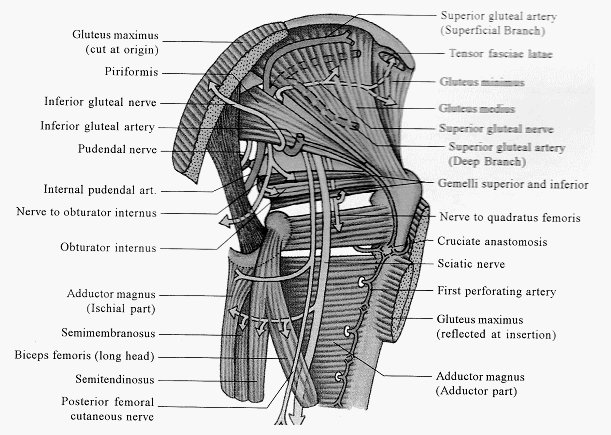
Structures passing thorugh greater sciatic foramen: S-SPIN-PIN

  1. Above pyriformis muscle: S
    • Superior gluteal artery and nerve
  2. Below pyriformis muscle: SPIN
    • Sciatic nerve
    • Posterior cutaneous nerve of thigh
    • Inferior gluteal artery and nerve
    • Nerve to quadratus femoris
    • Pudendal nerve
    • Internal pudendal vessels
    • Nerve to obturator internus

Structures passing through lesser sciatic foramen: PIN-T

The last 3 structures passing though the greater sciatic foramen also passes through the lesser sciatic foramen.

  1. Pudendal nerve
  2. Internal pudendal vessels
  3. Nerve to obturator internus
  4. Tendon of obturator internus

Structures passing through pudendal canal: PI

  1. Pudendal nerve
  2. Internal pudendal vessels
33 shares
  • Facebook33
  • Twitter
PGMEE, MRCS, USMLE, MBBS, MD/MS AnatomyObGyn

Post navigation

Previous post
Next post

Related Posts

PGMEE, MRCS, USMLE, MBBS, MD/MS Advance glaucomatous field defect

Understanding visual field defects in Glaucoma (Perimetry)

May 21, 2014May 21, 2014

Introduction Field of vision or Visual field is defined as the area that is perceived while fixating one central target. According to traquair’s analogy, visual field is “an island of vision surrounded by a sea of darkness”. It is a 3D hill – peak being fovea and at ground level,…

Read More
PGMEE, MRCS, USMLE, MBBS, MD/MS

Working formulation of NHL (Mnemonic)

Jan 16, 2019Feb 26, 2019

All follicular except large cell: Low grade All diffuse: Intermediate grade Blastic and non-cleaved: High grade

Read More
PGMEE, MRCS, USMLE, MBBS, MD/MS

AKI RIFLE Criteria Mnemonic

Aug 6, 2024Aug 6, 2024

Stage GFR criteria Urine output criteria Mnemonic 1, 2, 3, 4 1, 2, 3 1. Risk Cr ↑ 1.5-2 XGFR ↓ 25-50% (>1/4) <0.5 ml/kg/hr X 6-12 (>1/4 day) 2. Injury Cr ↑ 2-3 XGFR ↓ >50-75% (>2/4) <0.5 ml/kg/hr X >12-24 hrs (>2/4 day) 3. Failure Cr ↑ >3…

Read More

Comments (3)

  1. Rajendran Ambiavagar says:
    Jul 3, 2020 at 1:46 am

    Excellent. From a retired urologist studying anatomy for fun!!

    Reply
  2. Athingahangwi Ramabulana says:
    Jul 27, 2020 at 9:32 pm

    Thank you so much for all the work here! I’m a 3rd year medical student and it’s soo helpful.

    Reply
  3. Harry says:
    May 2, 2021 at 9:59 am

    Thank you for this! I’m a physical therapy student and this mnemonic helped me

    Reply

Leave a Reply to Athingahangwi Ramabulana Cancel reply

Your email address will not be published. Required fields are marked *

This site uses Akismet to reduce spam. Learn how your comment data is processed.

Pre-clinical (Basic Sciences)

Anatomy

Biochemistry

Community medicine (PSM)

Embryology

Microbiology

Pathology

Pharmacology

Physiology

Clinical Sciences

Anesthesia

Dermatology

Emergency medicine

Forensic

Internal medicine

Gynecology & Obstetrics

Oncology

Ophthalmology

Orthopedics

Otorhinolaryngology (ENT)

Pediatrics

Psychiatry

Radiology

Surgery

RSS Ask Epomedicine

  • What to study for Clinical examination in Orthopedics?
  • What is the mechanism of AVNRT?

Epomedicine weekly

  • About Epomedicine
  • Contact Us
  • Author Guidelines
  • Submit Article
  • Editorial Board
  • USMLE
  • MRCS
  • Thesis
©2026 Epomedicine | WordPress Theme by SuperbThemes