Skip to content
Epomedicine

Mnemonics, Simplified Concepts & Thoughts

Epomedicine

Mnemonics, Simplified Concepts & Thoughts

retroperitoneal-structures

Retroperitoneal Organs : Mnemonic

Epomedicine, Jun 27, 2018May 13, 2024

Retroperitoneal organs are partly covered on one side with parietal peritoneum. They are immobile or fixed. The classification of retroperitoneal organs divides primary and secondary retroperitoneal organs due to the embryonic development –

  1. Primary retroperitoneal organs: Never had mesentery
  2. Secondary retroperitoneal organs: Initially intraperitoneal but lost their mesentery during development
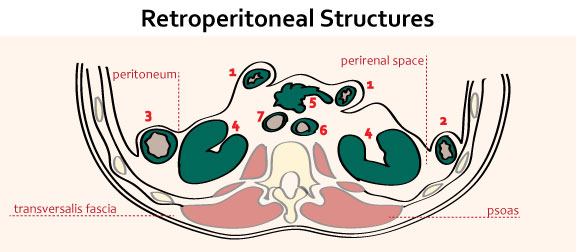
retroperitoneal-structures

Retroperitoneal structures

Mnemonic: SAD PUCKER

  1. Suprarental glands
  2. Aorta and Inferior venacava
  3. Duodenum (except 1st part)
  4. Pancreas (except tail)
  5. Ureters and bladder
  6. Colon (Ascending and Descending only), Cysterna chyli
  7. Kidneys
  8. Esophagus (Anterior and Left covered)
  9. Rectum (except upper 1/3)

Primary retroperitoneal structures

Mnemonic: SAUKER

  1. Suprarenal glands
  2. Aorta and inferior venacava
  3. Ureters and bladder
  4. Kidneys
  5. Esophagus
  6. Rectum

Secondary retroperitoneal structures

  1. Duodenum (descending and horizontal part)
  2. Pancreas (head, neck and body)
  3. Colon

Clinical significance

Kocher maneuver (access to retroperitoneum): Performed by first identifying the duodenum, and then making an incision in the peritoneum along its immediate lateral (right) aspect, allowing the duodenum and head of the pancreas to be separated from their peritoneal attachments and reflected 180 degrees medially (to the patient’s left) to gain access to retroperitoneal structures.

Extended Kocher maneuver: If greater exposure is required, the incision can then be extended caudally along the white line of Toldt, allowing the ascending colon to be reflected medially and more access to the more inferiorly lying retroperitoneal structures.

Retroperitoneal fibrosis:

  • Uncommon collagen vascular disease
  • Often presents initially with ureteric obstruction
  • Idiopathic (70%), Bening and malignant conditions, Medications

Eponymous signs of retroperitoneal hemorrhage:

  1. Grey-turner’s sign (flank ecchymosis): development of a hematoma along the lateral abdominal wall secondary to perirenal space bleeding tracking along with the quadratus lumborum
  2. Cullen’s sign (periumbilical ecchymosis): when retroperitoneal bleeding dissects along the falciform ligament anteriorly
  3. Fox’s sign (anteromedial thigh ecchymosis): from blood tracking along the psoas and iliacus muscles’ fascial planes
14 shares
  • Facebook14
  • Twitter
PGMEE, MRCS, USMLE, MBBS, MD/MS Anatomy

Post navigation

Previous post
Next post

Related Posts

PGMEE, MRCS, USMLE, MBBS, MD/MS wickhams stria

15 “P”s of Lichen Planus

Jun 2, 2019Jun 2, 2019

In your medical school, you must have heard about the 5 “P”s of Lichen planus representing the gross morphology of Lichen Planus. This 15 P mnemonic encompasses morphology, drug and other associations and histology of lichen planus. Morphology:PruriticPlanar (Flat-topped)PolygonalPurplePapulesPattern of white lines on papules (Wickham’s stria)Pterygium in nailsPhenomenon of Koebner…

Read More
PGMEE, MRCS, USMLE, MBBS, MD/MS Brown sequard syndrome

Brown-Sequard Syndrome – Anatomical Basis

Jul 25, 2016Sep 5, 2019

Definition of Brown Sequard Syndrome Neurological syndrome resulting from spinal cord hemisection (damage to one lateral half of spinal cord). Causes of Brown Sequard Syndrome Penetrating trauma Spinal fractures Spinal dislocation Disc herniation Vasculitis Radiation induced injury Clinical Manifestations and Anatomical Basis of Brown Sequard Syndrome 1. Damage of Corticospinal…

Read More
PGMEE, MRCS, USMLE, MBBS, MD/MS inferior wall stemi ecg

GRACE, HEART and TIMI score Mnemonics : Cardiac Chest Pain Risk Stratification

Oct 18, 2020Oct 18, 2020

GRACE Score Mnemonic: GRACE A. Global Registry of Acute Coronary Events B. Renal: Creatinine C. Age D. Cardiac: Heart rate Systolic blood pressure Cardiac arrest at admission Killip class: I – No CHF II – Basal rales and/or JVD III – Pulmonary edema IV – Cardiogenic shock E. ECG and…

Read More

Comments (3)

  1. Eddie mukwaya says:
    Jan 19, 2021 at 8:44 am

    I think most of the issues were tackled

    Reply
    1. RAM says:
      Jul 24, 2021 at 12:15 pm

      🙏

      Reply
  2. khidrtasiu says:
    Sep 27, 2021 at 8:25 am

    Why don’t you have an app please

    Reply

Leave a Reply to khidrtasiu Cancel reply

Your email address will not be published. Required fields are marked *

This site uses Akismet to reduce spam. Learn how your comment data is processed.

Epomedicine. Retroperitoneal Organs : Mnemonic [Internet]. Epomedicine; 2018 Jun 27 [cited 2025 Dec 8]. Available from: https://epomedicine.com/medical-students/retroperitoneal-organs-mnemonic/.

Pre-clinical (Basic Sciences)

Anatomy

Biochemistry

Community medicine (PSM)

Embryology

Microbiology

Pathology

Pharmacology

Physiology

Clinical Sciences

Anesthesia

Dermatology

Emergency medicine

Forensic

Internal medicine

Gynecology & Obstetrics

Oncology

Ophthalmology

Orthopedics

Otorhinolaryngology (ENT)

Pediatrics

Psychiatry

Radiology

Surgery

RSS Ask Epomedicine

  • What to study for Clinical examination in Orthopedics?
  • What is the mechanism of AVNRT?

Epomedicine weekly

  • About Epomedicine
  • Contact Us
  • Author Guidelines
  • Submit Article
  • Editorial Board
  • USMLE
  • MRCS
  • Thesis
©2025 Epomedicine . All rights reserved.