Skip to content
Epomedicine

Mnemonics, Simplified Concepts & Thoughts

Epomedicine

Mnemonics, Simplified Concepts & Thoughts

respiratory center lesion

Respiratory Center Simplified

Epomedicine, Jul 9, 2018

Mnemonic: Boat starts and PRASaD DIVEs
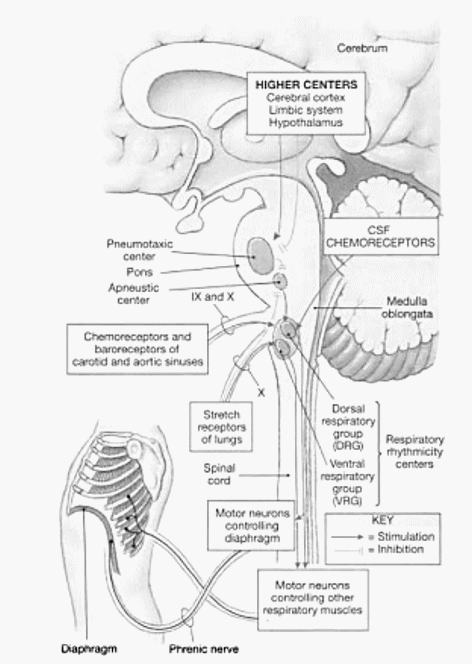
respiratory center

1. pre-Botzinger complex Starts respiratory rhythm (pacemaker): Boat Starts

  • Location: Between nucleus ambiguus and lateral reticular nucleus (upper medulla)

2. Pneumotaxic center Represses Apneustic center: PR-A

  • Location: Upper pons (Nucleus parabrachialis and Kolliker-fuse nucleus)

3. Apneustic center Stimulates DRG: A-SaD

  • Location: Lower pons

4. Dorsal respiratory group (DRG) for Inspiration (tidal): DI

  • Location: Dorsal medulla (Nucleus Tractus Solitarius)

5. Ventral respiratory group (VRG) for Expiration (forced): VE

  • Location: Ventrolateral medulla (Nucleus ambiguus and Nucelus retro-ambiguus)

In summary:

  1. Rhythmic cycle of breathing originates in medulla (pre-botzinger complex).
  2. Voluntary respiration is controlled by cerebral cortex. Limbic system and hypothalamus alter pattern of breathing in emotional stress such as fear and rage.
  3. Involuntary respiration is controlled by upper brainstem.
  4. DRG (NTS) is Inspiratory center (receives CN 9 and 10 afferents from peripheral chemoreceptors, airways and lungs)
  5. VRG (Nucleus ambiguus and retro-ambiguus) is Expiratory center (however, it has both inspiratory and expiratory neurons)
  6. Apneustic center stimulates DRG (inspiratory center) and causes inspiration (Apneusis = Prolonged inspiratory gasps).
  7. Pneumotaxic center (Nucleus parabrachialis and Kolliker fuse nucleus) and CN 10 inhibit Apneustic center to limit inspiration (volume) and increase the rate of respiration. Under normal conditions, after 2 seconds, apneustic center is inhibited by pneumotaxic center.

Effect of lesion/transection:
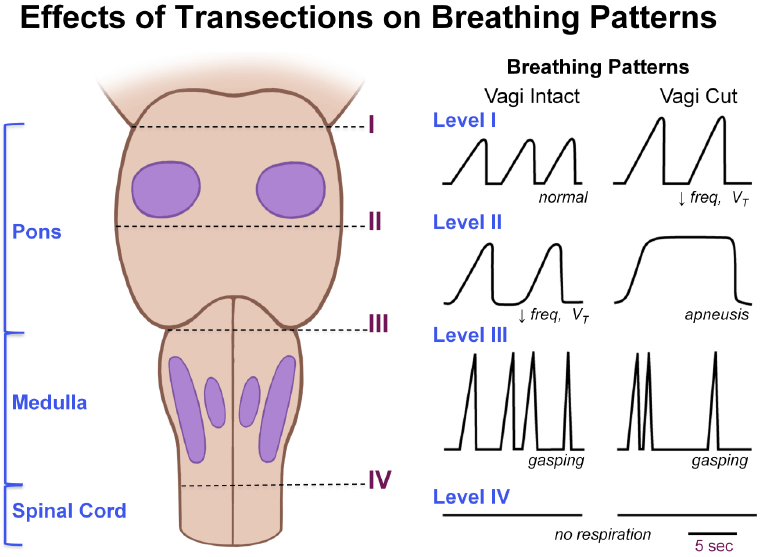
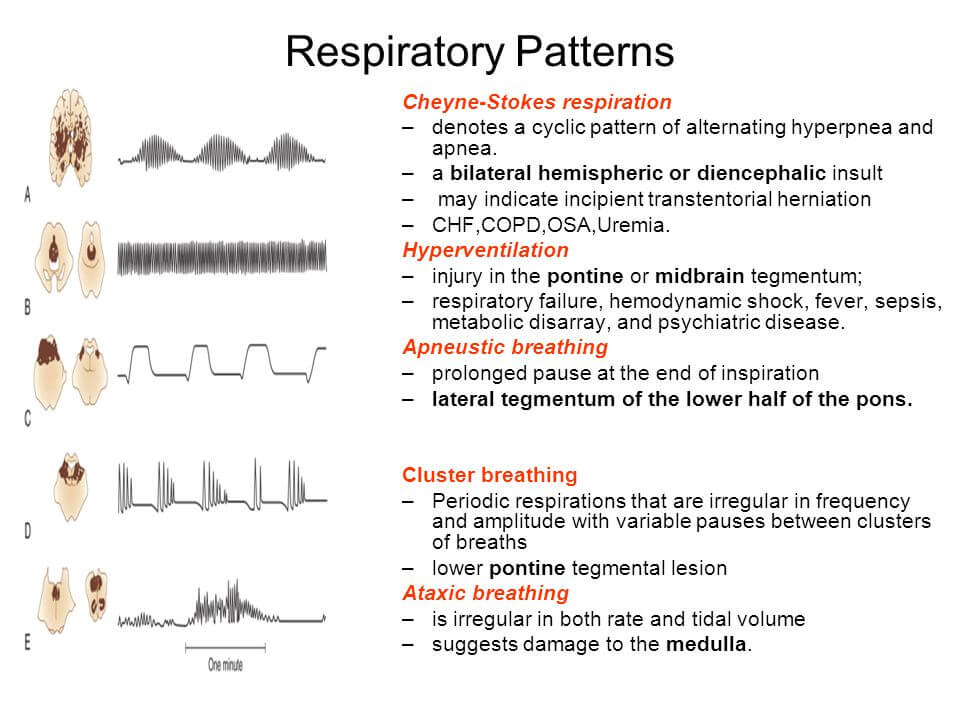
respiratory center lesion

From superior to inferior:

respiratory patterns

36 shares
  • Facebook35
  • Twitter
PGMEE, MRCS, USMLE, MBBS, MD/MS Nervous systemPhysiologyRespiratory system

Post navigation

Previous post
Next post

Related Posts

PGMEE, MRCS, USMLE, MBBS, MD/MS goodsall rule

Goodsall’s rule : Mnemonic

Apr 17, 2020Oct 1, 2020

Synonym: Goodsall-Salmon’s law In anal fistula, goodsall’s rule predicts the type of track and location of internal opening. An anterior external opening is more likely to have a straight track while a psoteriorly placed external opening is more likely to have a curved track. Mnemonic: Think of a dog with…

Read More
PGMEE, MRCS, USMLE, MBBS, MD/MS cholesterolosis of gallbladder

Strawberry Gallbladder (Cholesterolosis)

Jun 12, 2015Aug 17, 2015

Synonyms: Strawberry gallbladder is also known as hyperplastic cholecystoses. Hyperplastic cholecystoses are a spectrum of non-neoplastic proliferative disorders caused by deposition of cholesterol-laden macrophages within the wall of the gall bladder. The cholecystose range from abnormalities of the gallbladder wall (adenomyomatosis and strawberry gall bladder) to gallbladder polyps extending into…

Read More
PGMEE, MRCS, USMLE, MBBS, MD/MS lysosomal storage disorders

Lysosomal Storage Disorders Made Easy

Jan 22, 2017Jul 29, 2018

Among the common lysosomal storage disorders: Two of them are Mucopolysaccharidoses (Hunter and Hurler syndrome) Pompe’s disease is Glycogen Storage Disease. Others are Sphingolipidoses. Inheritance of Lysosomal Storage Diseases All are inherited as Autosomal Recessive (AR) condition except: Hunter syndrome (X-linked recessive) Fabry’s disease (X-linked recessive) Higher risk in Ashkenazi…

Read More

Leave a Reply Cancel reply

Your email address will not be published. Required fields are marked *

This site uses Akismet to reduce spam. Learn how your comment data is processed.

Epomedicine. Respiratory Center Simplified [Internet]. Epomedicine; 2018 Jul 9 [cited 2025 Nov 29]. Available from: https://epomedicine.com/medical-students/respiratory-center-simplified/.

Pre-clinical (Basic Sciences)

Anatomy

Biochemistry

Community medicine (PSM)

Embryology

Microbiology

Pathology

Pharmacology

Physiology

Clinical Sciences

Anesthesia

Dermatology

Emergency medicine

Forensic

Internal medicine

Gynecology & Obstetrics

Oncology

Ophthalmology

Orthopedics

Otorhinolaryngology (ENT)

Pediatrics

Psychiatry

Radiology

Surgery

RSS Ask Epomedicine

  • What to study for Clinical examination in Orthopedics?
  • What is the mechanism of AVNRT?

Epomedicine weekly

  • About Epomedicine
  • Contact Us
  • Author Guidelines
  • Submit Article
  • Editorial Board
  • USMLE
  • MRCS
  • Thesis
©2025 Epomedicine . All rights reserved.