Skip to content
Epomedicine

Mnemonics, Simplified Concepts & Thoughts

Epomedicine

Mnemonics, Simplified Concepts & Thoughts

Pheochromocytoma : Mnemonics

Epomedicine, Jun 25, 2023Jun 25, 2023

Pheochromocytoma is a catecholamine-producing tumor arising from chromaffin cells of the sympathetic nervous system derived embryologically from the primitive neural crest cells.

Sites:

  1. Adrenal medulla (most common)
  2. Organ of Zuckerkandl, i.e. ganglia at bifurcation of aorta (second most common)
  3. Paragangliomas (anywhere along parasympathetic chain)
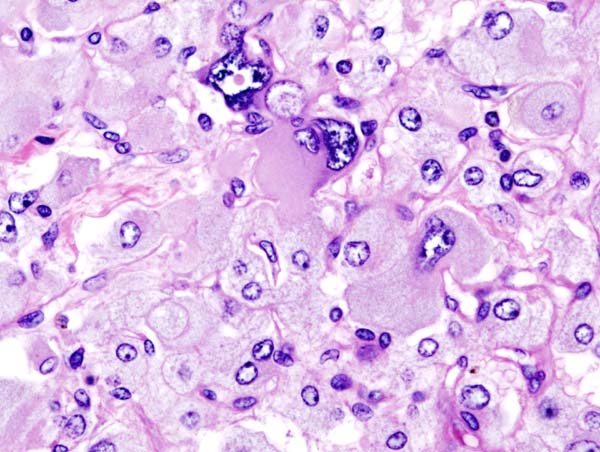
Adrenal pheochromocytoma
“File:Adrenal pheochromocytoma (3) histopathology.jpg” is licensed under CC BY-SA 3.0. To view a copy of this license, visit http://creativecommons.org/licenses/by-sa/3.0/?ref=openverse.

Clinical features

Mnemonic: 5 H or 7 P’s

5 H7 P
HypertensionParoxysmal rise in pressure (BP)
HeadachePain (headache)
HyperhidrosisPerspiration (hyperhidrosis)
HyperglycemiaPallor
HypermetabolismPalpitation
Pain (abdomen)
PMV in urine
Hypertension, headache and hyperhidrosis are present in 95% cases.

Rule of 10s

  1. 10% are bilateral
  2. 10% are extra-adrenal
  3. 10% are malignant (higher in extra-adrenal – upto 40%)
  4. 10% are familial
  5. 10% are pediatric
  6. 10% are calcified

Inherited syndromes of (Familial) Pheochromocytoma

1 – NF 1

2 – MEN 2

3 – VHL (3 letter word and Chromosome 3) and MEN 3
  • Facebook
  • Twitter
PGMEE, MRCS, USMLE, MBBS, MD/MS Endocrine systemInternal medicinePathology

Post navigation

Previous post
Next post

Related Posts

PGMEE, MRCS, USMLE, MBBS, MD/MS

Injection site swelling after vaccination in Infants

Mar 11, 2021Mar 11, 2021

Swelling and pain at injection site after vaccination is a frequently observed problem by parents and is often of concern to them. These type of reactions are generally observed after intramuscular vaccine and vaccine containing aluminium component. DPT as pentavalent is a frequent vaccine after which infants develop swelling. Types…

Read More
PGMEE, MRCS, USMLE, MBBS, MD/MS kramers chart neonatal jaundice

Neonatal Jaundice (NNJ) : Approach

Sep 2, 2015

Jaundice refers to accumulation of bilirubin in the epidermal tissues of the body, resulting in a yellowish tinge to the skin, sclera, and mucosa. Atleast 5 mg/dl of bilirubin level is required for clinically recognizing hyperbilirubinemia. A) Physiological Neonatal Jaundice: General consideration:

Read More
PGMEE, MRCS, USMLE, MBBS, MD/MS

Acute Undifferentiated Febrile Illness – Mnemonic

Jun 8, 2021Jun 8, 2021

Acute undifferentiated febrile illnesses (AUFI) are characterised by fever of less than two weeks’ duration without organ-specific symptoms at the onset. Mnemonic MA-ESR lists the five main disease groups that cause acute undifferentiated febrile illnesses a. Malaria: Including all malaria due to Plasmodium falciparum, P vivax, P ovale, P malariae,…

Read More

Leave a Reply Cancel reply

Your email address will not be published. Required fields are marked *

This site uses Akismet to reduce spam. Learn how your comment data is processed.

Epomedicine. Pheochromocytoma : Mnemonics [Internet]. Epomedicine; 2023 Jun 25 [cited 2026 Jan 13]. Available from: https://epomedicine.com/medical-students/pheochromocytoma-mnemonics/.

Pre-clinical (Basic Sciences)

Anatomy

Biochemistry

Community medicine (PSM)

Embryology

Microbiology

Pathology

Pharmacology

Physiology

Clinical Sciences

Anesthesia

Dermatology

Emergency medicine

Forensic

Internal medicine

Gynecology & Obstetrics

Oncology

Ophthalmology

Orthopedics

Otorhinolaryngology (ENT)

Pediatrics

Psychiatry

Radiology

Surgery

RSS Ask Epomedicine

  • What to study for Clinical examination in Orthopedics?
  • What is the mechanism of AVNRT?

Epomedicine weekly

  • About Epomedicine
  • Contact Us
  • Author Guidelines
  • Submit Article
  • Editorial Board
  • USMLE
  • MRCS
  • Thesis
©2026 Epomedicine . All rights reserved.