Skip to content
Epomedicine

Mnemonics, Simplified Concepts & Thoughts

Epomedicine

Mnemonics, Simplified Concepts & Thoughts

ORS resomal

ORS and ReSoMal – Mnemonic

Epomedicine, Jun 11, 2019Jun 11, 2019

Oral Rehydration Solution (ORS)

Grams per litre:

  1. SoDIum C-hloride: 2.6 gm
  2. SoDIum Ci-Trate: 2.9 gm
  3. Potassium chloride: 1.5 gm
  4. Glucose anhydrous: 13.5 gm

Mnemonic:

DI = 2 and C = 6
Ci-Trate = Rotate 6, i.e. 9
For Potassium chloride: Deduct 1 from the whole number and decimal both, i.e. (2-1).(6-1) = 1.5 gm

mmol per litre:

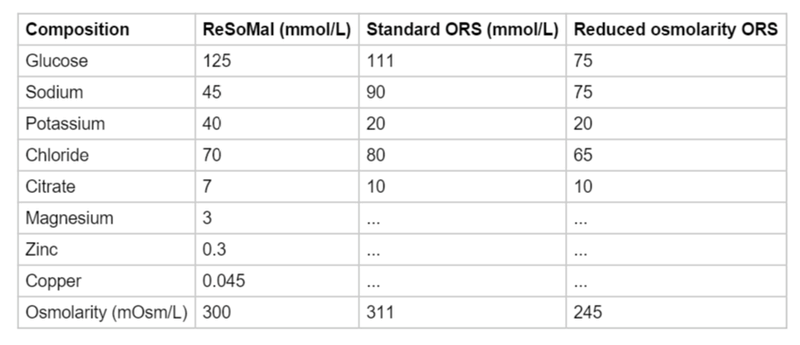
  1. Sodium and Glucose (Sugar): 75 each
  2. Chloride: 65
  3. Potassium: 20
  4. Citrate: 10
    Total: 245

Mnemonic:

S for Sodium and Sugar; S for 75
Sodium – 10 = Chloride = 65
Potassium – 10 = Citrate = 10
ors resomal

Rehydration Solution for Malnutrition (ReSoMal)

1 ORS packet + 50 gm sugar + 40 gm electrolytes and minerals (Cu, Zn, Mg) + 2 litre water

mmol/litre

  1. Sodium: ORS – 30 = 75-30 = 45
  2. Citrate: ORS – 3 = 10-3 = 7
  3. Glucose: ORS + 50 = 75+50 = 125
  4. Chloride: ORS + 5 = 65+5 = 70
  5. Potassium: ORS X 2 = 20 X 2 = 40
  6. Cu, Zn, Mn = 4
    Total = 300

Another Mnemonic:
1. Sodium and Potassium are almost equal. Take the mean of their ORS concentration, i.e. (75+20)/2 ~ 45 + 40
2. Remember the pairs:
Potassium and Minerals: 40 and 4 respsectively
Chloride and Citrate: 70 and 7 respectively
  • Facebook
  • Twitter
PGMEE, MRCS, USMLE, MBBS, MD/MS Gastrointestinal systemPediatrics

Post navigation

Previous post
Next post

Related Posts

PGMEE, MRCS, USMLE, MBBS, MD/MS

Proton Pump Inhibitors (PPI) Pharmacology : Mnemonics

Apr 28, 2021Apr 28, 2021

Relative Potency in Omeprazole Equivalent (OE) Mnemonic: PLOwER Pantoprazole (4.5 mg OE) Lansoprazole (13.5 mg OE) Omeprazole (20 mg OE) Esomeprazole (32 mg OE) Rabeprazole (36 mg OE) Side effects of PPI Mnemonic: KFC Kidney (Acute interstitial nephritis) Fractures (Hypochlorhydria leading to decreased serum calcium) C. difficile infection Besides, it…

Read More
PGMEE, MRCS, USMLE, MBBS, MD/MS

Anatomy of Middle Ear with Clinical correlation

Jul 22, 2017Jun 12, 2020

The ear, along the evolution has modified structurally and functionally. In lower animals, they functioned as alarm systems to detect any sounds of the prey or predator so as to fix their vision and also maintain the balance of the body to prevent fall. In the course of evolution, this…

Read More
PGMEE, MRCS, USMLE, MBBS, MD/MS

Physiology of Pulmonary Surfactant

Jun 16, 2020Jun 16, 2020

Origin Type II alveolar cells/pneumocytes (small but numerous) and Lamellar bodies (appear in Type II pneumocytes at around the 20th week of gestation) Type I alveolar cells (large and covers 95% alveoli) are squamous cells and involved in gas exchange process. Recycling 90% is reprocessed (through endocytosis); average time for…

Read More

Comment

  1. Deepak Das says:
    Jun 14, 2019 at 5:00 am

    Excellent mnemonics every week you send to me.Extremely grateful.I need more like the following.
    1.Ac.pancreatitis :BISHAP,RANSON score etc.
    2.Hepatic encephalopathy

    Reply

Leave a Reply Cancel reply

Your email address will not be published. Required fields are marked *

This site uses Akismet to reduce spam. Learn how your comment data is processed.

Pre-clinical (Basic Sciences)

Anatomy

Biochemistry

Community medicine (PSM)

Embryology

Microbiology

Pathology

Pharmacology

Physiology

Clinical Sciences

Anesthesia

Dermatology

Emergency medicine

Forensic

Internal medicine

Gynecology & Obstetrics

Oncology

Ophthalmology

Orthopedics

Otorhinolaryngology (ENT)

Pediatrics

Psychiatry

Radiology

Surgery

RSS Ask Epomedicine

  • What to study for Clinical examination in Orthopedics?
  • What is the mechanism of AVNRT?

Epomedicine weekly

  • About Epomedicine
  • Contact Us
  • Author Guidelines
  • Submit Article
  • Editorial Board
  • USMLE
  • MRCS
  • Thesis
©2026 Epomedicine | WordPress Theme by SuperbThemes