Skip to content
Epomedicine

Mnemonics, Simplified Concepts & Thoughts

Epomedicine

Mnemonics, Simplified Concepts & Thoughts

hyperkalemia ecg

Hyperkalemia Management – Mnemonic Approach

Epomedicine, Oct 24, 2020Oct 24, 2020

Mnemonic: C BIG K D

hyperkalemia ecg

Calcium gluconate (Cardiac stabilizer)

It is generally accepted that calcium should be given when there are ECG changes associated with hyperkalaemia.

Calcium gluconate 10% 10-30 ml IV (1-3 gm) over 5-10 minutes (Can be repeated after 5 minutes if ECG changes persistent)

0.5 ml/kg in children
Onsent of action: Immediate
Duration of action: 30-60 minutes

Calcium chloride contains 3 times more elemental calcium than calcium gluconate but must be given through central line due to high osmolarity.

Hyperkalaemic patients taking digoxin should be given calcium as a slow infusion over 20 to 30 minutes. This avoids hypercalcaemia that may potentiate the myocardial toxicity of digitalis.

Beta agonists (Drives K+ into cell)

Salbutamol

Onset of action: Within 30 minutes

IV: 0.5 mg (0.4 mcg/kg in children)

IV administration reduces K+ by ~1 to 1.5 mEq/l
Maximum effect for IV: 30 minutes

Nebulization: 10 mg (in children 2.5 mg if <25 kg and 5 mg if >25 kg) in 4 ml of NS over 10 minutes

Nebulization reduces K+ by 0.5 to 1 mEq/l
Maximum effect for nebulization: 90 minutes

Insulin with Glucose (Drives K+ into cell)

10 Units Soluble Insulin in 1-2 amp D50W IV over 5 minutes (Insulin 0.1-0.2 U/kg with 1ml/kg D50W)

Onset of action: 20 minutes
Maximum effect: 30-60 minutes
Duration: 4-6 hours
K+ drop by 0.6-1 mEq/L

Kayexalete (Gastrointestinal K+ binder)

1-2 gm/kg

Per Oral: Sodium polystyrene sulfonate 15-30 g in 100-200 ml 30% sorbitol (Sorbitol increases fecal excretion) or 10% glucose (repeated every 4-6 hours)

Per Rectal: 50 g with 150 ml tap water and left for atleast 60 minutes.

It may be indicated if haemodialysis is delayed (>2–3 hours).

Onset of action: 1-2 hours

Maximum effect: may take upto 6 hours

One gram resin exchanges 1mEq Na for 1mEq K

Adverse effect: Bowel necrosis

Diuretics (Renal K+ Excretor)

Can be used if patient is hypervolemic or normovolemic.

Furosemide 40 mg-80 mg (1-2 mg/kg) IV push

40 mg Furosemide = 1 mg Bumetanide
Onset of action: 15 minutes
Duration: 2-3 hours

Dialysis (Definitive management)

Indications:

  1. Severe hyperkalemia
  2. Drug measures have failed

K+ drops by 1 mEq/L in 1st hour and 2 mEq/L after 3 hours.
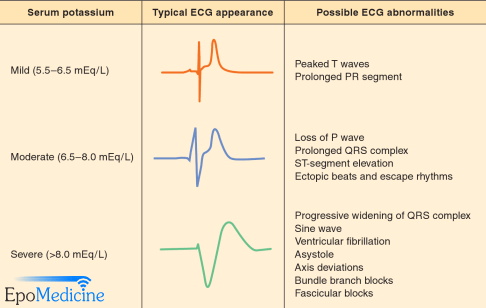
ECG changes in Hyperkalemia
  • Facebook
  • Twitter
PGMEE, MRCS, USMLE, MBBS, MD/MS Internal medicinePediatricsRenal and Electroloyte

Post navigation

Previous post
Next post

Related Posts

PGMEE, MRCS, USMLE, MBBS, MD/MS

Acute Stroke Management : Mnemonic Approach

Aug 28, 2019Aug 28, 2019

Mnemonic: BRAIN ATTACK a. Blood pressure: Antihypertensives are recommended only in following conditions: SBP >220 mmHg, DBP >120 mmHg or MAP >130 mmHg (Target SBP reduction by 15% in 1st 24 hours) End organ damage: Acute MI, Aortic dissection, Hypertensive encephalopathy, Severe left ventricular failure Candidates for thrombolysis: SBP >185…

Read More
PGMEE, MRCS, USMLE, MBBS, MD/MS

Anatomy of Tongue : Mnemonics

Apr 29, 2024Apr 29, 2024

Muscles Intrinsic Extrinsic Alter the shape of tongue Attaches tongue to the bone Mnemonic: VIST Mnemonic: Paris St. German Hour 1. Vertical 1. Palatoglossus (Palate) – anatomically a pharyngeal muscle 2. Inferior longitudinal 2. Styloglossus (Styloid) 3. Superior longitudinal 3. Genioglossus (Genial tubercle of mandible) 4. Transverse 4. Hyoglossus (Hyoid)…

Read More
PGMEE, MRCS, USMLE, MBBS, MD/MS fracture

Complications of Fractures

Oct 19, 2020Nov 4, 2022

This is a tabulated compilation for complications of fractures in general which can be immediate, early or delayed and local or generalized/systemic. This topic is commonly tested in exams. Local Systemic Immediate 1. Soft tissue injuries (Skin, Nerve, Vessels, Muscle-tendon) 2. Physeal injury 3. Hemarthrosis 4. Local visceral injury 1….

Read More

Comment

  1. Dr Roshan says:
    Oct 30, 2020 at 12:12 am

    Can available 598 fact’s of high yielding & mnemonics.
    I will be very thankful.

    Reply

Leave a Reply Cancel reply

Your email address will not be published. Required fields are marked *

This site uses Akismet to reduce spam. Learn how your comment data is processed.

Epomedicine. Hyperkalemia Management – Mnemonic Approach [Internet]. Epomedicine; 2020 Oct 24 [cited 2026 Jan 17]. Available from: https://epomedicine.com/medical-students/hyperkalemia-management-mnemonic-approach/.

Pre-clinical (Basic Sciences)

Anatomy

Biochemistry

Community medicine (PSM)

Embryology

Microbiology

Pathology

Pharmacology

Physiology

Clinical Sciences

Anesthesia

Dermatology

Emergency medicine

Forensic

Internal medicine

Gynecology & Obstetrics

Oncology

Ophthalmology

Orthopedics

Otorhinolaryngology (ENT)

Pediatrics

Psychiatry

Radiology

Surgery

RSS Ask Epomedicine

  • What to study for Clinical examination in Orthopedics?
  • What is the mechanism of AVNRT?

Epomedicine weekly

  • About Epomedicine
  • Contact Us
  • Author Guidelines
  • Submit Article
  • Editorial Board
  • USMLE
  • MRCS
  • Thesis
©2026 Epomedicine . All rights reserved.