Hypothalamus is composed of several nuclei with different important functions – hence, it is important and confusing at the same time. I have devised a pictorial or visual mnemonic to make things easier for you.
Hypothalamus is a Cow
Imagine a Crying and Farting Cow when recalling the Hypothalamus.
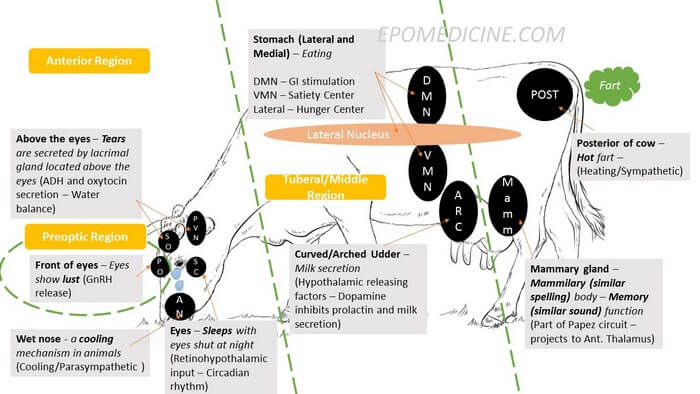
Preoptic: Front of eyes (Eyes show lust)
- GnRH secretion
Supra-optic: Above eyes (Lacrimal gland is Above eyes and secrete tears)
- Water balance
Supra-chiasmatic: The eyes (Closes when sleeping during night)
- Circadian rhythm
Anterior nucleus: Wet nose (Cooling system in animals)
- Cooling/parasympathetic
Medial and Lateral nuclei: Stomach (Eating)
- Lateral nuclei – Hunger center
- Ventromedial nuclei (VMN) – Satiety center
- Dorsomedial nuclei (DMN) – Gastrointestinal stimulation
Arcuate nucleus: Curved or Arched Udder (Milk secretion)
- Hypothalamic releasing factors including Dopamine which inhibits Prolactin and milk secretion
Posterior nucleus: Farting posterior of cow (Heat)
- Heating/Sympathetic
Mammillary bodies: Mammary of Cow (Memory)
- Mammillary and Mammary have similar looking spellings
- Mammary and Memory have similar sounds.
- It is a part of papez circuit involved in Memory. Mammillary bodies receives efferent from hippocapmpus via fornix and project efferent fibers to Anterior nucleus of Thalamus via Mammilothalamic tract.
Match this with Real Hypothalamus
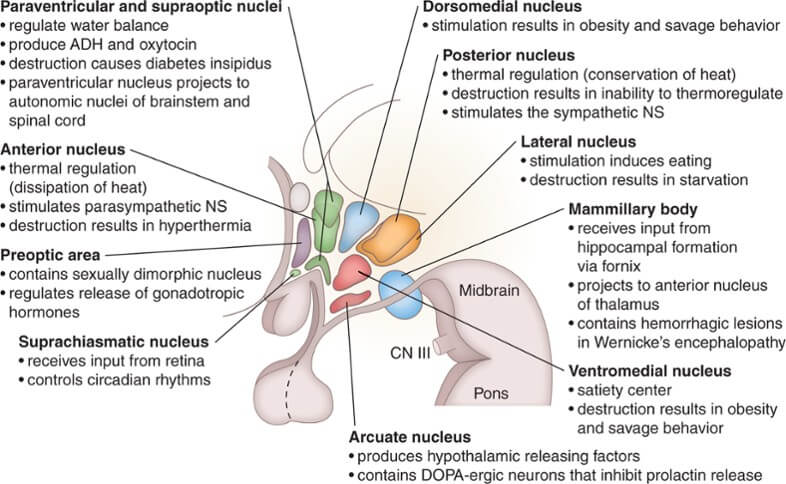
Lesions of Hypothalamus
1. Lateral nucleus:
- Hunger center inhibited by Leptin
- Damage leads to Anorexia and Aphagia.
2. Ventromedial nucleus (VMN):
- Satiety center stimulated by Leptin
- Damage leads to Hyperphagia and Obesity.
3. Anterior hypothalamus:
- Cooling center which senses elevated body temperature and mediates response to dissipate heat via parasympathetic input.
- Damage leads to Hyperthermia.
4. Posterior hypothalamus:
- Heating center which senses decreased body temperature and mediates the conservation of heat via sympathetic input.
- Damage leads to Poikilothermia (inability to regulate temperature).
5. Mammillary bodies:
- Part of papez circuit involved in memory.
- Damaged in Korsakoff syndrome (thiamine deficiency in chronic alcoholism) leading to both anterograde and retrograde amnesia with confabulations.
5. Arcuate nucleus:
- Produce releasing hormones and inhibitory factors, which pass through hypophyseal-portal veins to reach anterior pituitary gland.
- Dopaminergic projections from arcuate nuclei inhibit prolactin secretion from anterior pituitary.
- Damage leads to galactorrhea (milk discharge) and amenorrhea.
6. Preoptic nucleus:
- GnRH release which stimulates release of LH and FSH.
- Damage before puberty leads to arrest of sexual development.
- Damage after puberty leads to amenorrhea and impotence.
7. Paraventricular and Supraoptic nuclei:
- Synthesizes neuropeptides ADH and oxytocin which are transported via supraopticohypophyseal tract to Posterior pituitary and stored there.
- Damage leads to Diabetes insipidus characterized by polydipsia and polyuria.
8. Suprachiasmatic nucleus:
- Some of the periodic activities of mammals controlled by the Suprachiasmatic Nucleus are length and time of sleep, hormone levels, activity, body temperature, digestive functions etc.
- Damage leads to damage to the periodicity of these activities.

He is the section editor of Orthopedics in Epomedicine. He searches for and share simpler ways to make complicated medical topics simple. He also loves writing poetry, listening and playing music. He is currently pursuing Fellowship in Hip, Pelvi-acetabulum and Arthroplasty at B&B Hospital.
very greatful to you sir .Thanks
Very good creativity ,sir
Very helpful for us
i find it very funny that you are indian and you chose a cow of all animals to represent this
thanks btw
thanks a ton
I was struggling in remembering them. Now it is pretty easy. Thanks a lot sir
Thank you so much for this, doctor!
Thank you so much for such beautiful information.
Good article on brainstem. Could u be kind enough to let us know the source of the “real hypothalamus” picture? I couldnt find a higher resolution image for my notes thats why
Very intelligent, good and nice write-up,may Allah continue bless you sir
Well, I can definitely say I got a kick out of this one 🙂
It was simply awesome ,clear and understandable in a quick view .thankyou sir