Skip to content
Epomedicine

Mnemonics, Simplified Concepts & Thoughts

Epomedicine

Mnemonics, Simplified Concepts & Thoughts

lung volumes and capacities

Lung Volumes and Capacities : Mnemonic

Epomedicine, Jul 10, 2018

Mnemonic: 6 LITERs

Lung Capacity (TLC = 6L) = Inspiratory reserve volume (IRV = 3.3 L) + Tidal volume (TV = 0.5 L) + Expiratory reserve volume (ERV = 1 L) + Reserve volume (RV = 1.2 L)

Mnemonic: There are 4 lung volumes that do not overlap and 4 lung capacities that overlap.
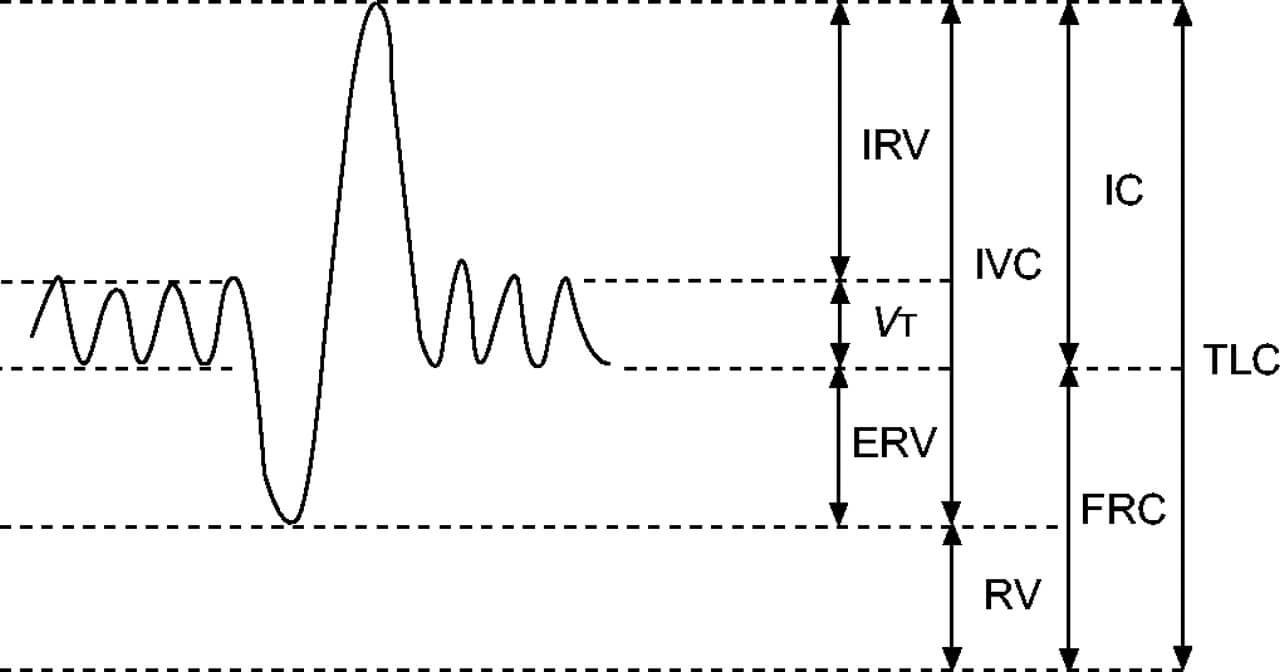
lung volumes and capacities

Lung volumes

1. Tidal volume (TV): Air inhaled and exhaled during quiet breathing

2. Inspiratory reserve volume (IRV): Maximum volume of air that can be inspired in excess of normal inspiration

3. Expiratory reserve volume (ERV): Maximum volume of air that can be expired in excess of normal expiration

4. Residual volume (RV): Volume remaining after maximal expiration

Lung capacities

1. Inspiratory capacity (IC) = TV + IRV

2. Vital capacity (VC) = TV + IRV + ERV or IC + ERV

3. Functional Residual Capacity (FRC) = ERV + RV

4. Total lung capacity (TLC) = IRV + TV + ERV + RV or IC + FRC
  • Facebook
  • Twitter
PGMEE, MRCS, USMLE, MBBS, MD/MS PhysiologyRespiratory system

Post navigation

Previous post
Next post

Related Posts

Applied anatomy of Knee Joint

Jan 5, 2014

A. Osteology: 1. Femur: Largest bone in the body Distal femur possess 2 condyles of which the medial one is larger Medial epicondyle is more porminent and supports the adductor tubercle 2. Patella (Knee cap): Largest sesamoid bone Functions: fulcrum for quadriceps protects knee joint enhances lubrication and nutrition of…

Read More
PGMEE, MRCS, USMLE, MBBS, MD/MS antigenic shift and drift

Antigenic Shift and Drift

Apr 5, 2017

Antigenic Drift Nature of antigenic variation: Minor Mechanism: Gradual accumulation of amino acid substitutions due to point mutation in the hemagglutinin (H) and neuraminidase (N) genes. As mutations accumulate, antibodies generated by exposure to previous strains do not neutralize current strains to the same extent, resulting in only limited or…

Read More
PGMEE, MRCS, USMLE, MBBS, MD/MS CSF circulation

CSF Circulation Made Simple

Jul 17, 2016Jun 15, 2018

Cerebrospinal Fluid (CSF) Production and Absorption CSF is produced by the choroid plexus that lines the ventricles. Choroid plexus = Infoldings of blood vessels of piamater + Modified ciliated ependymal cells Tight junctions of the choroid plexus cells form Blood-CSF barrier. CSF is reabsorbed by arachnoid granulations to enter dural…

Read More

Leave a Reply Cancel reply

Your email address will not be published. Required fields are marked *

This site uses Akismet to reduce spam. Learn how your comment data is processed.

Pre-clinical (Basic Sciences)

Anatomy

Biochemistry

Community medicine (PSM)

Embryology

Microbiology

Pathology

Pharmacology

Physiology

Clinical Sciences

Anesthesia

Dermatology

Emergency medicine

Forensic

Internal medicine

Gynecology & Obstetrics

Oncology

Ophthalmology

Orthopedics

Otorhinolaryngology (ENT)

Pediatrics

Psychiatry

Radiology

Surgery

RSS Ask Epomedicine

  • What to study for Clinical examination in Orthopedics?
  • What is the mechanism of AVNRT?

Epomedicine weekly

  • About Epomedicine
  • Contact Us
  • Author Guidelines
  • Submit Article
  • Editorial Board
  • USMLE
  • MRCS
  • Thesis
©2026 Epomedicine | WordPress Theme by SuperbThemes