Skip to content
Epomedicine

Mnemonics, Simplified Concepts & Thoughts

Epomedicine

Mnemonics, Simplified Concepts & Thoughts

Proapoptotic and Antiapoptotic

Apoptosis (Caspases and Genes) : Mnemonics

Epomedicine, Jan 5, 2017Aug 13, 2023

Caspases (Pro-apoptotics)

Initiator caspases:

  1. Intrinsic – 9 (IN for nINe); also 2 (Roman numeral II – I for Intrinsic)
  2. Extrinsic – 8 (E for Eight); also 10 (Roman numeral X – X for eXtrinsic)

Executioner caspases: 3 and 7

  • Executioner is synonymous to hangman.
  • Remember the gallow – it resembles “7“.
  • Executioner starts with “E” – reverse of E is 3 (most important).

Pro-apoptotic genes

Mnemonic: “B” followed by a vowel

  1. BAX
  2. BAD
  3. BAK
  4. BIM
  5. BID
  6. BIK
  7. BOK

Exception: BCL-XS is pro-apoptotic.

Others: CDEFgH

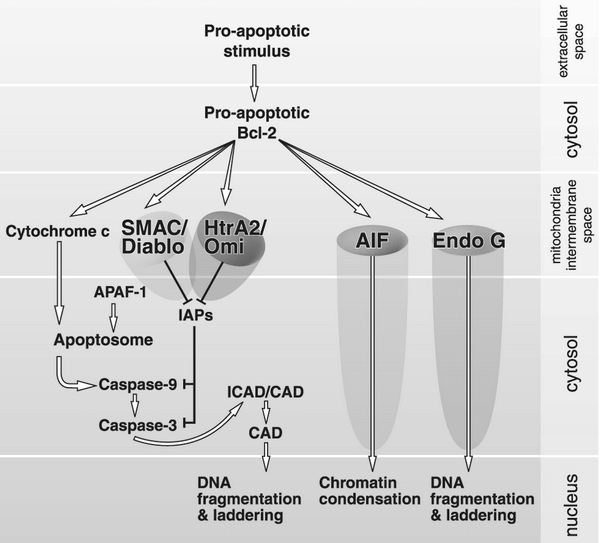
  1. Cytochrome C
  2. Diablo/Smac (Inhibits inhibitor of apoptosis)
  3. Endonuclease G
  4. Fas
  5. HtrA2
Proapoptotic and Antiapoptotic

Anti-apoptotic genes

Mnemonic: Contains “L” or “XL”

  1. BCL-2
  2. BCL-XL
  3. MCL-1
  4. BCL-W
  5. MCL-1

Other: Inhibitor of Apoptosis (XIAP)

How all these genes and molecules work together to complete apoptosis? Find it here.
18 shares
  • Facebook18
  • Twitter
PGMEE, MRCS, USMLE, MBBS, MD/MS General conceptsPathology

Post navigation

Previous post
Next post

Related Posts

PGMEE, MRCS, USMLE, MBBS, MD/MS rVSV-ZEBOV

Ebola Virus Disease

Feb 19, 2016May 5, 2016

Author: Sulabh Kumar Shrestha, KISTMCTH The “Red Death” had long devastated the country. No pestilence had ever been so fatal, or so hideous. Blood was its Avatar and its seal—the redness and the horror of blood. There were sharp pains, and sudden dizziness, and then profuse bleeding at the pores, with dissolution. The scarlet stains…

Read More
PGMEE, MRCS, USMLE, MBBS, MD/MS

Dog bite wounds : Primary closure or Delayed closure?

Sep 7, 2020Sep 13, 2020

A study of 50 dog bite wounds revealed that the commonest colonizing: Aerobic micro-organisms are: Pasteurella (50%), Streptococcus (46%), Staphylococcus (46%), Neisseria (32%), and Corynebacterium (12%), Eikenella corrodens (2%) Anaerobic micro-organisms are: Fusobacterium nucleatum (16%), Bacteroides tectus (14%), Prevotella heparinolytica (14%), Propionibacterium acnes (14%), Prevotella intermedia (8%), Peptostreptococcus anaerobius (8%),…

Read More
PGMEE, MRCS, USMLE, MBBS, MD/MS visual cycle

Visual cycle – Simplified

May 31, 2019May 31, 2019

11-cis-retinal combines with opsin protein to form rhodopsin. Light stimulates conversion of rhodopsin bound 11-cis-retinal to all-trans-retinol (all-trans-retinol is transported from photoreceptor cells to retinal pigment epithelium), which subsequently dissociates from opsin (bleaching), leading to membrane depolarization and initiation of action potential in photoreceptors in the neural retina. Once in…

Read More

Leave a Reply Cancel reply

Your email address will not be published. Required fields are marked *

This site uses Akismet to reduce spam. Learn how your comment data is processed.

Pre-clinical (Basic Sciences)

Anatomy

Biochemistry

Community medicine (PSM)

Embryology

Microbiology

Pathology

Pharmacology

Physiology

Clinical Sciences

Anesthesia

Dermatology

Emergency medicine

Forensic

Internal medicine

Gynecology & Obstetrics

Oncology

Ophthalmology

Orthopedics

Otorhinolaryngology (ENT)

Pediatrics

Psychiatry

Radiology

Surgery

RSS Ask Epomedicine

  • What to study for Clinical examination in Orthopedics?
  • What is the mechanism of AVNRT?

Epomedicine weekly

  • About Epomedicine
  • Contact Us
  • Author Guidelines
  • Submit Article
  • Editorial Board
  • USMLE
  • MRCS
  • Thesis
©2026 Epomedicine | WordPress Theme by SuperbThemes