Skip to content
Epomedicine

Mnemonics, Simplified Concepts & Thoughts

Epomedicine

Mnemonics, Simplified Concepts & Thoughts

bedbug diseases

Medical Significance of Bedbugs

Epomedicine, Sep 1, 2017Oct 26, 2022

Two species of bedbugs bite people: the common bedbug (Cimex lenticularis) and the tropical bedbug (Cimex hemipterous). These bugs are called udus (उडुस) in Nepali and khatmal (खटमल) in Hindi language. The adult bedbug is the approximate size, shape, and color of an apple seed. They are more commonly associated with conditions of poor hygiene and overcrowding. They hide during the day, usually close to human sleeping quarters, and come out to feed at night. Thier lifespan is 6-7 months and can survive without food for that long. All stages in the lifecycle of bedbugs rely exclusively on blood for nutrition. They reach adulthood in about 1 month. They possess stink glands and emit odor giving distinct odor to heavily infested rooms. They take about 5-10 minutes to obtain a full blood meal.

Medical significance of bedbugs
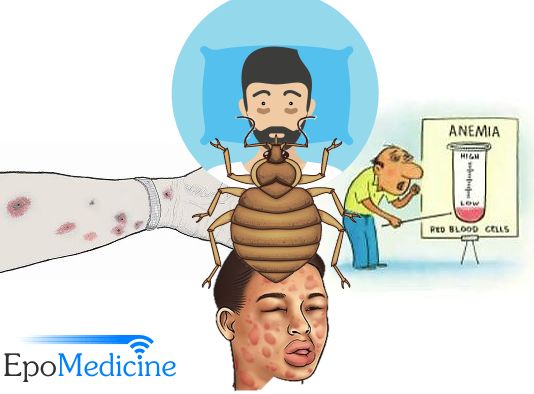
bedbug diseases

Skin lesions

Morphology: Typically, pruritic (itchy) erythematous (red) maculopapule, 0.5-2 cm in diameter, with a central hemorrhagic crust or vesicle at the bite site (similar to arthropod bites) 1Delaunay, P., Blanc, V., Del Giudice, P., Levy-Bencheton, A., Chosidow, O., Marty, P., & Brouqui, P. (2011). Bedbugs and Infectious Diseases. Clinical Infectious Diseases: An Official Publication of the Infectious Diseases Society of America, 52(2), 200–210. http://doi.org/10.1093/cid/ciq102

Site: Often concentrated on unclothed zones – arms, legs, face (around eyes) or back

Arrangement: Often in linear arrangement (often aligned 3 in a row, giving rise to colloquialism – breakfast, lunch and dinner) or cluster 2Pediatric Dermatology E-Book By Lawrence A. Schachner, Ronald C. Hansen

Resolution: Lesions resolve in a week if not abraded

Can be complicated by: Excoriations and secondary infections

Others:

  1. Localized urticaria (wheals)
  2. Vesicles and bulla containing clear or bloody exudate

Psychological or Emotional effects

  1. Loss of sleep
  2. Anxiety
  3. Worsening of existing mental health

Systemic reactions

  1. Asthma exacerbation
  2. Generalized urticaria
  3. Anaphylaxis 3Parasitic Pathogens edited by Dongyou Liu

Anemia

Few studies have shown bedbugs to be possible cause of iron deficiency anemia due to blood loss when the infestation is massive. Anemia due to excessive bedbug bites have been reported in following cases:

  1. Infants and children in Hyderabad, India 4Venkatachalam PS, Belavady B. 1962. Loss of haemoglobin iron due to excessive biting by bed bugs. A possible aetiological factor in the iron deficiency anaemia of infants and children. Trans. R. Soc. Trop. Med. Hyg. 56: 218–221.
  2. Severe anemia in 60-year-old patient where no other identifiable cause 5Pritchard, M. J., & Hwang, S. W. (2009). Severe anemia from bedbugs. CMAJ : Canadian Medical Association Journal, 181(5), 287–288. http://doi.org/10.1503/cmaj.090482
  3. A 60-year-old woman and her 67-year-old male partner, admitted for pneumonia and non-ST elevation myocardial infarction, respectively, had severe anaemia (Hb 5.3 and 5.2 g/dL, respectively), as a result from massive infestation with Cimex lectularius. 6ere anaemia in adults. Parasitol Res. 2012 Jun;110(6):2577-9. doi:10.1007/s00436-011-2777-6. Epub 2011 Dec 22. PubMed PMID: 22190128.

Infectious diseases

Bedbugs have been found naturally infected with >20 diseases such as those causing anthrax, plague, hepatitis, typhus and HIV. However, they have not been implicated in disease transmission so far. However, few researches have shown bed bug to be possible vectors for Chaga’s disease. In a study supported by University of Pennsylvania, bed bugs were shown to acquire T.cruzi and transmit it to susceptible host during cohabitation and through contaminated feces placed on broken host skin by researchers.7Salazar, R., Castillo-Neyra, R., Tustin, A. W., Borrini-Mayorí, K., Náquira, C., & Levy, M. Z. (2015). Bed Bugs (Cimex lectularius) as Vectors of Trypanosoma cruzi. The American Journal of Tropical Medicine and Hygiene, 92(2), 331–335. http://doi.org/10.4269/ajtmh.14-0483

22 shares
  • Facebook22
  • Twitter
Clinical Skills and Approaches DermatologyMicrobiology

Post navigation

Previous post
Next post

Related Posts

Clinical Skills and Approaches kramers chart neonatal jaundice

Icterus

Nov 16, 2013Aug 18, 2017

Synonyms: Jaundice Definition of Icterus Icterus is the yellowish discoloration of skin and mucous membrane and body fluids (CSF, joint fluid, cysts) evident as a result of hyperbilirubinemia with subsequent deposition of bile pigments in tissue which is rich in elastin. The Greeks claimed the sight of an oriole would…

Read More
Clinical Skills and Approaches pronator drift positive

Pronator Drift (Barre’s sign) : Neurological Examination

Jan 22, 2016Jun 18, 2016

Components of pronator drift Progress from distal to proximal: Downward arm drift Forearm pronation Flexion of the wrist and elbow Method of assessment for pronator drift When the patient extends both arms upright in the supinated position and hold them at shoulder height for atleast 10 seconds (Patients should be…

Read More
Clinical Skills and Approaches renal angle tenderness

Costovertebral or Renal angle tenderness

Jul 26, 2019Jul 26, 2019

Synonyms: Murphy’s kidney punch, CVA tenderness (CVAT) Anatomy of Costovertebral angle or Renal angle: Costovertebral angle is formed by the junction of the 12th, or lowermost, rib with the paravertebral muscles, which run parallel to and on both sides of the vertebral column. Eliciting costovertebral angle tenderness: Position of patient:…

Read More

Leave a Reply Cancel reply

Your email address will not be published. Required fields are marked *

This site uses Akismet to reduce spam. Learn how your comment data is processed.

Pre-clinical (Basic Sciences)

Anatomy

Biochemistry

Community medicine (PSM)

Embryology

Microbiology

Pathology

Pharmacology

Physiology

Clinical Sciences

Anesthesia

Dermatology

Emergency medicine

Forensic

Internal medicine

Gynecology & Obstetrics

Oncology

Ophthalmology

Orthopedics

Otorhinolaryngology (ENT)

Pediatrics

Psychiatry

Radiology

Surgery

RSS Ask Epomedicine

  • What to study for Clinical examination in Orthopedics?
  • What is the mechanism of AVNRT?

Epomedicine weekly

  • About Epomedicine
  • Contact Us
  • Author Guidelines
  • Submit Article
  • Editorial Board
  • USMLE
  • MRCS
  • Thesis
©2026 Epomedicine | WordPress Theme by SuperbThemes