Skip to content
Epomedicine

Mnemonics, Simplified Concepts & Thoughts

Epomedicine

Mnemonics, Simplified Concepts & Thoughts

erythropoiesis

Erythropoiesis Simplified

Epomedicine, Sep 2, 2017Sep 2, 2017

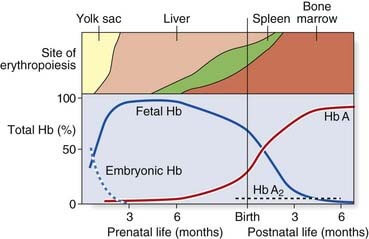
Hemoglobin Switching mnemonics

1st to appear: Embryonic hemoglobin (Gower and Portland)

Switch from fetal hemoglobin to adult hemoglobin: “Gamma goes, Beta becomes, Alpha always”

  • Fetal hemoglobin: α2γ2
  • Adult hemoglobin: α2β2
ζ chain α chain
ε chain HbE Gower 1 HbE Gower 2
γ chain HbE Portland I HbF
β chain HbE Portland II HbA
δ chain N/A HbA2

hemoglobin switching

Mnemonic for 4 sites of erythropoiesis

“Young Liver Synthesizes The Blood”

  1. Yolk sac: 3-8 weeks
  2. Liver: 6-30 weeks
  3. Spleen and Thymus: 9-28 weeks
  4. Bone marrow: 28 weeks to adult

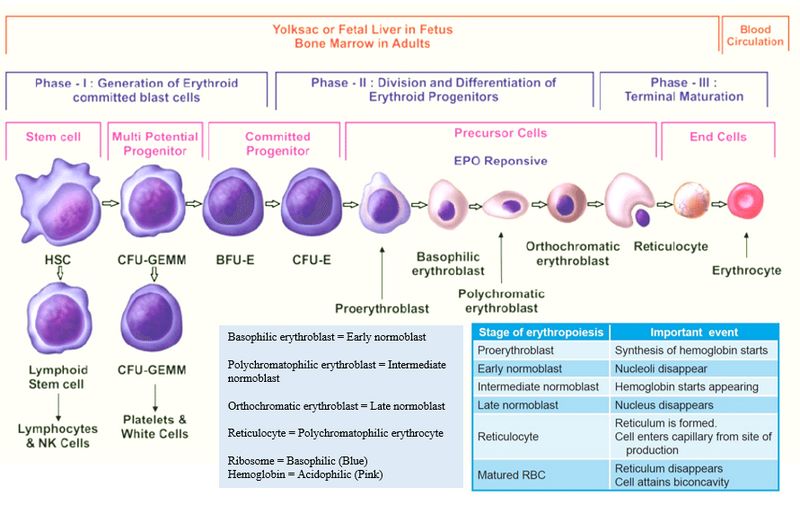
Erythropoiesis Stages Mnemonic

“Powerful Businesses Pollute Our Reeling Environment” OR

Just remember “PB PORE”

  1. Proerythroblast or Pronormoblast (Rubriblast)
  2. Basophilic normoblast (Macroblast or Early normoblast or rubricyte)
  3. Polychromatic normoblast (Intermediate normoblast)
  4. Orthochromatic normoblast (Normoblast or Late normoblast or metarubricyte)
  5. Reticulocyte (Polychromatic erythrocyte)
  6. Erythrocyte

erythropoiesis

Remember the duration of erythropoiesis from proerythroblast to erythrocyte is 6-8 days (average 7 days).

  • Proerythroblast to Reticulocyte = 4 days (1 day for each)
  • Reticulocyte to erythrocyte = 2 to 4 days (reticulocyte spends 1-2 days in marrow and circulates for 1-2 days in peripheral blood before maturing to erythrocyte)


As the cell matures the following morphological changes take place progressively:

  1. Cell Size: Decreases
  2. Nucleus: Size decreases, chromatin becomes more clumped and the nucleoli disappear
  3. Cytoplasm: Shrinks
  4. Cytoplasmic basophilia decreases:
    • Ribosome (basophilic because of RNA content, i.e. stains blue) appears first
    • Ribosome synthesizes Hemoglobin (acidophilic, i.e. stains pink)
    • As the haemoglobin content approaches the desired levels the number of ribosomes decreases.
    • As erythropoiesis progressess the cytoplasm changes from deep blue (mainly ribosomes) in basophilic normoblast to polychromatophilic (ribosomes and haemoglobin) in polychromatophilic normoblast and resembling that of a erythrocyte (mainly haemoglobin) in orthochromatophilic normoblast.
  5. Cell number: The earliest nucleated stages are least numerous and the later stages the most numerous.
11 shares
  • Facebook11
  • Twitter
PGMEE, MRCS, USMLE, MBBS, MD/MS HematologyPhysiology

Post navigation

Previous post
Next post

Related Posts

PGMEE, MRCS, USMLE, MBBS, MD/MS

Radiological Lines for assessing Basilar Invagination : Mnemonic

Nov 24, 2024Feb 21, 2025

Mnemonic: Imagine a letter “Z“. a. McRae’s line has “R” and is at Roof. b. Chamberlain’s line starts with “C” and is at Center. c. McGregor’s line has “G” and is at Ground. a. McRae’s line (foramen magnum line): drawn from anterior margin of foramen (basion) to posterior margin of…

Read More
PGMEE, MRCS, USMLE, MBBS, MD/MS

Injection site swelling after vaccination in Infants

Mar 11, 2021Mar 11, 2021

Swelling and pain at injection site after vaccination is a frequently observed problem by parents and is often of concern to them. These type of reactions are generally observed after intramuscular vaccine and vaccine containing aluminium component. DPT as pentavalent is a frequent vaccine after which infants develop swelling. Types…

Read More
PGMEE, MRCS, USMLE, MBBS, MD/MS intercellular junctions

Cell-Cell or Interceullular Junctions

May 22, 2019May 22, 2019

Junction Location Composition Function Remarks Tight junction (Zonula occludens) Epithelial cell-Epithelial cell Claudin and Occludin (attaches to cytoskeleton – actin filament) Prevents paracellular movement of solutes and diffusion Adherens junction (Zonula adherens) Epithelial cell-Epithelial cell E-cadherin (attaches to cytoskeleton – actin filament) Belt desmosome (Anchoring) Cadherins are Ca2+ depndend adhesion…

Read More

Comment

  1. ED NOISIN says:
    Aug 23, 2025 at 10:48 pm

    AWESOME SUMMARY OR ERYTHROPOIESIS!

    Reply

Leave a Reply to ED NOISIN Cancel reply

Your email address will not be published. Required fields are marked *

This site uses Akismet to reduce spam. Learn how your comment data is processed.

Epomedicine. Erythropoiesis Simplified [Internet]. Epomedicine; 2017 Sep 2 [cited 2026 Jan 14]. Available from: https://epomedicine.com/medical-students/erythropoiesis-simplified/.

Pre-clinical (Basic Sciences)

Anatomy

Biochemistry

Community medicine (PSM)

Embryology

Microbiology

Pathology

Pharmacology

Physiology

Clinical Sciences

Anesthesia

Dermatology

Emergency medicine

Forensic

Internal medicine

Gynecology & Obstetrics

Oncology

Ophthalmology

Orthopedics

Otorhinolaryngology (ENT)

Pediatrics

Psychiatry

Radiology

Surgery

RSS Ask Epomedicine

  • What to study for Clinical examination in Orthopedics?
  • What is the mechanism of AVNRT?

Epomedicine weekly

  • About Epomedicine
  • Contact Us
  • Author Guidelines
  • Submit Article
  • Editorial Board
  • USMLE
  • MRCS
  • Thesis
©2026 Epomedicine . All rights reserved.