Skip to content
Epomedicine

Mnemonics, Simplified Concepts & Thoughts

Epomedicine

Mnemonics, Simplified Concepts & Thoughts

Elbow Anastomoses : Mnemonic

Epomedicine, Mar 14, 2021Mar 14, 2021

First things first. It is essential to understand the meaning of collateral and recurrent arteries. Recurrent arteries turn back so as to reverse direction. Collateral arteries refer to side branches of the major arteries.
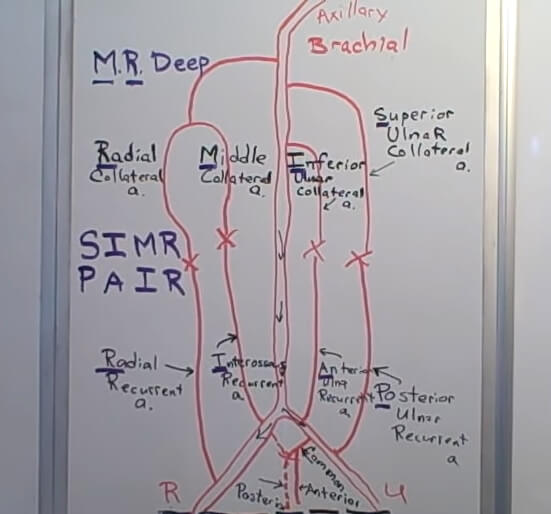
elbow anastomoses mnemonic

Mnemonic: M.R. Deep

On the posterior aspect of the shaft of the humerus:

Profunda brachii (Deep branch of brachial artery) branches into a middle and a radial collateral artery.

Similarly:

Brachial artery gives off a superior ulnar collateral artery (about 1-2 cm below profunda brachii) and an inferior ulnar collateral artery (about 1 cm above the medial supracondylar ridge).

Mnemonic: SIMR – PAIR

  1. Superior ulnar collateral artery ↔ Posterior ulnar recurrent artery (Deep antecubital fossa)
  2. Inferior ulnar collateral artery ↔ Anterior ulnar recurrent artery (Deep antecubital fossa)
  3. Middle collateral artery ↔ Interosseous recurrent artery from posterior interosseous artery (Lateral supracondylar ridge)
  4. Radial collateral artery ↔ Radial recurrent artery (Deep antecubital fossa)

About 1 inch below antecubital fossa, brachial artery divides into radial & ulnar artery.
About 1 inch below the origin of the ulnar artery, the common interosseous artery arises and subsequently divides into an anterior and posterior branch. Posterior branch gives off interosseous recurrent artery.
Risk of amputation is 50% with ligation of brachial artery proximal to profunda brachii artery and 25% with that below the profunda brachii artery.
  • Facebook
  • Twitter
PGMEE, MRCS, USMLE, MBBS, MD/MS AnatomyCardiovascular systemMusculoskeletal system

Post navigation

Previous post
Next post

Related Posts

PGMEE, MRCS, USMLE, MBBS, MD/MS choosing hypoglycemics

Approach to Uncomplicated Diabetes Mellitus : Simplified

Feb 19, 2016Jun 12, 2016

A) GLUCOSE LEVEL 1. Post-prandial: 140-200 mg/dl: Impaired glucose tolerance (Pre-diabetes) Diabetes prevented with: weight loss, exercise, metformin (in high risk) ≥200 mg/dl (+ Clinical symptoms): Diabetes confirmed 2. Fasting: 100-126 mg/dl: Impaired fasting glucose (Pre-diabetes) ≥126 mg/dl (+ Clinical symptoms): Diabetes confirmed

Read More
PGMEE, MRCS, USMLE, MBBS, MD/MS thalamus structure

Thalamic Connections Mnemonic

Jul 16, 2016Aug 4, 2023

Structure of Thalamus A vertical “Y” shaped white mater – internal medullary lamina divides thalamus into: In anatomical position: Pulvinar = Posterior end or posterior pole of thalamus Thalamic Connections Picture mnemonic Remember the schematic diagram drawn below showing important parts of thalamus in an anticlockwise fashion: Now, we assign…

Read More
PGMEE, MRCS, USMLE, MBBS, MD/MS tnm breast cancer

TNM and Staging of Breast Cancer Simplified

Aug 14, 2016Aug 14, 2016

TNM Classification for Breast Cancer Primary Tumor (T) T1: ≤2 cm (20 mm) mi: ≤1 mm a: 1-5 mm b: 5-10 mm c: 10-20 mm T2: 2-5 cm T3: >5 cm T4: Direct extension to chest wall and/or skin a: Chest wall (exclude only pectoralis muscle adherence/invasion) b: Ipsilateral ulceration, satellite nodules…

Read More

Comments (4)

  1. Atsu Selase says:
    Mar 19, 2022 at 11:07 pm

    This was very very helpful.

    Reply
    1. Danny says:
      Mar 20, 2022 at 2:37 pm

      Ei Afia hahahaha. IT VERY HELPFUL mmom

      Reply
  2. Hybrid says:
    Jun 12, 2025 at 4:50 pm

    This is very helpful 🥹

    Reply
  3. Jada Lumbercle says:
    Aug 2, 2025 at 2:06 am

    Bless you, sir!

    Reply

Leave a Reply Cancel reply

Your email address will not be published. Required fields are marked *

This site uses Akismet to reduce spam. Learn how your comment data is processed.

Epomedicine. Elbow Anastomoses : Mnemonic [Internet]. Epomedicine; 2021 Mar 14 [cited 2026 Sep 12]. Available from: https://epomedicine.com/medical-students/elbow-anastomoses-mnemonic/.

Pre-clinical (Basic Sciences)

Anatomy

Biochemistry

Community medicine (PSM)

Embryology

Microbiology

Pathology

Pharmacology

Physiology

Clinical Sciences

Anesthesia

Dermatology

Emergency medicine

Forensic

Internal medicine

Gynecology & Obstetrics

Oncology

Ophthalmology

Orthopedics

Otorhinolaryngology (ENT)

Pediatrics

Psychiatry

Radiology

Surgery

RSS feed: Ask Epomedicine Ask Epomedicine

  • What to study for Clinical examination in Orthopedics?
  • What is the mechanism of AVNRT?

Epomedicine weekly

  • About Epomedicine
  • Contact Us
  • Author Guidelines
  • Submit Article
  • Editorial Board
  • USMLE
  • MRCS
  • Thesis
©2026 Epomedicine | WordPress Theme by SuperbThemes