Skip to content
Epomedicine

Mnemonics, Simplified Concepts & Thoughts

Epomedicine

Mnemonics, Simplified Concepts & Thoughts

Elbow Anastomoses : Mnemonic

Epomedicine, Mar 14, 2021Mar 14, 2021

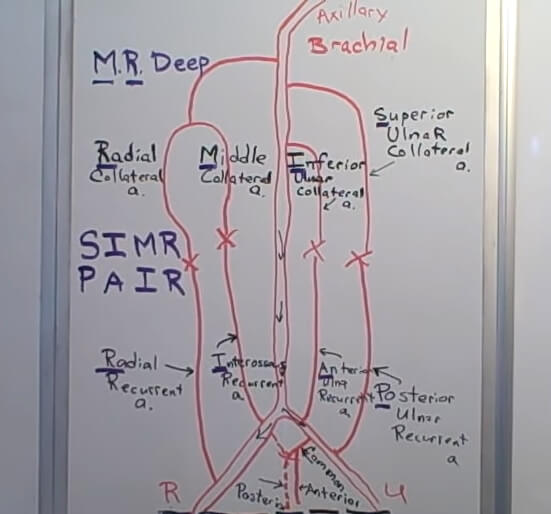
First things first. It is essential to understand the meaning of collateral and recurrent arteries. Recurrent arteries turn back so as to reverse direction. Collateral arteries refer to side branches of the major arteries.
elbow anastomoses mnemonic

Mnemonic: M.R. Deep

On the posterior aspect of the shaft of the humerus:

Profunda brachii (Deep branch of brachial artery) branches into a middle and a radial collateral artery.

Similarly:

Brachial artery gives off a superior ulnar collateral artery (about 1-2 cm below profunda brachii) and an inferior ulnar collateral artery (about 1 cm above the medial supracondylar ridge).

Mnemonic: SIMR – PAIR

  1. Superior ulnar collateral artery ↔ Posterior ulnar recurrent artery (Deep antecubital fossa)
  2. Inferior ulnar collateral artery ↔ Anterior ulnar recurrent artery (Deep antecubital fossa)
  3. Middle collateral artery ↔ Interosseous recurrent artery from posterior interosseous artery (Lateral supracondylar ridge)
  4. Radial collateral artery ↔ Radial recurrent artery (Deep antecubital fossa)

About 1 inch below antecubital fossa, brachial artery divides into radial & ulnar artery.
About 1 inch below the origin of the ulnar artery, the common interosseous artery arises and subsequently divides into an anterior and posterior branch. Posterior branch gives off interosseous recurrent artery.
Risk of amputation is 50% with ligation of brachial artery proximal to profunda brachii artery and 25% with that below the profunda brachii artery.
  • Facebook
  • Twitter
PGMEE, MRCS, USMLE, MBBS, MD/MS AnatomyCardiovascular systemMusculoskeletal system

Post navigation

Previous post
Next post

Related Posts

PGMEE, MRCS, USMLE, MBBS, MD/MS cellular adaptations

Cellular Adaptations

Jun 17, 2016Aug 31, 2018

Hypertrophy, Hyperplasia, Atrophy and Metaplasia are the main four types of cellular adaptations. Adaptations are: Reversible changes In the number, size, phenotype, metabolic activity or functions of cells In response to the changes in the environment (stress).   Hypertrophy Definition: Increase in cell size Occurs in: non-dividing (permanent) cells: cardiac and…

Read More
PGMEE, MRCS, USMLE, MBBS, MD/MS

Coronary Arteries : Mnemonic

Jun 12, 2023Jun 12, 2023

Right coronary artery (RCA) Course: Branches: Mnemonic: TRaP Me IN Large: Small: Left coronary artery (LCA) Course: Branches: Mnemonic: LaTe PAD Large: Left Anterior Descending (LAD) artery – Small: Arterial supply of conducting system of heart 1. RCA: SA node, AV node, AV bundle 2. LCA: Right bundle branch of…

Read More
PGMEE, MRCS, USMLE, MBBS, MD/MS

Rosacea: Etiopathogenesis, Diagnosis and Management

Nov 11, 2013Sep 26, 2021

Synonyms: Rosacea acne, Adult acne, Rhinophyma Defintion: A chronic and recurrent inflammatory disorder of the pilosebaceous units and vasculature of the face characterized by erythema and telangiectases and punctuated by acute episodes of papules, pustules and swelling. Rosacea is a disorder of sebaceous gland. Learn the anatomy and physiology of sebaceous gland. Classification:…

Read More

Comments (4)

  1. Atsu Selase says:
    Mar 19, 2022 at 11:07 pm

    This was very very helpful.

    Reply
    1. Danny says:
      Mar 20, 2022 at 2:37 pm

      Ei Afia hahahaha. IT VERY HELPFUL mmom

      Reply
  2. Hybrid says:
    Jun 12, 2025 at 4:50 pm

    This is very helpful 🥹

    Reply
  3. Jada Lumbercle says:
    Aug 2, 2025 at 2:06 am

    Bless you, sir!

    Reply

Leave a Reply to Hybrid Cancel reply

Your email address will not be published. Required fields are marked *

This site uses Akismet to reduce spam. Learn how your comment data is processed.

Pre-clinical (Basic Sciences)

Anatomy

Biochemistry

Community medicine (PSM)

Embryology

Microbiology

Pathology

Pharmacology

Physiology

Clinical Sciences

Anesthesia

Dermatology

Emergency medicine

Forensic

Internal medicine

Gynecology & Obstetrics

Oncology

Ophthalmology

Orthopedics

Otorhinolaryngology (ENT)

Pediatrics

Psychiatry

Radiology

Surgery

RSS Ask Epomedicine

  • What to study for Clinical examination in Orthopedics?
  • What is the mechanism of AVNRT?

Epomedicine weekly

  • About Epomedicine
  • Contact Us
  • Author Guidelines
  • Submit Article
  • Editorial Board
  • USMLE
  • MRCS
  • Thesis
©2026 Epomedicine | WordPress Theme by SuperbThemes