Skip to content
Epomedicine

Mnemonics, Simplified Concepts & Thoughts

Epomedicine

Mnemonics, Simplified Concepts & Thoughts

decorticate decerebrate

Decorticate and Decerebrate Rigidity – Mnemonics

Epomedicine, Jun 3, 2019Jun 3, 2019

Rubrospinal tract mediates flexor of the upper arm.
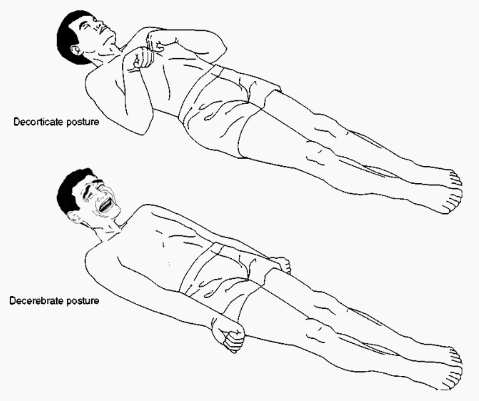
Here is a way to remember these two postures and never forget again.

Decerebrate has more “E” and more “R”.

  1. Extended upper limbs
  2. Rubrospinal tract transected (Red nucleus is above the level of lesion, i.e. below midbrain level)

Decorticate has “COR”.

  1. Upper limbs are brought towards CORE (i.e. flexed)
  2. Loss of CORTICAL inhibition of red nucleus (rubro-spinal tract), i.e. tonic discharge from red nucleus.

Lower limb in extended and plantar flexed in both the cases.
4 shares
  • Facebook4
  • Twitter
PGMEE, MRCS, USMLE, MBBS, MD/MS Internal medicineNervous systemPediatrics

Post navigation

Previous post
Next post

Related Posts

PGMEE, MRCS, USMLE, MBBS, MD/MS neutropenia

Neutropenic Fever and Empiric Therapy

Jul 4, 2016Jul 4, 2016

Synonym: Febrile Neutropenia Definition of Neutropenic Fever Fever: Single oral temperature ≥ 38.3 °c (101 °F) or ≥ 38 °c (100.4 °F) sustained over 1 hour Neutropenia: Absolute Neutrophil Count (ANC) <500 cells/cu.mm or ANC expected to fall <500/cu.mm in next 48 hours Profound neutropenia: ANC <100/cu.mm Prolonged neutropenia: Neutropenia for >7 days…

Read More
PGMEE, MRCS, USMLE, MBBS, MD/MS Brown sequard syndrome

Brown-Sequard Syndrome – Anatomical Basis

Jul 25, 2016Sep 5, 2019

Definition of Brown Sequard Syndrome Neurological syndrome resulting from spinal cord hemisection (damage to one lateral half of spinal cord). Causes of Brown Sequard Syndrome Penetrating trauma Spinal fractures Spinal dislocation Disc herniation Vasculitis Radiation induced injury Clinical Manifestations and Anatomical Basis of Brown Sequard Syndrome 1. Damage of Corticospinal…

Read More
PGMEE, MRCS, USMLE, MBBS, MD/MS voulantary horizontal conjugate gaze

Horizontal Conjugate Gaze Pathway

Jul 27, 2016May 19, 2019

Components of Pathway For both eyes to look at a side: Contralateral Frontal Eye Field (Brodmann area 8) Ipsilateral PPRF (Paramedial Pontine Reticular Formation) Ipsilateral CN VI Nucleus Contralateral Medial Longitudinal Fasciculus (MLF) Contralateral CN III Nucleus Horizontal Conjugate Gaze Pathway Lesions of Conjugate Gaze Pathway Abducens (CN VI) nerve:…

Read More

Comments (6)

  1. Andrew says:
    Sep 11, 2020 at 6:13 pm

    IS THAT THE YAO MING FACE PLEASE ANSWER ME I FEEL LIKE I’M GOING CRAZY

    Reply
    1. Luke says:
      Sep 16, 2020 at 8:36 pm

      its gotta be

      Reply
    2. Johanna says:
      Sep 24, 2020 at 9:21 pm

      Thought I was going crazy too but it absolutely is. How it made its way into this image is beyond me.

      Reply
    3. Lund says:
      Jan 27, 2021 at 12:32 pm

      Yes indeed

      Reply
    4. Coochie says:
      Jun 11, 2022 at 4:15 pm

      Yo is that Yao Ming??

      Reply
  2. Sychomadman says:
    Jul 8, 2021 at 4:48 am

    I see ur a man of culture as well. XD

    Reply

Leave a Reply to Coochie Cancel reply

Your email address will not be published. Required fields are marked *

This site uses Akismet to reduce spam. Learn how your comment data is processed.

Pre-clinical (Basic Sciences)

Anatomy

Biochemistry

Community medicine (PSM)

Embryology

Microbiology

Pathology

Pharmacology

Physiology

Clinical Sciences

Anesthesia

Dermatology

Emergency medicine

Forensic

Internal medicine

Gynecology & Obstetrics

Oncology

Ophthalmology

Orthopedics

Otorhinolaryngology (ENT)

Pediatrics

Psychiatry

Radiology

Surgery

RSS Ask Epomedicine

  • What to study for Clinical examination in Orthopedics?
  • What is the mechanism of AVNRT?

Epomedicine weekly

  • About Epomedicine
  • Contact Us
  • Author Guidelines
  • Submit Article
  • Editorial Board
  • USMLE
  • MRCS
  • Thesis
©2026 Epomedicine | WordPress Theme by SuperbThemes