Skip to content
Epomedicine

Mnemonics, Simplified Concepts & Thoughts

Epomedicine

Mnemonics, Simplified Concepts & Thoughts

decorticate decerebrate

Decorticate and Decerebrate Rigidity – Mnemonics

Epomedicine, Jun 3, 2019Jun 3, 2019

Rubrospinal tract mediates flexor of the upper arm.
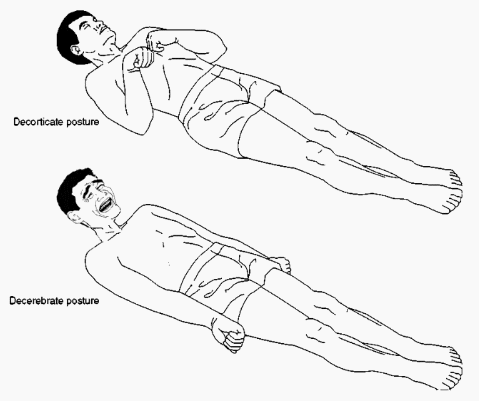
Here is a way to remember these two postures and never forget again.

Decerebrate has more “E” and more “R”.

  1. Extended upper limbs
  2. Rubrospinal tract transected (Red nucleus is above the level of lesion, i.e. below midbrain level)

Decorticate has “COR”.

  1. Upper limbs are brought towards CORE (i.e. flexed)
  2. Loss of CORTICAL inhibition of red nucleus (rubro-spinal tract), i.e. tonic discharge from red nucleus.

Lower limb in extended and plantar flexed in both the cases.

4 shares
  • Facebook4
  • Twitter
PGMEE, MRCS, USMLE, MBBS, MD/MS Internal medicineNervous systemPediatrics

Post navigation

Previous post
Next post

Related Posts

PGMEE, MRCS, USMLE, MBBS, MD/MS

Osteopetrosis : Mnemonic

Jul 20, 2022Jul 20, 2022

Synonyms: Marble bone disease Albers-Schonberg disease (Autosomal dominant form) Mnemonic: OSTEOPETROSIS Osteoclast dysfunction (Carbonic anhydrase II gene mutation or chloride channel dysfunction) Symmetric skeletal sclerosis Thickened cortex with loss of medullary canal diameter (bone in bone appearance) Extramedullary hematopoiesis (aplastic anemia and hepatosplenomegaly) Overgrowth of skull foramina (cranial nerve palsies)…

Read More
PGMEE, MRCS, USMLE, MBBS, MD/MS Submandibular gland

Applied Anatomy of Submandibular Salivary Gland

May 31, 2014Jun 19, 2023

Synonyms: Submaxillary gland (SMG), Mandibular gland Definition: Submandibular glands are one of the major salivary glands comprised of mixed serous and mucous acini and located below the lower border of the body of mandible. It is the second largest salivary gland and produces approximately 70% of the saliva. Location: Submandibular triangle…

Read More
PGMEE, MRCS, USMLE, MBBS, MD/MS wilms tumor

Wilm’s Tumor (Nephroblastoma) : Quick review

Oct 27, 2017Jul 13, 2020

Wilm’s tumor is the most common primary renal tumor of childhood. Origin: Embryonic nephrogenic (mesodermal) cells Mechanism: Deletion of WT-1 gene on chromosome 11 Pathology: a. Macroscopic (Gross): large, solitary tan to grey color mass; pale on cut section with areas of hemorrhage; 10% are bilateral or multicentric; grossly difficult…

Read More

Comments (6)

  1. Andrew says:
    Sep 11, 2020 at 6:13 pm

    IS THAT THE YAO MING FACE PLEASE ANSWER ME I FEEL LIKE I’M GOING CRAZY

    Reply
    1. Luke says:
      Sep 16, 2020 at 8:36 pm

      its gotta be

      Reply
    2. Johanna says:
      Sep 24, 2020 at 9:21 pm

      Thought I was going crazy too but it absolutely is. How it made its way into this image is beyond me.

      Reply
    3. Lund says:
      Jan 27, 2021 at 12:32 pm

      Yes indeed

      Reply
    4. Coochie says:
      Jun 11, 2022 at 4:15 pm

      Yo is that Yao Ming??

      Reply
  2. Sychomadman says:
    Jul 8, 2021 at 4:48 am

    I see ur a man of culture as well. XD

    Reply

Leave a Reply Cancel reply

Your email address will not be published. Required fields are marked *

This site uses Akismet to reduce spam. Learn how your comment data is processed.

Pre-clinical (Basic Sciences)

Anatomy

Biochemistry

Community medicine (PSM)

Embryology

Microbiology

Pathology

Pharmacology

Physiology

Clinical Sciences

Anesthesia

Dermatology

Emergency medicine

Forensic

Internal medicine

Gynecology & Obstetrics

Oncology

Ophthalmology

Orthopedics

Otorhinolaryngology (ENT)

Pediatrics

Psychiatry

Radiology

Surgery

RSS Ask Epomedicine

  • What to study for Clinical examination in Orthopedics?
  • What is the mechanism of AVNRT?

Epomedicine weekly

  • About Epomedicine
  • Contact Us
  • Author Guidelines
  • Submit Article
  • Editorial Board
  • USMLE
  • MRCS
  • Thesis
©2026 Epomedicine | WordPress Theme by SuperbThemes