Skip to content
Epomedicine

Mnemonics, Simplified Concepts & Thoughts

Epomedicine

Mnemonics, Simplified Concepts & Thoughts

Patient Decision Making Capacities – CURVES mnemonic

Epomedicine, Jun 27, 2020May 24, 2024

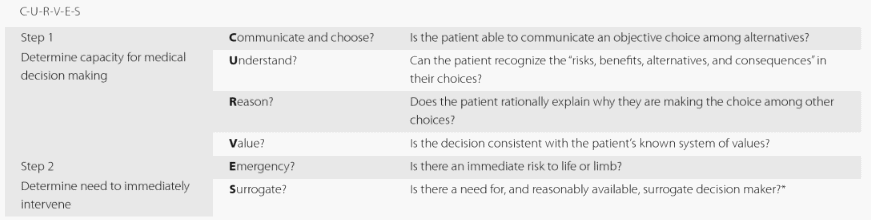
a. Choose and communicate

  • Can the patient make a choice and communicate that choice?

b. Understand

  • Does the patient understand the risks, benefits, alternatives and consequences of the decision?

c. Reason

  • Can the patient provide logic or reason behind his/her decision?

d. Value

  • Is the choice the patient makes consistent with their values?

e. Emergency

  • Is there an impending, emergent risk to the life or limb?

f. Surrogate

  • Is there a decision maker available or advanced directives of the patient?

The first 4 letters (C-U-R-V) assess the Decision-Making Capacity of the patient. A paitent lacks capacity if any of these pre-requisite abilities are absent.

The last 2 letters (E-S) sssess whether emergency treatment can be delivered without Informed Consent. Treating with implied consent is only appropriate when the patient does not have capacity to make the decision (C-U-R-V), it is an Emergency (E), and there is no surrogate decision maker (S) available, i.e. lack all the 6 points of CURVES.

Reference:

Chow GV, Czarny MJ, Hughes MT, Carrese JA. CURVES: a mnemonic for determining medical decision-making capacity and providing emergency treatment in the acute setting. Chest. 2010 Feb;137(2):421-7. doi: 10.1378/chest.09-1133. PMID: 20133288.
18 shares
  • Facebook18
  • Twitter
PGMEE, MRCS, USMLE, MBBS, MD/MS Ethics

Post navigation

Previous post
Next post

Related Posts

PGMEE, MRCS, USMLE, MBBS, MD/MS Facial nerve corticonuclear tract

Facial Nerve Anatomy

May 23, 2014Aug 5, 2023

SYNONYMS: Cranial nerve seven (VII), Nervus facialis Supranuclear pathways 1. Somatomotor cortex: controlling motor component of facial nerve lies in precentral gyrus (Broadmann area 4,6,8) 2. Volitional component: Corticonuclear tracts descend and cross to supply both ipsilateral and contralateral facial (mainly to the contralateral side) nucleus i.e. frontal branch components…

Read More
PGMEE, MRCS, USMLE, MBBS, MD/MS Basal ganglia

Basal Ganglia Pathways Simplified

Jul 27, 2016Oct 29, 2017

The combination of excitatory and inhibitory signals in the basal ganglia circuit is pretty confusing. Let’s break the circuit and make them easy to understand. There are 2 pathways in Basal ganglia circuit: Excitatory pathway Inhibitory pathway Let’s declare 2 things first: Dopaminergic nigrostriatal projection increases motor activity. Cholinergic striatal…

Read More
Fellowship Blog

Normal Hip Development

Dec 23, 2025Feb 2, 2026

4-6 weeks of gestation: By 7 weeks of gestation: By 11 weeks of gestation: Late gestation: Postnatal: The acetabulum is deepened by the natural pressure from the developing femoral head on the acetabulum. Hips in newborns with developmental dysplasia are not just normal hips with capsular laxity; they are structurally…

Read More

Comments (2)

  1. Dr.Prof. N.K.Gupta says:
    Jan 1, 2021 at 3:18 pm

    This is excellent piece of information, very helpful in clinical practice

    Reply
  2. Mnemonic says:
    Mar 11, 2022 at 11:00 pm

    Thank you very much. Thank you so much for explaining in such a beautiful way. Looking forward to your next post

    Reply

Leave a Reply Cancel reply

Your email address will not be published. Required fields are marked *

This site uses Akismet to reduce spam. Learn how your comment data is processed.

Pre-clinical (Basic Sciences)

Anatomy

Biochemistry

Community medicine (PSM)

Embryology

Microbiology

Pathology

Pharmacology

Physiology

Clinical Sciences

Anesthesia

Dermatology

Emergency medicine

Forensic

Internal medicine

Gynecology & Obstetrics

Oncology

Ophthalmology

Orthopedics

Otorhinolaryngology (ENT)

Pediatrics

Psychiatry

Radiology

Surgery

RSS Ask Epomedicine

  • What to study for Clinical examination in Orthopedics?
  • What is the mechanism of AVNRT?

Epomedicine weekly

  • About Epomedicine
  • Contact Us
  • Author Guidelines
  • Submit Article
  • Editorial Board
  • USMLE
  • MRCS
  • Thesis
©2026 Epomedicine | WordPress Theme by SuperbThemes