Skip to content
Epomedicine

Mnemonics, Simplified Concepts & Thoughts

Epomedicine

Mnemonics, Simplified Concepts & Thoughts

Patient Decision Making Capacities – CURVES mnemonic

Epomedicine, Jun 27, 2020May 24, 2024

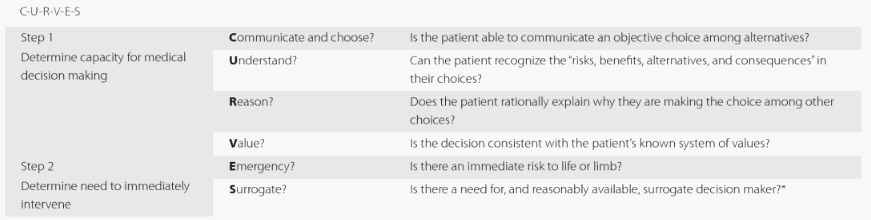
a. Choose and communicate

  • Can the patient make a choice and communicate that choice?

b. Understand

  • Does the patient understand the risks, benefits, alternatives and consequences of the decision?

c. Reason

  • Can the patient provide logic or reason behind his/her decision?

d. Value

  • Is the choice the patient makes consistent with their values?

e. Emergency

  • Is there an impending, emergent risk to the life or limb?

f. Surrogate

  • Is there a decision maker available or advanced directives of the patient?

The first 4 letters (C-U-R-V) assess the Decision-Making Capacity of the patient. A paitent lacks capacity if any of these pre-requisite abilities are absent.

The last 2 letters (E-S) sssess whether emergency treatment can be delivered without Informed Consent. Treating with implied consent is only appropriate when the patient does not have capacity to make the decision (C-U-R-V), it is an Emergency (E), and there is no surrogate decision maker (S) available, i.e. lack all the 6 points of CURVES.

Reference:

Chow GV, Czarny MJ, Hughes MT, Carrese JA. CURVES: a mnemonic for determining medical decision-making capacity and providing emergency treatment in the acute setting. Chest. 2010 Feb;137(2):421-7. doi: 10.1378/chest.09-1133. PMID: 20133288.

18 shares
  • Facebook18
  • Twitter
PGMEE, MRCS, USMLE, MBBS, MD/MS Ethics

Post navigation

Previous post
Next post

Related Posts

PGMEE, MRCS, USMLE, MBBS, MD/MS myeloid differentiation aml

Concept of Acute Myeloid Leukemia (AML) FAB Classification

Aug 23, 2016Mar 10, 2018

There is no need of mnemonics to remember the FAB classification of Acute Myeloid Leukemia (AML); just remember the process myeloid differentiation. A simple schematic diagram with few intermediate processes and stimulating factors eliminated will meet our purpose here. The cells belonging to the myeloid lineage are: Granulocytes: Neutrophils, Eosinophils…

Read More
PGMEE, MRCS, USMLE, MBBS, MD/MS

Finger Extensor Apparatus – Simplified

Apr 26, 2020Oct 3, 2022

Synonyms: Extensor expansion, Extensor hood, Dorsal expansion, Dorsal hood, Dorsal aponeurosis Components: Extrinsic tendons Intrinsic tendons Soft-tissue stabilizing structures Extrinsic tendon Extensor Digitorum Communis (EDC; may be absent in little fingers) ± Extensor Indicis Proprius (EIP; usually ulnar to EDC) ± Extensor Digiti Minimi (EDM; ulnar to EDC) passes dorsally…

Read More
PGMEE, MRCS, USMLE, MBBS, MD/MS granuloma morphology pathophysiology

Morphology of Granuloma

Jan 19, 2017Jan 31, 2017

Concentric layers of Granuloma There are 4 concentric layers in a granuloma, however the clear distinction is difficult in reality due to overlapping. From inside to out: 1. Necrosis Caseating necrosis: Tuberculosis, Leprosy Coagulative necrosis: Buruli ulcer (M.ulcerans), Gumma containing central blood vessels (Syphilis) Fibrinoid necrosis: Aschoff bodies (Rheumatic granuloma),…

Read More

Comments (2)

  1. Dr.Prof. N.K.Gupta says:
    Jan 1, 2021 at 3:18 pm

    This is excellent piece of information, very helpful in clinical practice

    Reply
  2. Mnemonic says:
    Mar 11, 2022 at 11:00 pm

    Thank you very much. Thank you so much for explaining in such a beautiful way. Looking forward to your next post

    Reply

Leave a Reply to Mnemonic Cancel reply

Your email address will not be published. Required fields are marked *

This site uses Akismet to reduce spam. Learn how your comment data is processed.

Pre-clinical (Basic Sciences)

Anatomy

Biochemistry

Community medicine (PSM)

Embryology

Microbiology

Pathology

Pharmacology

Physiology

Clinical Sciences

Anesthesia

Dermatology

Emergency medicine

Forensic

Internal medicine

Gynecology & Obstetrics

Oncology

Ophthalmology

Orthopedics

Otorhinolaryngology (ENT)

Pediatrics

Psychiatry

Radiology

Surgery

RSS Ask Epomedicine

  • What to study for Clinical examination in Orthopedics?
  • What is the mechanism of AVNRT?

Epomedicine weekly

  • About Epomedicine
  • Contact Us
  • Author Guidelines
  • Submit Article
  • Editorial Board
  • USMLE
  • MRCS
  • Thesis
©2026 Epomedicine | WordPress Theme by SuperbThemes