Skip to content
Epomedicine

Mnemonics, Simplified Concepts & Thoughts

Epomedicine

Mnemonics, Simplified Concepts & Thoughts

Femoral Anteversion test (Craig’s test)

Epomedicine, Jun 27, 2020Jun 27, 2020

Synonym: Trochanteric prominence angle test

Patient position: Prone with knee on test side flexed to 90 degrees

Test procedure: Examiner palpates the greater trochanter and internally and externally rotates the hip until the greater trochanter lies at the lateral most aspect of the hip (the greater trochanter is parallel to the examination table or bed at this point) thereby projecting the femoral head into center of acetabulum.
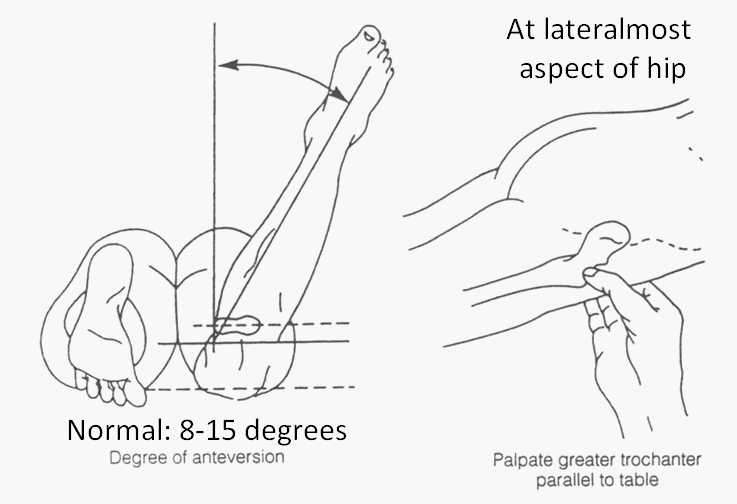
Angle measurement: Measure the angle of internal or external rotation using the goniometer.

Interpretation:

  1. Normal: At birth, the mean anteversion angle is 30 degrees which decreases to 8-15 degrees in adults (angle of internal rotation).
  2. Angle >15 degrees: Increased anteversion leads to squinting patellae & pigeon toed walking (in-toeing) which is twice as common in girls.
  3. Angle <8 degrees: Retroversion

Reference: Orthopedic Physical Assessment By David J. Magee, BPT, PhD, CM
34 shares
  • Facebook34
  • Twitter
Clinical Skills and Approaches Clinical examinationMusculoskeletal systemOrthopedics

Post navigation

Previous post
Next post

Related Posts

Clinical Skills and Approaches

Plantar fasciitis : Injection Technique

Aug 2, 2024Aug 2, 2024

Anatomy Plantar fascia arise from medial and lateral tubercles on the inferior surface of calcaneus. The lesion is invariably found at the medial head. Intersection technique 1. Position: Supine with knee flexed and hip externally rotated (figure of 4) 2. Landmark: Point of intersection of a line drawn parallel to…

Read More
Clinical Skills and Approaches gait abnormalities patterns

Examination of Gait

May 26, 2014Sep 7, 2022

Definitions Gait: Gait is the cyclical pattern of musculoskeletal motion that carries the body forwards. It involves a cyclic loss and regaining of balance by a shift of the line of gravity in relation to the center of gravity. Normal gait is smooth, symmetrical and ergonomically economical. Gait cycle: The…

Read More
Clinical Skills and Approaches

FARES method of Shoulder Reduction

Nov 30, 2019Nov 30, 2019

Indication: Anterior shoulder dislocation Position of patient: Supine Position of physician: Standing on the side of the dislocated shoulder Steps: Physician holds the wrist of the patient with both the arms keeping elbow of the patient extended and forearm in neutral position Arm is slowly abducted in brief oscillating movement…

Read More

Leave a Reply Cancel reply

Your email address will not be published. Required fields are marked *

This site uses Akismet to reduce spam. Learn how your comment data is processed.

Pre-clinical (Basic Sciences)

Anatomy

Biochemistry

Community medicine (PSM)

Embryology

Microbiology

Pathology

Pharmacology

Physiology

Clinical Sciences

Anesthesia

Dermatology

Emergency medicine

Forensic

Internal medicine

Gynecology & Obstetrics

Oncology

Ophthalmology

Orthopedics

Otorhinolaryngology (ENT)

Pediatrics

Psychiatry

Radiology

Surgery

RSS Ask Epomedicine

  • What to study for Clinical examination in Orthopedics?
  • What is the mechanism of AVNRT?

Epomedicine weekly

  • About Epomedicine
  • Contact Us
  • Author Guidelines
  • Submit Article
  • Editorial Board
  • USMLE
  • MRCS
  • Thesis
©2026 Epomedicine | WordPress Theme by SuperbThemes