Skip to content
Epomedicine

Mnemonics, Simplified Concepts & Thoughts

Epomedicine

Mnemonics, Simplified Concepts & Thoughts

coombs test

Coomb’s test : Mnemonic

Dr. Sulabh Kumar Shrestha, MS Orthopedics, May 23, 2019May 23, 2019

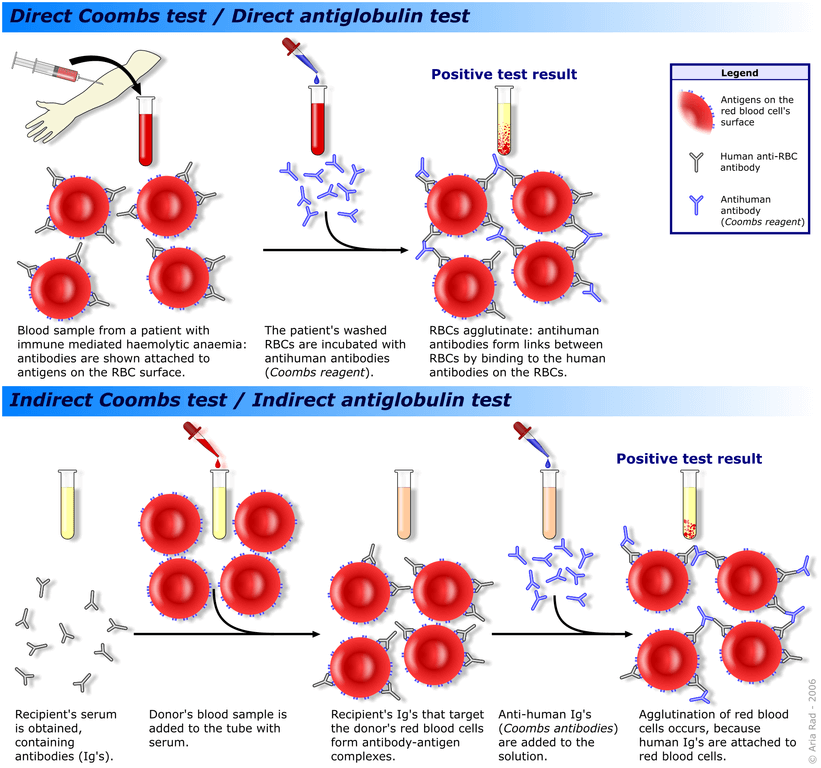
Components of Coomb’s test:

Mnemonic: ABCD

  1. A: Antibody (to be detected)
  2. B: Blood antigen (RBC)
  3. C: Coomb’s reagent (Anti-antibody)
  4. D: Detect agglutination
No machine-readable author provided. A. Rad~commonswiki assumed (based on copyright claims). [CC BY-SA 3.0], via Wikimedia Commons

Direct Coomb’s/Antiglobulin test (DAT or DCT):

Mnemonic: In DAT/DCT we take A+B from patient and add C [(A+B) + C]

Another Mnemonic: DCBA (Direct Coomb’s detect Blood Bound Antibody)

  1. Patient component: RBC +/- Antibody
  2. Coomb’s reagent: Anti-antibody
  3. Result: Agglutinates if Antibody bound to RBC (Positive)

Indirect Coomb’s/Antiglobulin test (IAT):

Mnemonic: In IAT, we take A from patient and add B+C [A+(B+C)]

  1. Patient component: +/- Antibody (serum)
  2. Reagent: donor RBC + Coomb’s reagent (Anti-antibody)
  3. Result: Agglutinates if Antibody present in serum (Positive)

Clinical Examples

a. Direct Coomb’s test (DCT):

  • Mix infant’s RBC with Coomb’s reagent: if cells agglutinate, maternal antibody is present

b. Indirect Coomb’s test (IAT):

  • Prenatal testing: Mix mother’s serum with Rh (D)+ cells (antigen) and add Coomb’s reagent: cells agglutinate if there is anti-D antibody is present in mother (this may be due to Rh+ fetus or Rh+ blood transfusion)
    • Rho-gam (anti-D antibody) is given to Rh- mother to neutralize circulating Rh antigen preventing the formation of antibody.
  • Cross-matching: Mix recipient’s serum with donor’s blood with antigens and add Coomb’s reagent: cells agglutinate if there is antibody to donor blood antigen in recipeint’s serum.

dr. sulabh kumar shrestha
Dr. Sulabh Kumar Shrestha, MS Orthopedics

He is the section editor of Orthopedics in Epomedicine. He searches for and share simpler ways to make complicated medical topics simple. He also loves writing poetry, listening and playing music. He is currently pursuing Fellowship in Hip, Pelvi-acetabulum and Arthroplasty at B&B Hospital.
18 shares
  • Facebook18
  • Twitter
PGMEE, MRCS, USMLE, MBBS, MD/MS HematologyObGyn

Post navigation

Previous post
Next post

Related Posts

PGMEE, MRCS, USMLE, MBBS, MD/MS primary dental eruption

Dental eruption : Mnemonic

Mar 4, 2018

Primary teeth begin eruption at around 6 months and Permanent teeth at around 6 years. In general, lower tooth erupts before it’s upper counterpart with few exceptions (lower before upper rule). Age of 6-12 years is a period of mixed dentition (eruption of permanent 1st molar to eruption of 2nd…

Read More
PGMEE, MRCS, USMLE, MBBS, MD/MS Superficial Cervical plexus

Superficial Cervical Plexus Block : Mnemonic

Nov 3, 2015

This is a visual mnemonic for the nerve arrangement of superficial cervical cutaneous branches of cervical plexus. This mnemonic was created only for the ease to remember and may not resemble exact anatomy. The site of injection for superior cervical plexus nerve block is the midpoint of posterior border of…

Read More
PGMEE, MRCS, USMLE, MBBS, MD/MS thyroglossal cyst

Thyroglossal Duct Cyst

May 6, 2014May 6, 2014

Synonyms: Thyroglossal cyst, Thyrolingual cyst, Thyroglossal duct remnant, TGDC, TDC, TGDR Definition: Thyroglossal duct cyst is a congenital malformation that occurs due to incomplete closure of the thyroglossal duct which presents as a cystic midline neck swelling at birth. Thyroglossal fistulas are usually recognized by their external opening (typically located…

Read More

Leave a Reply Cancel reply

Your email address will not be published. Required fields are marked *

This site uses Akismet to reduce spam. Learn how your comment data is processed.

Shrestha SK. Coomb’s test : Mnemonic [Internet]. Epomedicine; 2019 May 23 [cited 2026 Jan 2]. Available from: https://epomedicine.com/medical-students/coombs-test-mnemonic/.

Pre-clinical (Basic Sciences)

Anatomy

Biochemistry

Community medicine (PSM)

Embryology

Microbiology

Pathology

Pharmacology

Physiology

Clinical Sciences

Anesthesia

Dermatology

Emergency medicine

Forensic

Internal medicine

Gynecology & Obstetrics

Oncology

Ophthalmology

Orthopedics

Otorhinolaryngology (ENT)

Pediatrics

Psychiatry

Radiology

Surgery

RSS Ask Epomedicine

  • What to study for Clinical examination in Orthopedics?
  • What is the mechanism of AVNRT?

Epomedicine weekly

  • About Epomedicine
  • Contact Us
  • Author Guidelines
  • Submit Article
  • Editorial Board
  • USMLE
  • MRCS
  • Thesis
©2026 Epomedicine . All rights reserved.