Skip to content
Epomedicine

Mnemonics, Simplified Concepts & Thoughts

Epomedicine

Mnemonics, Simplified Concepts & Thoughts

adrenal steroidogenesis

Congenital Adrenal Hyperplasia Basics : Explained with Mnemonics

Epomedicine, Jul 24, 2018

Adrenal cortex synthesize steroids.

Mnemonic: GFR – Salt, Sugar, Sex

  • Zona gomerulosa: Salt (Aldosterone)
  • Zona fasciculata: Sugar (Cortisol)
  • Zona reticulosa: Sex (Testosterone)

Congenital adrenal hyperplasia (CAH)
cah enzymes

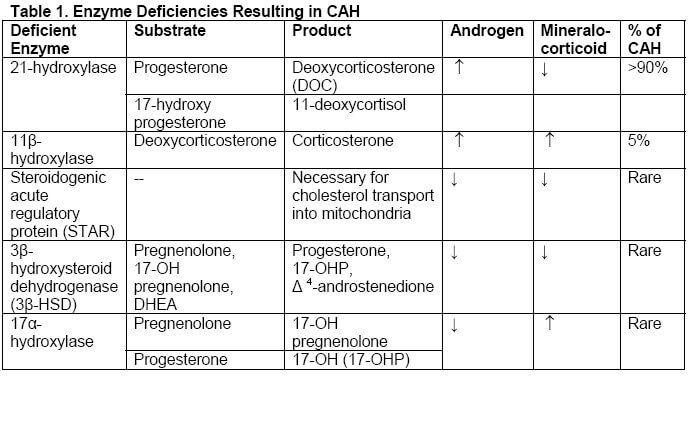
Deficiency of 3 different enzymes can cause Congenital Adrenal Hyperplasia.

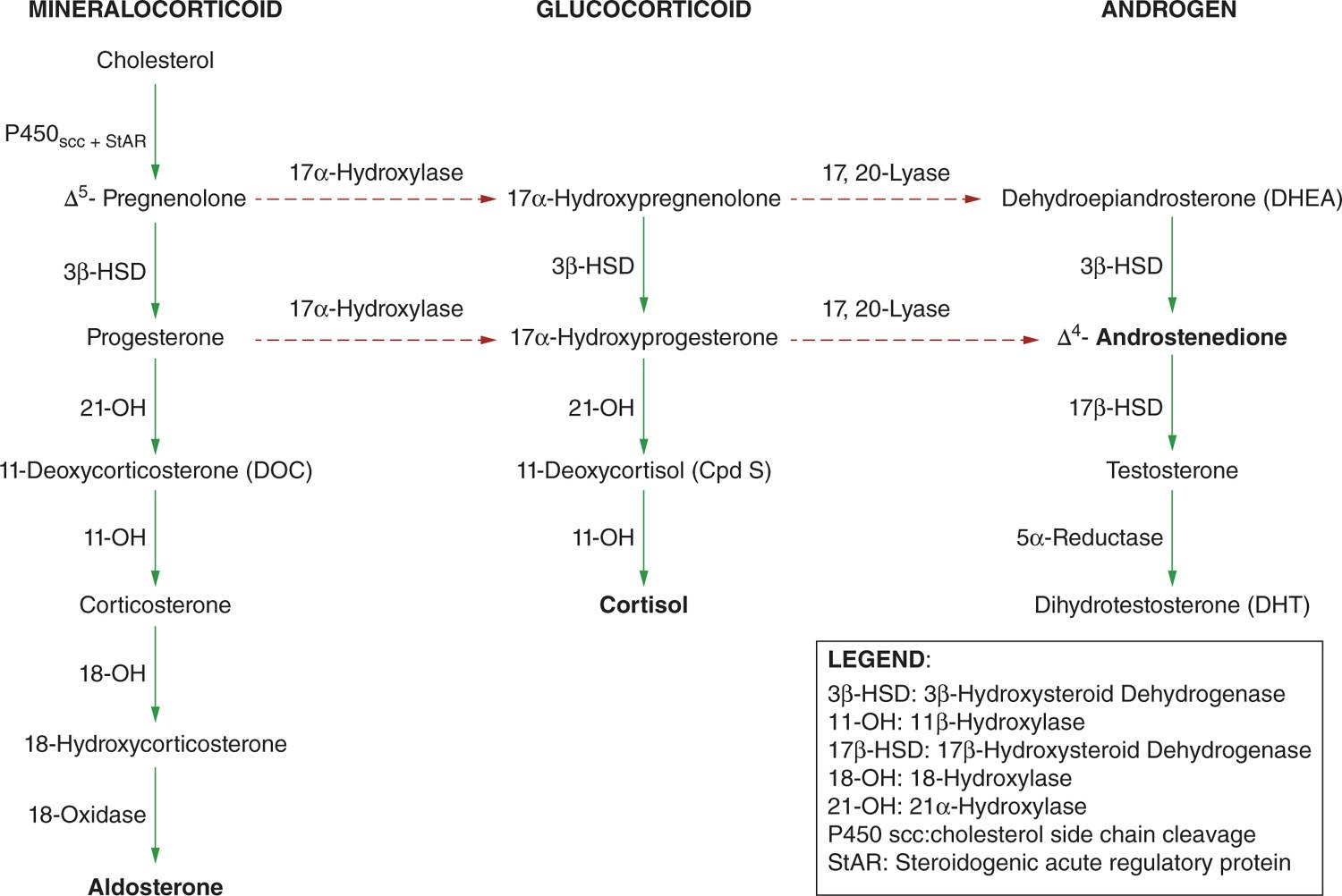
Mnemonic: Remember the mnemonic GFR, first layer of cortex synthesizes aldosterone and the last layer synthesizes sex steroids. So, the numberals in enzyme can be assumed to represent following:

  • 1st digit: Blood pressure
  • 2nd digit: Testosterone

The “1” looks like an up arrow, hence, it signifies “increase“.

All the 3 conditions are associated with the hypertrophy of adrenals due to high levels of ACTH (lack of suppression). In all 3 conditions corticosteroid is decreased. The most common one is due to 21 hydroxylase deficiency.

1. 11 hydroxylase deficiency:

  • 1 – Increased blood pressure (hypertension)
  • 1 – Increased testosterone (virilization in females)

2. 21 hydroxylase deficiency:

  • 2 – Decreased blood pressure (hypotension)
  • 1 – Increased testosterone (virilization in females)

3. 17 hydroxylase deficiency:

  • 1 – Increased blood pressure (hypertension)
  • 7 – No increase in testosterone

adrenal steroidogenesis

  1. Adrenal steroidogenesis is regulated by ACTH from anterior pituitary gland.
  2. Circulating level of plasma cortisol is a key player in the hypothalamic-pituitary-adrenal feedback system and exerts a negative feedback effect on the secretion of ACTH .
  3. ACTH secretion increases due to decrease in cortisol secretion as in CAH (loss of negative-feedback on ACTH) resulting in:
    • Overstimulation of the adrenals – hyperplasia
    • Stimulation of excessive synthesis of the adrenal products of those pathways unimpaired by an enzyme deficiency and causes an accumulation of precursor molecules in pathways blocked by an enzyme deficiency.

3 B-HSD is involved in synthesis of all 3 steroids involved in salt, sugar and sex.

Mnemonic: 3 involves all 3

  • Hence, deficiency of 3 B-HSD leads to decrease in all 3 steroids.

21 OH and 11 OH are involved in synthesis of salt and sugar only.

  • Hence, deficiency of 21 OH and 11 OH enzymes lead to increase in sex steroids.
  • In 11 OH deficiency, hypertension occurs due to accumulation of Deoxycorticosterone (DOC) which has mineralocorticoid activity.
16 shares
  • Facebook16
  • Twitter
PGMEE, MRCS, USMLE, MBBS, MD/MS Endocrine systemPhysiology

Post navigation

Previous post
Next post

Related Posts

PGMEE, MRCS, USMLE, MBBS, MD/MS ulnar nerve course

Ulnar nerve Anatomy – Course and Innervation

Jun 7, 2018Jun 1, 2024

Origin: C(7), C8, T1 (medial cord of Brachial plexus) Course: Motor innervation: 1. Forearm: Flexor carpi ulnaris (weakness of ulnar deviation and flexion of wrist), Medial half of flexor digitorum profundus (branches near the elbow) 2. Hand: branches near wrist Sensory innervation: Palmar branch at forearm and Digital branch at wrist…

Read More
PGMEE, MRCS, USMLE, MBBS, MD/MS

How to crack Postgraduate MD/MS Entrance Examination?

May 24, 2024May 26, 2024

(Article for Nepalese/ Indian and South Asian students) Postgraduate entrance exam for MD/MS is one of the toughest examinations in Nepal. The cut throat competition, the dilemma between studying or earning, and the pressure to perform against the toppers and best minds in the country make it one of the…

Read More
PGMEE, MRCS, USMLE, MBBS, MD/MS lung volumes and capacities

Lung Volumes and Capacities : Mnemonic

Jul 10, 2018

Mnemonic: 6 LITERs Lung Capacity (TLC = 6L) = Inspiratory reserve volume (IRV = 3.3 L) + Tidal volume (TV = 0.5 L) + Expiratory reserve volume (ERV = 1 L) + Reserve volume (RV = 1.2 L) Mnemonic: There are 4 lung volumes that do not overlap and 4…

Read More

Comments (2)

  1. Shruthi says:
    Sep 24, 2021 at 4:38 pm

    Thanks a lot!

    Reply
  2. Murielle says:
    Oct 5, 2024 at 4:29 pm

    Many thanks 111111!

    Reply

Leave a Reply Cancel reply

Your email address will not be published. Required fields are marked *

This site uses Akismet to reduce spam. Learn how your comment data is processed.

Pre-clinical (Basic Sciences)

Anatomy

Biochemistry

Community medicine (PSM)

Embryology

Microbiology

Pathology

Pharmacology

Physiology

Clinical Sciences

Anesthesia

Dermatology

Emergency medicine

Forensic

Internal medicine

Gynecology & Obstetrics

Oncology

Ophthalmology

Orthopedics

Otorhinolaryngology (ENT)

Pediatrics

Psychiatry

Radiology

Surgery

RSS Ask Epomedicine

  • What to study for Clinical examination in Orthopedics?
  • What is the mechanism of AVNRT?

Epomedicine weekly

  • About Epomedicine
  • Contact Us
  • Author Guidelines
  • Submit Article
  • Editorial Board
  • USMLE
  • MRCS
  • Thesis
©2026 Epomedicine | WordPress Theme by SuperbThemes