Skip to content
Epomedicine

Mnemonics, Simplified Concepts & Thoughts

Epomedicine

Mnemonics, Simplified Concepts & Thoughts

adrenal steroidogenesis

Congenital Adrenal Hyperplasia Basics : Explained with Mnemonics

Epomedicine, Jul 24, 2018

Adrenal cortex synthesize steroids.

Mnemonic: GFR – Salt, Sugar, Sex

  • Zona gomerulosa: Salt (Aldosterone)
  • Zona fasciculata: Sugar (Cortisol)
  • Zona reticulosa: Sex (Testosterone)

Congenital adrenal hyperplasia (CAH)
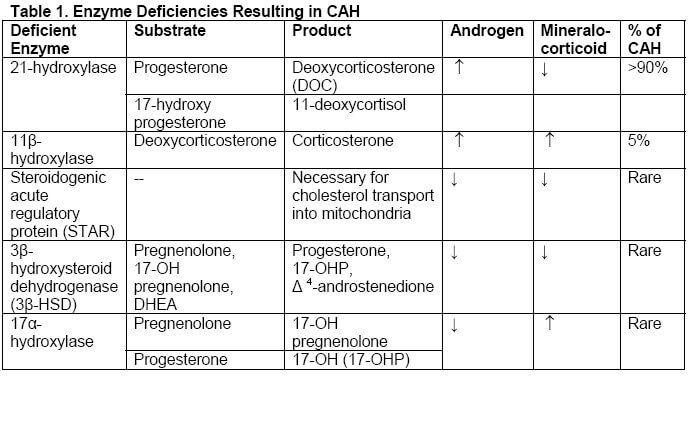
cah enzymes

Deficiency of 3 different enzymes can cause Congenital Adrenal Hyperplasia.

Mnemonic: Remember the mnemonic GFR, first layer of cortex synthesizes aldosterone and the last layer synthesizes sex steroids. So, the numberals in enzyme can be assumed to represent following:

  • 1st digit: Blood pressure
  • 2nd digit: Testosterone

The “1” looks like an up arrow, hence, it signifies “increase“.

All the 3 conditions are associated with the hypertrophy of adrenals due to high levels of ACTH (lack of suppression). In all 3 conditions corticosteroid is decreased. The most common one is due to 21 hydroxylase deficiency.

1. 11 hydroxylase deficiency:

  • 1 – Increased blood pressure (hypertension)
  • 1 – Increased testosterone (virilization in females)

2. 21 hydroxylase deficiency:

  • 2 – Decreased blood pressure (hypotension)
  • 1 – Increased testosterone (virilization in females)

3. 17 hydroxylase deficiency:

  • 1 – Increased blood pressure (hypertension)
  • 7 – No increase in testosterone

adrenal steroidogenesis

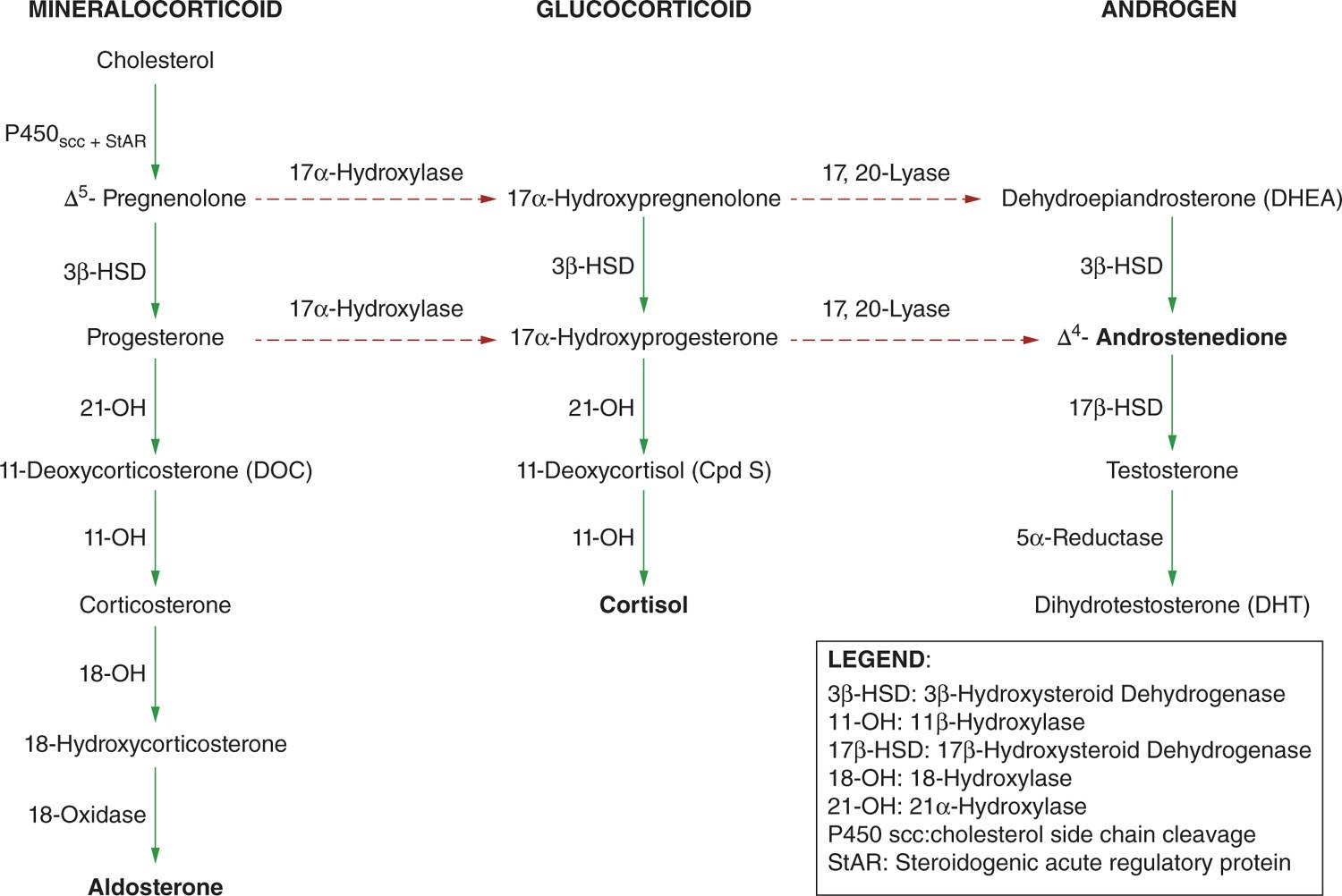
  1. Adrenal steroidogenesis is regulated by ACTH from anterior pituitary gland.
  2. Circulating level of plasma cortisol is a key player in the hypothalamic-pituitary-adrenal feedback system and exerts a negative feedback effect on the secretion of ACTH .
  3. ACTH secretion increases due to decrease in cortisol secretion as in CAH (loss of negative-feedback on ACTH) resulting in:
    • Overstimulation of the adrenals – hyperplasia
    • Stimulation of excessive synthesis of the adrenal products of those pathways unimpaired by an enzyme deficiency and causes an accumulation of precursor molecules in pathways blocked by an enzyme deficiency.

3 B-HSD is involved in synthesis of all 3 steroids involved in salt, sugar and sex.

Mnemonic: 3 involves all 3

  • Hence, deficiency of 3 B-HSD leads to decrease in all 3 steroids.

21 OH and 11 OH are involved in synthesis of salt and sugar only.

  • Hence, deficiency of 21 OH and 11 OH enzymes lead to increase in sex steroids.
  • In 11 OH deficiency, hypertension occurs due to accumulation of Deoxycorticosterone (DOC) which has mineralocorticoid activity.
16 shares
  • Facebook16
  • Twitter
PGMEE, MRCS, USMLE, MBBS, MD/MS Endocrine systemPhysiology

Post navigation

Previous post
Next post

Related Posts

PGMEE, MRCS, USMLE, MBBS, MD/MS

Organ Transplant Complications and Rejection

Aug 20, 2023Aug 20, 2023

Types of Transplant Rejection Type Time Mechanism Pathology Hypersensitivity Management Host against Graft (Host vs Graft) Mnemonic: TIA Hyperacute Immediate (<5 days) Anti-donor antibodies in recipient Thrombosis and Obliteration of blood supply Type II UntreatablePrevent by cross-matchingRemove graft Acute (most common) < 6 months (most common in 1st month) Anti-donor…

Read More
PGMEE, MRCS, USMLE, MBBS, MD/MS

Amylase and Lipase in Acute Pancreatitis

Aug 28, 2019Aug 28, 2019

Test Rise Peak Return to baseline Lipase 4-6 hours 48 8-14 days Amylase 2-4 hours 24-48 5-7 days Serum lipase elevation has a better diagnostic value as compared to serum amylase due to its superior specificity.   Amylase has a low molecular weight and as a result can easily pass through…

Read More
PGMEE, MRCS, USMLE, MBBS, MD/MS

ECG Axis Determination : Mnemonic

Aug 11, 2019Aug 11, 2019

Lead I = left (0 degrees)Lead aVF = floor (90 degrees) Lead I +ve and Lead aVF +ve = Between 0-90 degrees (Normal axis) Lead I -ve and Lead aVF +ve = Between 90-180 degrees (Right axis deviation) Lead I +ve and Lead aVF -ve = Between 0 to -90…

Read More

Comments (2)

  1. Shruthi says:
    Sep 24, 2021 at 4:38 pm

    Thanks a lot!

    Reply
  2. Murielle says:
    Oct 5, 2024 at 4:29 pm

    Many thanks 111111!

    Reply

Leave a Reply Cancel reply

Your email address will not be published. Required fields are marked *

This site uses Akismet to reduce spam. Learn how your comment data is processed.

Pre-clinical (Basic Sciences)

Anatomy

Biochemistry

Community medicine (PSM)

Embryology

Microbiology

Pathology

Pharmacology

Physiology

Clinical Sciences

Anesthesia

Dermatology

Emergency medicine

Forensic

Internal medicine

Gynecology & Obstetrics

Oncology

Ophthalmology

Orthopedics

Otorhinolaryngology (ENT)

Pediatrics

Psychiatry

Radiology

Surgery

RSS Ask Epomedicine

  • What to study for Clinical examination in Orthopedics?
  • What is the mechanism of AVNRT?

Epomedicine weekly

  • About Epomedicine
  • Contact Us
  • Author Guidelines
  • Submit Article
  • Editorial Board
  • USMLE
  • MRCS
  • Thesis
©2026 Epomedicine | WordPress Theme by SuperbThemes