Skip to content
Epomedicine

Mnemonics, Simplified Concepts & Thoughts

Epomedicine

Mnemonics, Simplified Concepts & Thoughts

inhibition_Lineweaver_Burk

Competitive, Non-competitive and Uncompetitive Inhibitors

Epomedicine, Aug 10, 2018Aug 18, 2024

Vmax is the maximum velocity, or how fast the enzyme can go at full ‘‘speed.’’ Vmax is reached when all of the enzyme is in the enzyme–substrate complex.

  • Vmax is directly proportional to the enzyme concentration.

Km is the substrate concentration at which v = 1/2 Vmax. Km approximately describes the affinity of the substrate for the enzyme. The lower the value of Km, the higher the apparent affinity for substrate.
inhibition_Lineweaver_Burk
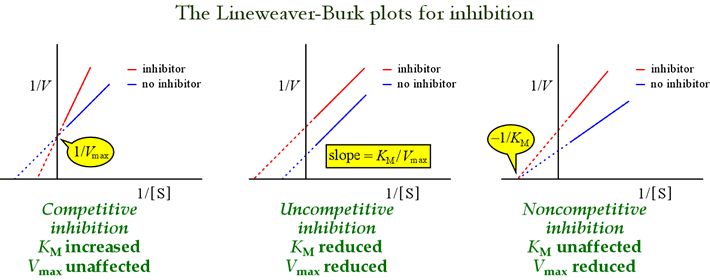
[S] = concentration of substrate; V = Velocity
The closer to 0 on the Y-axis, the higher the Vmax
The closer to 0 on the X-axis, the higher the Km.

Mnemonic:

  1. Competitive inhibitor (Km-pitive inhibitor): Km increases, Vmax doesn’t change
  2. Non-competitive inhibitor (Non-Km-pitivie inhibitor): Km doesn’t change, Vmax decreases

Competitive inhibition:

These are structurally similar to substrates and hence competes with substrate to bind at active site of enzyme (cannot bind to enzyme substrate complex). Increasing the substrate can overcome inhibition as overall efficacy of enzyme is not affected (more substrate is needed to achieve 1/2 Vmax, i.e. Km increases).

Non-competitive inhibition:

These are structurally different from substrates and hence bind enzymes at sites distinct from substrate binding site and reduce the enzyme activity (i.e. no competition with substrate). It can bind to both the enzyme and enzyme-substrate complex. Increasing the substrate will not overcome the inhibition, hence, Vmax decreases and hence, Km remains same.

  • May be irreversible or reversible

Uncompetitive inhibitors:

These are like non-competitive inhibitiors but, they only bind to the enzyme when substrate is bound to the enzyme (i.e. binds to enzyme substrate complex only). Uncompetitive inhibitors decrease both Vmax and Km.

Graph:

Mnemonic:

  1. Vmax = Vertical (y-axis)
  2. Km = x-axis (‘k’ looks like ‘x’)
  3. Very efficient and Com(Km)petent, i.e. Vmax represent efficacy and Km represent competency.

Competitive inhibitors:

  • Competitive inhibitors Cross at y-axis (i.e. Vmax is same).

Non-competitibe inhibitors:

  • Doesn’t cross but converge at x-axis (i.e. Km is same).

Uncompetitive inhibitors:

  • Follow separate path to the left (both Vmax and Km is decreased).
Competitive inhibitors, reversibleCompetitive inhibitors, irreversibleNoncompetitive inhibitors
Resemble substrateYesYesNo
Overcome by increasing [S]YesNoNo
Bind active siteYesYesNo
Effect on VmaxUnchangedDecreasedDecreased
Effect on KmIncreasedUnchangedUnchanged
PharmacodynamicsDecreased potencyDecreased efficacyDecreased efficacy
36 shares
  • Facebook36
  • Twitter
PGMEE, MRCS, USMLE, MBBS, MD/MS BiochemistryGeneral conceptsPharmacology

Post navigation

Previous post
Next post

Related Posts

PGMEE, MRCS, USMLE, MBBS, MD/MS

Cardiology Mnemonics

Sep 18, 2019Sep 18, 2019

INFECTIVE ENDOCARDITIS INDICATIONS FOR SURGERY A: Aortic valve, Annular Abscess B: Block (heart block), Bacteremia (persistent) C: Complications, CCF D: Destructive penetrating lesion E: Emboli F: Fever despite appropriate antibiotics, Fungus G: Growing vegetations H: Heart failure, Highly resistant organisms PROSTHETIC HEART VALVES COMPLICATIONS: VIP BEAST V: Valve Obstruction I: INR monitoring, Infective Endocarditis P: Paravalvular…

Read More
PGMEE, MRCS, USMLE, MBBS, MD/MS lung embryology

Lung Development – Embryology Made Easy

Aug 10, 2016Aug 10, 2016

Remember the mnemonic – “Every Premature Child Takes Air“. The development of lungs comprises of 5 distinct stages: Embryonic (3-8 weeks, i.e. embryonic period) Pseudoglandular (5-16 weeks) Canalicular (16-26 weeks) Terminal saccular (26-36 weeks) Alveolar (36 weeks to 40 weeks and continues to childhood) The first and last stages, i.e….

Read More
PGMEE, MRCS, USMLE, MBBS, MD/MS

Working formulation of NHL (Mnemonic)

Jan 16, 2019Feb 26, 2019

All follicular except large cell: Low grade All diffuse: Intermediate grade Blastic and non-cleaved: High grade

Read More

Comment

  1. Sexylady ;) says:
    Mar 16, 2022 at 11:38 am

    This was very helpful, it really helped me with my bioprocess engineering lecture. Thank you very much 🙂

    Reply

Leave a Reply Cancel reply

Your email address will not be published. Required fields are marked *

This site uses Akismet to reduce spam. Learn how your comment data is processed.

Epomedicine. Competitive, Non-competitive and Uncompetitive Inhibitors [Internet]. Epomedicine; 2018 Aug 10 [cited 2025 Dec 26]. Available from: https://epomedicine.com/medical-students/competitive-non-competitive-and-uncompetitive-inhibitors/.

Pre-clinical (Basic Sciences)

Anatomy

Biochemistry

Community medicine (PSM)

Embryology

Microbiology

Pathology

Pharmacology

Physiology

Clinical Sciences

Anesthesia

Dermatology

Emergency medicine

Forensic

Internal medicine

Gynecology & Obstetrics

Oncology

Ophthalmology

Orthopedics

Otorhinolaryngology (ENT)

Pediatrics

Psychiatry

Radiology

Surgery

RSS Ask Epomedicine

  • What to study for Clinical examination in Orthopedics?
  • What is the mechanism of AVNRT?

Epomedicine weekly

  • About Epomedicine
  • Contact Us
  • Author Guidelines
  • Submit Article
  • Editorial Board
  • USMLE
  • MRCS
  • Thesis
©2025 Epomedicine . All rights reserved.