Skip to content
Epomedicine

Mnemonics, Simplified Concepts & Thoughts

Epomedicine

Mnemonics, Simplified Concepts & Thoughts

Cluster of Differentiation (CD Markers) Mnemonics

Epomedicine, Feb 20, 2021Feb 20, 2021

“CD” in immunology stands for Cluster of Differentiation and includes cell surface markers that can be detected by lab technique called flow cytometry. Well, we will just focus on the ones you need to remember at undergraduate level. If you wish to go into further details, there are plenty of resources available in the internet.
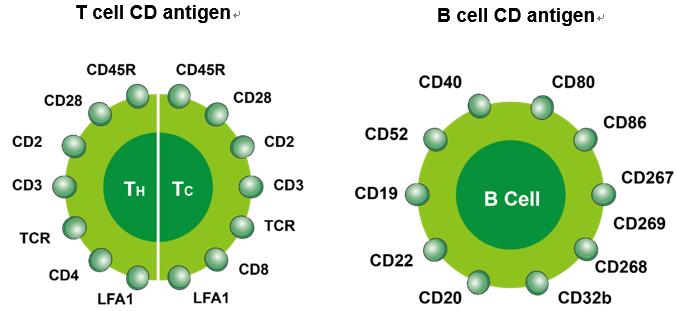
CD markers

CD45 = Leukocyte Common Antigen (LCA) i.e. expressed in all except erythrocytes and platelets.

CD3 = Pan-T cell marker

CD19 = Pan-B cell marker

CD13, CD33 and CD11b = Pan-myeloid markers

T cells and B cells

T cells: Tiny numbers

  • CD2
  • CD4 (T-helper cells)
  • CD8 (Cytotoxic T cells; i.e. 2 X 4 = 8)
  • CD28 (Costimulatory molecule needed to activate T cells) – has “2” and “8”
  • Also: CD1, CD3, CD5 and CD7

B cells: Big numbers

  • CD10 or CALLA (Common ALL Antigen): Pre-B cells and derivatives
  • CD21 (EBV receptor)
  • CD19, 20, 22, 23
  • CD 40 (Competence signal molecule needed for isotype switching and formation of memory cells)
    • Mnemonic: CD 19 + CD 21 = CD40

Receptors present in Antigen Presenting Cells (APCs) including B cells:

  1. CD80 (B7-1) and CD86 (B7-2): Cosimulatory molecules present in Antigen Presenting Cells (APC)
  2. MHC class II

Wannabe T cells: Add 1 in front of CD4 and CD8

  1. Macrophages (CD14)
  2. Neutrophils (CD18)

Remember in sequence: 34, 45, 56 (Stem cells, Lymphoid pecursor and then NK cells)

Stem cells: CD34

Stem cell markers are CD34, tDT and HLA-DR.

Leukocyte common antigen or LCA: CD45

NK cells (that come from lymphocyte precursors): CD56 (also CD16)

  • This can also be remembered as 1 + 5 = 6 (CD16 and CD56)

Dendritic cells: CD1 and CD11

  • Langerhans cells (Dendritic cells of skin that are APCs): CD1a (Used in Langerhans cell histiocytosis)
  • Dendritic cells including Langerhans cells: CD11c (Integrins that interact with ICAMs)

Hairy cell leukemia: A type of mature B-cell CLL

  • Early B cells: CD19, CD20, CD22 (CD21 is early B cell marker and absent in hairy cell leukemia)
  • CD11c
  • CD103 (Regulatory T cells and Intestinal mucosal dendritic cells)
52 shares
  • Facebook
  • Twitter
PGMEE, MRCS, USMLE, MBBS, MD/MS General conceptsImmunology

Post navigation

Previous post
Next post

Related Posts

PGMEE, MRCS, USMLE, MBBS, MD/MS

Skin Malignancies : Mnemonics

May 24, 2024May 24, 2024

Malignant Melanoma Diagnosis or Clinical features: Mnemonic: ABCDE Risk factors: Mnemonic: MM RISK Pathologic Types: Mnemonic: Melanoma Always Spreads to Nodes (in order of worsening prognosis) Mnemonic Type Incidence Site Growth pattern Melanoma Maligna – lentiginous 10-15% Face (Precursor – Hutchison’s freckles/lentigo maligna) long in-situ stage before vertical growth Always…

Read More
PGMEE, MRCS, USMLE, MBBS, MD/MS chronic lead poisoning

Chronic Lead Poisoning : Mnemonic

Jun 21, 2018

Mnemonic: ABCDEFGH Anemia: Results from ALA dehydrogenase inhibition Also causes RBC membranes to be permeable to K+ and decrease Na+/K+ ATPase leading to hemolysis Basophilic stippling Burtonian lines: Gum “lead lines” develop in 2-50% Results from subepithelial deposit of lead sulfide granules on gingival margins Colic: Spasmodic pain involving smooth…

Read More
PGMEE, MRCS, USMLE, MBBS, MD/MS

Staging and Grading of Bone Tumors (Neoplasm)

Nov 3, 2022Nov 3, 2022

Enneking (MSTS) Staging for Malignant Bone Tumors Stage Grade Site Metastasis IA Low Intra-compartmental None IB Low Extra-compartmental None IIA High Intra-compartmental None IIB High Extra-compartmental None III Any Any Regional or Distant Low-grade tumors generally have few mitotic figures, little if any cellular atypia, and have a relatively non-infiltrative…

Read More

Leave a Reply Cancel reply

Your email address will not be published. Required fields are marked *

This site uses Akismet to reduce spam. Learn how your comment data is processed.

Pre-clinical (Basic Sciences)

Anatomy

Biochemistry

Community medicine (PSM)

Embryology

Microbiology

Pathology

Pharmacology

Physiology

Clinical Sciences

Anesthesia

Dermatology

Emergency medicine

Forensic

Internal medicine

Gynecology & Obstetrics

Oncology

Ophthalmology

Orthopedics

Otorhinolaryngology (ENT)

Pediatrics

Psychiatry

Radiology

Surgery

RSS Ask Epomedicine

  • What to study for Clinical examination in Orthopedics?
  • What is the mechanism of AVNRT?

Epomedicine weekly

  • About Epomedicine
  • Contact Us
  • Author Guidelines
  • Submit Article
  • Editorial Board
  • USMLE
  • MRCS
  • Thesis
©2026 Epomedicine | WordPress Theme by SuperbThemes