Skip to content
Epomedicine

Mnemonics, Simplified Concepts & Thoughts

Epomedicine

Mnemonics, Simplified Concepts & Thoughts

chemokines

Chemokines Mnemonics

Dr. Sulabh Kumar Shrestha, MS Orthopedics, Jan 18, 2017Jan 18, 2017

Difference between cytokines and chemokines

Cytokines are small proteins released by cells, the function of which is “cell-signaling“.

Chemokines are small cytokines, which functions as a “chemo-attractant“.

Types of Chemokines

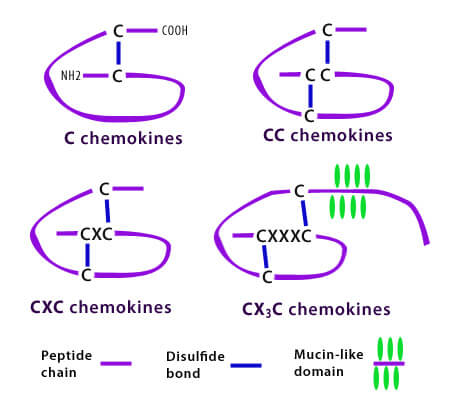
When you go through the structural classification of chemokines, you come accross various arrangements of letter:

  • C: denotes cysteine
  • X: denotes other amino acids

chemokines

CXC (alpha chemokines): Acts on NEUTROPHILS.

  • Example: IL-8

C-C (beta chemokines): Acts on ALL LEUKOCYTES EXCEPT NEUTROPHILS

  • Monocyte Chemoattractant protein – 1 (MCP-1)
  • Regulated and Normal T cell expressed and secreted (RANTES)
  • Eotaxin

C (gamma chemokines): Acts on LYMPHOCYTES

  • Example: Lymphotaxin

CX3C (d-chemokine): Acts on Monocytes and T-lymphocytes

  • Only example: Fractalkaline

Mnemonic:

Just remember the timeline of cells during inflammation:

  1. First to appear: Neutrophil
  2. Then appears: Monocyte-macrophages (Remember as other leukocytes)
  3. Then in chronic inflammation: Lymphocytes

In the order of decreasing “letters” in the subfamily of chemokines:

  1. CXC = Alpha chemokines
  2. CC = Beta chemokines
  3. C = Gamma chemokines

CXC = Acts on neutrophils (IL-8)

CC = Acts on other leukocytes (MCP-1, RANTES, Eotaxin)

C = Acts on Lymphocytes (Lymphokines)

CX3C = Unique (Fractalkaline)

dr. sulabh kumar shrestha
Dr. Sulabh Kumar Shrestha, MS Orthopedics

He is the section editor of Orthopedics in Epomedicine. He searches for and share simpler ways to make complicated medical topics simple. He also loves writing poetry, listening and playing music. He is currently pursuing Fellowship in Hip, Pelvi-acetabulum and Arthroplasty at B&B Hospital.
10 shares
  • Facebook10
  • Twitter
PGMEE, MRCS, USMLE, MBBS, MD/MS General conceptsPathologyPhysiology

Post navigation

Previous post
Next post

Related Posts

PGMEE, MRCS, USMLE, MBBS, MD/MS

Pirani Score and Dimeglio Classification for Clubfoot Assessment

Apr 13, 2022Aug 3, 2022

Pirani socre Pirani score for assessment of clubfoot (CTEV) consists of 6 parameters (3 each in midfoot and hindfoot) which is scored as 0, 0.5 or 1 with a maximum possible score of 6. The parameters can be remembered using the mnemonic: PER TOM Posterior crease Empty heel Rigid equinus…

Read More
PGMEE, MRCS, USMLE, MBBS, MD/MS gastrinoma triangle

Gastrinoma (Passaro’s) triangle

Feb 17, 2017

Boundaries of Gastrinoma Triangle It is an imaginary triangle formed by 3 points in upper abdomen: Apex: Cystic duct-CBD junction Inferior point: 2nd part duodenum-3rd part duodenum junction Left lateral point: Pancreatic neck-body junction This area is located to the right of Superior Mesenteric Artery (SMA) i.e. Proximal duodenum and…

Read More
PGMEE, MRCS, USMLE, MBBS, MD/MS

Pregabalin : Pharmacology

Dec 5, 2021Dec 5, 2021

Pharmacokinetics After oral ingestion, Pregabalin is rapidly absorbed (Tmax 1.3 hr) Bioavailability is >90% and independent of dose Pregabalin is NOT protein bound Vd is 0.4 L/kg Serum pregabalin concentrations are linearly related to dosage Pregabalin is NOT metabolized Pregabalin is primarily excreted unchanged in urine (98%) with a clearance…

Read More

Leave a Reply Cancel reply

Your email address will not be published. Required fields are marked *

This site uses Akismet to reduce spam. Learn how your comment data is processed.

Shrestha SK. Chemokines Mnemonics [Internet]. Epomedicine; 2017 Jan 18 [cited 2026 Jan 1]. Available from: https://epomedicine.com/medical-students/chemokines-mnemonics/.

Pre-clinical (Basic Sciences)

Anatomy

Biochemistry

Community medicine (PSM)

Embryology

Microbiology

Pathology

Pharmacology

Physiology

Clinical Sciences

Anesthesia

Dermatology

Emergency medicine

Forensic

Internal medicine

Gynecology & Obstetrics

Oncology

Ophthalmology

Orthopedics

Otorhinolaryngology (ENT)

Pediatrics

Psychiatry

Radiology

Surgery

RSS Ask Epomedicine

  • What to study for Clinical examination in Orthopedics?
  • What is the mechanism of AVNRT?

Epomedicine weekly

  • About Epomedicine
  • Contact Us
  • Author Guidelines
  • Submit Article
  • Editorial Board
  • USMLE
  • MRCS
  • Thesis
©2026 Epomedicine . All rights reserved.