Skip to content
Epomedicine

Mnemonics, Simplified Concepts & Thoughts

Epomedicine

Mnemonics, Simplified Concepts & Thoughts

Cerebral cortex layers microanatomy

Cerebral Cortex Layers (Microanatomy) Simplified

Dr. Sulabh Kumar Shrestha, MS Orthopedics, Jul 30, 2016Jul 30, 2016

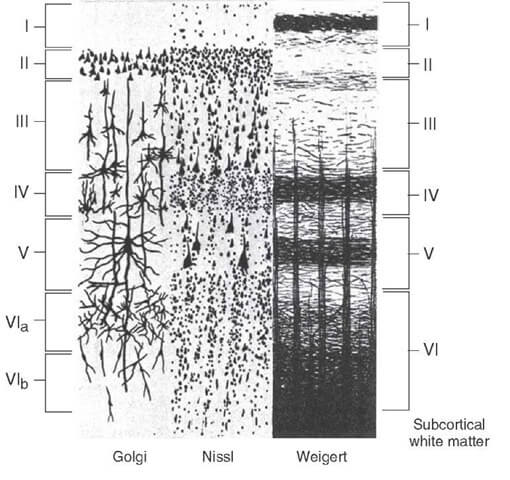
The neocortex have 6 layers and allocortex have only 3 layers.
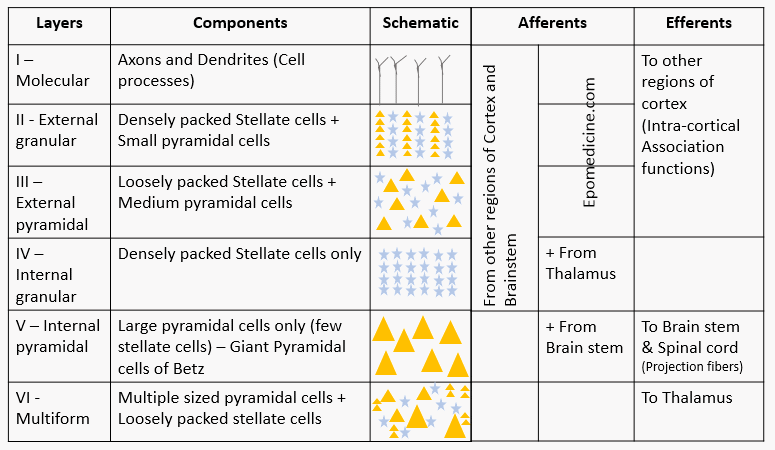
Cerebral cortex layers microanatomy

The 6 layers of Neocortex:

Orientation of layers:

  • Outer: Towards meaninges
  • Inner: Towards white matter

Idea about the layers:

  • Molecular or plexiform: Only cell processes
  • Granular layer: Densely packed stellate cells
  • Pyramidal layer: Medium and Large pyramidal cells
  • Multiform layer: Different types of cells
  • Pyramidal cells are absent in inner granular layer
Layers Components Afferents Efferents
I – Molecular Axons and Dendrites (Cell processes) From other regions of Cortex and Brainstem To other regions of cortex

(Intra-cortical

Association functions)

II – External granular Densely packed Stellate cells + Small pyramidal cells
III – External pyramidal Loosely packed Stellate cells + Medium pyramidal cells
IV – Internal granular Densely packed Stellate cells only + From Thalamus
V – Internal pyramidal Large pyramidal cells only (few stellate cells) – Giant Pyramidal cells of Betz + From Brain stem To Brain stem & Spinal cord (Projection fibers)
VI – Multiform Multiple sized pyramidal cells + Loosely packed stellate cells To Thalamus

The 3 layers of allocortex:

  1. Molecular layer
  2. Pyramidal layer
  3. Multiform layer

Allocortex is found in: Limbic system

  1. Olfactory cortex
  2. Hippocampal formation
  3. Subiculum

Mesocortex: A transitional type of 3 to 6-layered cortex between neocortex and allocortex –

  1. Parahippocampal gyrus
  2. Pre- and Para-subiculum
  3. Insula

real cortex

Neurons of the cortex:

  1. Pyramidal cells:
    • Large layer V pyramidal cells project axons to brainstem and spinal cord.
    • Smaller layer II and III pyramidal cells project axons to other cortical areas.
  2. Stellate cells: Interneurons whose axons remain within the cortex
  3. Fusiform cells (in deeper layers): Gives rise to corticothalamic projections
  4. Horizontal cells of Cajal
  5. Cells of Martinotti

Bands of Baillarger: Formed by high concentration of horizontally arranged nerve fibers.

  • External band: In layer IV
  • Internal band: In layer V


dr. sulabh kumar shrestha
Dr. Sulabh Kumar Shrestha, MS Orthopedics

He is the section editor of Orthopedics in Epomedicine. He searches for and share simpler ways to make complicated medical topics simple. He also loves writing poetry, listening and playing music. He is currently pursuing Fellowship in Hip, Pelvi-acetabulum and Arthroplasty at B&B Hospital.
14 shares
  • Facebook14
  • Twitter
PGMEE, MRCS, USMLE, MBBS, MD/MS AnatomyNervous system

Post navigation

Previous post
Next post

Related Posts

PGMEE, MRCS, USMLE, MBBS, MD/MS

Methotrexate : Mnemonic

Feb 21, 2023Feb 21, 2023

Methotrexate is a dihydrofolate reductase (DHFRase) inhibitor which inhibits DNA repair, synthesis and cellular replication. Actively proliferating tissues such as malignant cells, bone marrow, fetal cells, buccal and intestinal mucosa, and cells of the urinary bladder are in general more sensitive to its effect. A convenient regimen for Low Dose…

Read More
PGMEE, MRCS, USMLE, MBBS, MD/MS primary dental eruption

Dental eruption : Mnemonic

Mar 4, 2018

Primary teeth begin eruption at around 6 months and Permanent teeth at around 6 years. In general, lower tooth erupts before it’s upper counterpart with few exceptions (lower before upper rule). Age of 6-12 years is a period of mixed dentition (eruption of permanent 1st molar to eruption of 2nd…

Read More
PGMEE, MRCS, USMLE, MBBS, MD/MS PPV NPV baye

Baye’s theorem derived PPV and NPV

May 28, 2019Oct 26, 2022

Let’s unveil the mathematics behind the relation between: Prevalence (Pre-test probability) Predictive value (Post-test probability) Sensitivity Specificity SYMBOLS: Total screened population = nPrevalence = PSensitivity = SnSpecificity = SpTrue positive = TPTrue negative = TNFalse positive = FPFalse negative = FNWith disease = D+Without disease = D-Positive predictive value =…

Read More

Comment

  1. Lilian says:
    Oct 25, 2025 at 12:10 pm

    Clear and Concise- thanks!

    Reply

Leave a Reply to Lilian Cancel reply

Your email address will not be published. Required fields are marked *

This site uses Akismet to reduce spam. Learn how your comment data is processed.

Shrestha SK. Cerebral Cortex Layers (Microanatomy) Simplified [Internet]. Epomedicine; 2016 Jul 30 [cited 2026 Jan 5]. Available from: https://epomedicine.com/medical-students/cerebral-cortex-layers-microanatomy-simplified/.

Pre-clinical (Basic Sciences)

Anatomy

Biochemistry

Community medicine (PSM)

Embryology

Microbiology

Pathology

Pharmacology

Physiology

Clinical Sciences

Anesthesia

Dermatology

Emergency medicine

Forensic

Internal medicine

Gynecology & Obstetrics

Oncology

Ophthalmology

Orthopedics

Otorhinolaryngology (ENT)

Pediatrics

Psychiatry

Radiology

Surgery

RSS Ask Epomedicine

  • What to study for Clinical examination in Orthopedics?
  • What is the mechanism of AVNRT?

Epomedicine weekly

  • About Epomedicine
  • Contact Us
  • Author Guidelines
  • Submit Article
  • Editorial Board
  • USMLE
  • MRCS
  • Thesis
©2026 Epomedicine . All rights reserved.