Skip to content
Epomedicine

Mnemonics, Simplified Concepts & Thoughts

Epomedicine

Mnemonics, Simplified Concepts & Thoughts

Carpal bones – Mnemonic

Epomedicine, May 31, 2020May 31, 2020

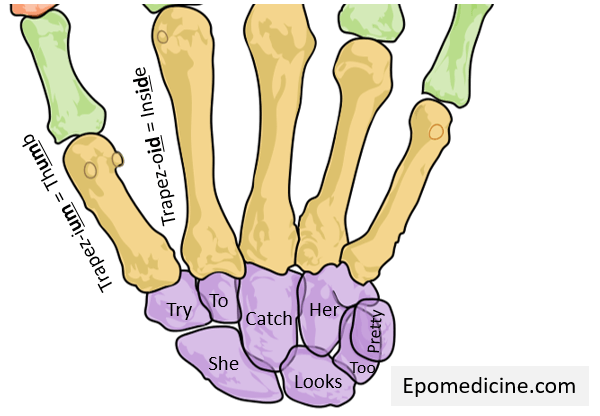
There are certain well-known sentences used as a mnemonic to remember the names and arrangement of the 8 carpal bones in 2 rows.

  1. She Looks Too Pretty, Try To Catch Her
  2. Some Lovers Try Positions That They Cannot Handle
carpal bones mnemonic
LadyofHats / Public domain [edited by Epomedicine]

So using this mnemonic, we will learn the arrangement of the carpal bones:

a. Proximal row (radial to ulnar):

  • Scaphoid (boat-shaped): most commonly fractured carpal bone
  • Lunate (moon-shaped)
  • Triquetral (pyramid-shaped)
  • Pisiform (pea-shaped): smallest carpal bone (also classified as sesamoid)

b. Distal row (radial to ulnar):

  • Trapezium (Irregular quadrilateral with one side parallel)
  • Trapezoid (Irregular quadrilateral with no sides parallel): smallest carpal bone in distal row
  • Capitate (head-shaped): largest carpal bone
  • Hamate (having hook/hamulus)

The problem with this mnemonic is the two “T”s in distal row both starting from”Trapez-“.

This can be remembered using another simple trick:

  1. Trapez-ium: Towards thumb
  2. Trapez-oid: On it’s side or Inside
Carpal Bones Ossification: Mnemonic
82 shares
  • Facebook38
  • Twitter
PGMEE, MRCS, USMLE, MBBS, MD/MS AnatomyMusculoskeletal system

Post navigation

Previous post
Next post

Related Posts

PGMEE, MRCS, USMLE, MBBS, MD/MS

Spaces and Compartments of Hand

Aug 28, 2021Oct 3, 2022

Spaces of Hand Deep space infections occur in one of the three anatomically defined potential spaces within the hand. Thenar, mid-palmar and hypothenar spaces Interdigital subfascial web space Forearm space of parona Deep hand space Dorsal border Volar border Ulnar border Radial border Remarks Thenar Adductor pollicis Palmar aponeurosis Middle…

Read More
PGMEE, MRCS, USMLE, MBBS, MD/MS

AO fracture classification made easy

Oct 8, 2022Dec 2, 2024

It is an alpha-numeric system of classification developed by Muller and colleagues. Step 1: 1st digit specifies bone Step 2: 2nd digit specifies segment of bone Square definition: Proximal and distal segments are defined by a square whose sides = length of widest part of epiphysis Exceptions of square definition:…

Read More
PGMEE, MRCS, USMLE, MBBS, MD/MS

Blood Supply of Humeral Head

Feb 22, 2021Feb 22, 2021

Anterior Humeral Circumflex Artery (AHCA) Origin: Axillary artery Course: Along the inferior border of subscapularis Gives anterolateral ascending branch which courses along lateral aspect of bicipital groove entering the humeral head and becoming arcuate artery Continues posterolaterally to anastomose with Posterior Humeral Circumflex Artery (PHCA) Posterior Humeral Circumflex Artery (PHCA)…

Read More

Leave a Reply Cancel reply

Your email address will not be published. Required fields are marked *

This site uses Akismet to reduce spam. Learn how your comment data is processed.

Pre-clinical (Basic Sciences)

Anatomy

Biochemistry

Community medicine (PSM)

Embryology

Microbiology

Pathology

Pharmacology

Physiology

Clinical Sciences

Anesthesia

Dermatology

Emergency medicine

Forensic

Internal medicine

Gynecology & Obstetrics

Oncology

Ophthalmology

Orthopedics

Otorhinolaryngology (ENT)

Pediatrics

Psychiatry

Radiology

Surgery

RSS Ask Epomedicine

  • What to study for Clinical examination in Orthopedics?
  • What is the mechanism of AVNRT?

Epomedicine weekly

  • About Epomedicine
  • Contact Us
  • Author Guidelines
  • Submit Article
  • Editorial Board
  • USMLE
  • MRCS
  • Thesis
©2026 Epomedicine | WordPress Theme by SuperbThemes