Skip to content
Epomedicine

Mnemonics, Simplified Concepts & Thoughts

Epomedicine

Mnemonics, Simplified Concepts & Thoughts

Carcinoid Tumors : Mnemonic

Epomedicine, Jun 30, 2023Jun 30, 2023

Origin: Neuroendocrine cells

Location: Lungs, Bronchi, Trachea, Gastrointestinal tract

Synthesize: Biogenic amines (mainly serotonin which is metabolied to 5-HIAA)

5 Manifestations
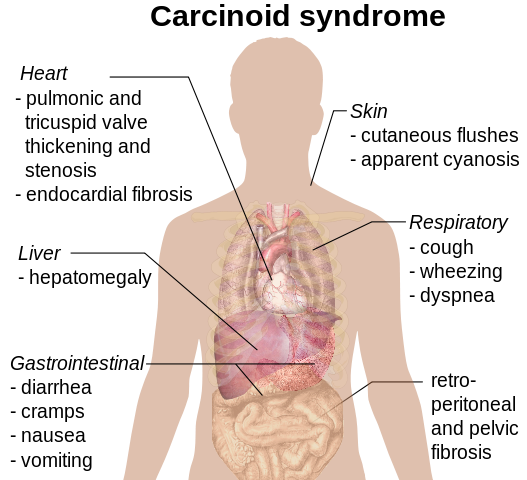
carcinoid syndrome
Mikael Häggström, CC0, via Wikimedia Commons

Mnemonic: 5-HIAAS

1. Heart disease (2/3 patients)

  • Right sided valvular heart lesions (due to factors secreted into hepatic vein by liver metastases)
    • Tricuspid regurgitation
    • Tricuspid stenosis
    • Pulmonary stenosis (less common)
  • Left sided heart disease (infrequent): 10%
  • Hypotension

2. Intestinal manifestations

  • Gastrointestinal bleeding
  • Obstruction
  • Watery diarrhea unresponsive to fasting

3. Airway obstruction

  • Localized wheezing +/- hemoptysis

4. Asthma

  • Significant diffuse wheezing

5. Skin manifestations

  • Intense cutaneous flushing
  • Necrolytic erythema

Alternative mnemonic: CARCinoid

  1. Cutaneous flushing
  2. Asthmatic wheezing
  3. Right sided valvular heart lesions
  4. Cramping and diarrhea

Rule of 1/3

  • 1/3 of carcinoid tumors metastasize.
  • 1/3 of carcinoid tumors present with 2nd malignancy.
  • 1/3 of carcinoid tumors are multiple.

Surgery for appendiceal carcinoid tumor

  1. <2 cm: Simple appendectomy
  2. >2 cm or mesoappendix invasion: Hemicolectomy

Medical therapy

  1. Somatostatin analogue: Octreotide
  2. Tryptophan hydroxylase inhibitor: Telotristat
  • Facebook
  • Twitter
PGMEE, MRCS, USMLE, MBBS, MD/MS Endocrine systemGastrointestinal systemGeneral SurgeryOncology

Post navigation

Previous post
Next post

Related Posts

PGMEE, MRCS, USMLE, MBBS, MD/MS

Acute Undifferentiated Febrile Illness – Mnemonic

Jun 8, 2021Jun 8, 2021

Acute undifferentiated febrile illnesses (AUFI) are characterised by fever of less than two weeks’ duration without organ-specific symptoms at the onset. Mnemonic MA-ESR lists the five main disease groups that cause acute undifferentiated febrile illnesses a. Malaria: Including all malaria due to Plasmodium falciparum, P vivax, P ovale, P malariae,…

Read More
PGMEE, MRCS, USMLE, MBBS, MD/MS Anterior and posterior epistaxis

Epistaxis Basics : Anatomy, Physiology and Pathology

May 3, 2014

Synonyms: Nosebleed, Nasal bleeding Definition: Epistaxis is defined as bleeding from the nasal cavity. It ranges from minor blood-tinged mucus when blowing the nose to life-threatening hemorrhage. Epidemiology: Age: Bimodal distribution – common in <10 years and >60 years Season: Winter Anatomy and Physiology: Why is the nose prone to…

Read More
PGMEE, MRCS, USMLE, MBBS, MD/MS

Timing of Wound Closure (Primary, Secondary, Tertiary)

Aug 26, 2020Aug 26, 2020

Before moving to the concept of wound closure, it is necessary to understand the pathophysiology behind different types of healing. We have covered stages of wound healing in general previously. There are three types of wound healing: Primary intention Secondary intention Tertiary intention Healing by primary intention occurs when the…

Read More

Comment

  1. Kelvin says:
    Jul 3, 2023 at 5:15 am

    This is a great mnemonic. You’ve always delivered the best, God bless you for teaching and searching ❤️🙏🏾🤙

    Reply

Leave a Reply Cancel reply

Your email address will not be published. Required fields are marked *

This site uses Akismet to reduce spam. Learn how your comment data is processed.

Epomedicine. Carcinoid Tumors : Mnemonic [Internet]. Epomedicine; 2023 Jun 30 [cited 2025 Dec 26]. Available from: https://epomedicine.com/medical-students/carcinoid-tumors-mnemonic/.

Pre-clinical (Basic Sciences)

Anatomy

Biochemistry

Community medicine (PSM)

Embryology

Microbiology

Pathology

Pharmacology

Physiology

Clinical Sciences

Anesthesia

Dermatology

Emergency medicine

Forensic

Internal medicine

Gynecology & Obstetrics

Oncology

Ophthalmology

Orthopedics

Otorhinolaryngology (ENT)

Pediatrics

Psychiatry

Radiology

Surgery

RSS Ask Epomedicine

  • What to study for Clinical examination in Orthopedics?
  • What is the mechanism of AVNRT?

Epomedicine weekly

  • About Epomedicine
  • Contact Us
  • Author Guidelines
  • Submit Article
  • Editorial Board
  • USMLE
  • MRCS
  • Thesis
©2025 Epomedicine . All rights reserved.