Skip to content
Epomedicine

Mnemonics, Simplified Concepts & Thoughts

Epomedicine

Mnemonics, Simplified Concepts & Thoughts

Osteochondroma : Mnemonics

Dr. Sulabh Kumar Shrestha, MS Orthopedics, Oct 5, 2022Oct 5, 2022

Features of Osteochondroma

Mnemonic: Six “C”

  1. Commonest benign bone tumor
  2. Continue to grow until Closure of physis
  3. Cartilage cap (appears larger clinically than in X-ray)
  4. Continuous with native bone (cortex and medullary canal)
  5. Cane (pedunculated/stalked points away from joint and sessile/broad based have higher risk of malignant degeneration)
  6. Change (mutation) in EXT1, EXT2 and EXT3 genes
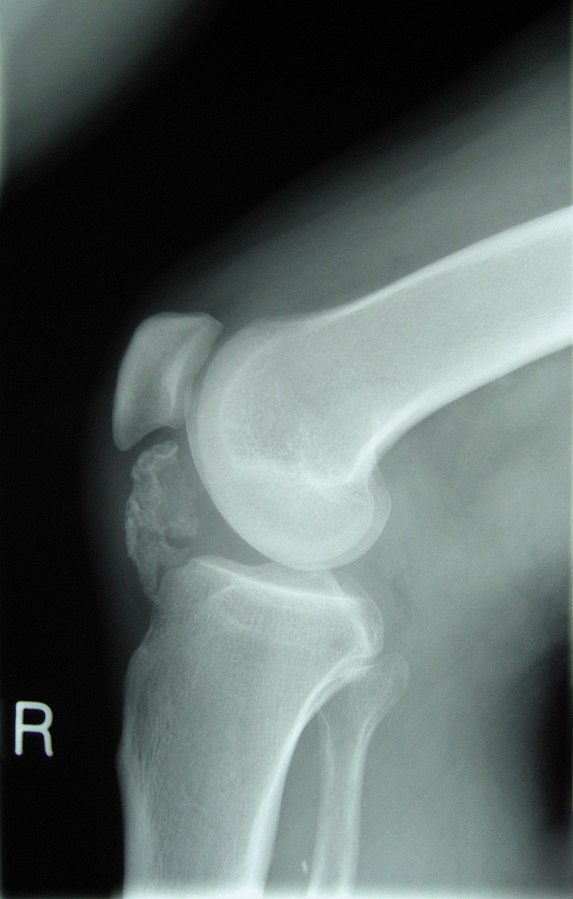
osteochondroma
Michael R Carmont, Sian Davies, Daniel Gey van Pittius and Robin Rees, CC BY 2.0, via Wikimedia Commons

Complications

Mnemonic: ABCDE

  1. Adventitious bursa (pain)
  2. Breakage of stalk (pain)
  3. Chondrosarcoma (pain; risk: 1% in solitary osteochondroma and 10% in multiple osteochondroma)
  4. Deformities:
    • Femoral shortening
    • Coxa valga
    • Genu valgum, Ankle valgus (because of shortened fibula)
    • Patellar dislocation
    • Ulnar shortening, radial bowing and ulnar deviation of hand
    • Radial head dislocation
  5. Encroachment:
    • Nerve compression (sciatic, common peroneal, radial)
    • Pseudoaneurysm (popliteal artery)
    • Tendon (rotator cuff impingement, subscapularis tear, bicipital tendinitis)

Common locations

Mnemonic: FGH

  1. Femur (proximal)
  2. Genu (knee)
  3. Humerus (proximal)
  4. Hallux (subungual)

Risk factors for Malignant transformation

Mnemonic: GLAD PaST

  1. Growth after skeletal maturity
  2. Lucency (new)
  3. Additional scintigraphic activity
  4. Destruction (cortical)
  5. Pain after puberty
  6. Soft tissue mass
  7. Thickened cartilage cap >1.5 cm

Pathogenesis theories
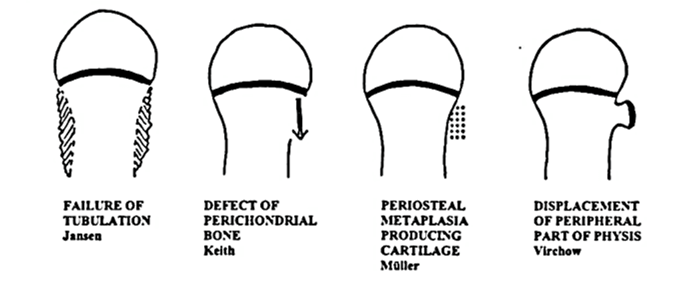
theories osteochondroma

Mnemonic: Five “P”

1. Bone defect

  • Perichondral bone defect and (Keith)

2. Cartilaginous metaplasia

  • Periosteal metaplasia in periphyseal-perimetaphyseal area producing cartilage (Muller)

3. Displacement of physis

  • Peripheral part of physis displacement (Virchow)

4. Epiphysis retains chondrogenic potential

  • Pathological retainment of chondrogenic properties by the epiphysis that would form perichondral bone of the groove of ranvier (Langenskiold)

5. Failure of tubulation

  • Prominent metaphysis suggesting tubulation failure (Jansen)

dr. sulabh kumar shrestha
Dr. Sulabh Kumar Shrestha, MS Orthopedics

He is the section editor of Orthopedics in Epomedicine. He searches for and share simpler ways to make complicated medical topics simple. He also loves writing poetry, listening and playing music. He is currently pursuing Fellowship in Hip, Pelvi-acetabulum and Arthroplasty at B&B Hospital.
  • Facebook
  • Twitter
PGMEE, MRCS, USMLE, MBBS, MD/MS Musculoskeletal systemOncologyOrthopedics

Post navigation

Previous post
Next post

Related Posts

Emergency Medicine pulmonary embolism xray

Pulmonary Embolism : Chest X-ray Signs

Oct 25, 2017

1. Classic presentation is normal X-ray in patient with dyspnea and hypoxia 2. Atelectasis or parenchymal abnormality (68%) 3. Elevated hemidiaphragm 4. Pleural effusion (Felson’s sign – pleural effusion on left > right) 5. Hampton’s hump: peripheral pleural based wedge-shaped density above the diaphragm due to pulmonary infarct 6. Westermark’s…

Read More
PGMEE, MRCS, USMLE, MBBS, MD/MS

Mnemonic Approach to Elbow Xray – FOOL

Oct 12, 2019Jun 14, 2022

Mnemonic: FOOLa. Fat padsb. Overt findings and outlinesc. Ossification centersd. Lines Fat pads The elbow joint has anterior and posterior fat pads which are extra-synovial but within the articular capsule. These are present as a radiolucent (black) line (compared to bone and surrounding soft tissues) in lateral X-rays. Normal finding:…

Read More
PGMEE, MRCS, USMLE, MBBS, MD/MS

Pharmacokinetics Mnemonics

Aug 12, 2019Aug 18, 2024

ADME is the 4-letter acronym used to describe pharmacokinetics: ABCD is another 4-letter acronym used to describe pharmacokinetics: The most important pharmacokinetic parameters from a dosing point of view are: Vd = Volume of distributionD = DoseCo = Concentration in plasmaCL = ClearancekE = Elimination constantt1/2 = Half life In…

Read More

Leave a Reply Cancel reply

Your email address will not be published. Required fields are marked *

This site uses Akismet to reduce spam. Learn how your comment data is processed.

Pre-clinical (Basic Sciences)

Anatomy

Biochemistry

Community medicine (PSM)

Embryology

Microbiology

Pathology

Pharmacology

Physiology

Clinical Sciences

Anesthesia

Dermatology

Emergency medicine

Forensic

Internal medicine

Gynecology & Obstetrics

Oncology

Ophthalmology

Orthopedics

Otorhinolaryngology (ENT)

Pediatrics

Psychiatry

Radiology

Surgery

RSS Ask Epomedicine

  • What to study for Clinical examination in Orthopedics?
  • What is the mechanism of AVNRT?

Epomedicine weekly

  • About Epomedicine
  • Contact Us
  • Author Guidelines
  • Submit Article
  • Editorial Board
  • USMLE
  • MRCS
  • Thesis
©2026 Epomedicine | WordPress Theme by SuperbThemes