Indications: Surgeries distal to and including patient’s elbow
Contraindications:
- Dislocated shoulder
- Enlarged axillary lymph node
- Obesity
Dose: 0.5% bupivacaine and/or 2% lignocaine with adrenaline (below calculated maximum doses) + NS
Equipment: Use a 0.8 X 40 mm needle
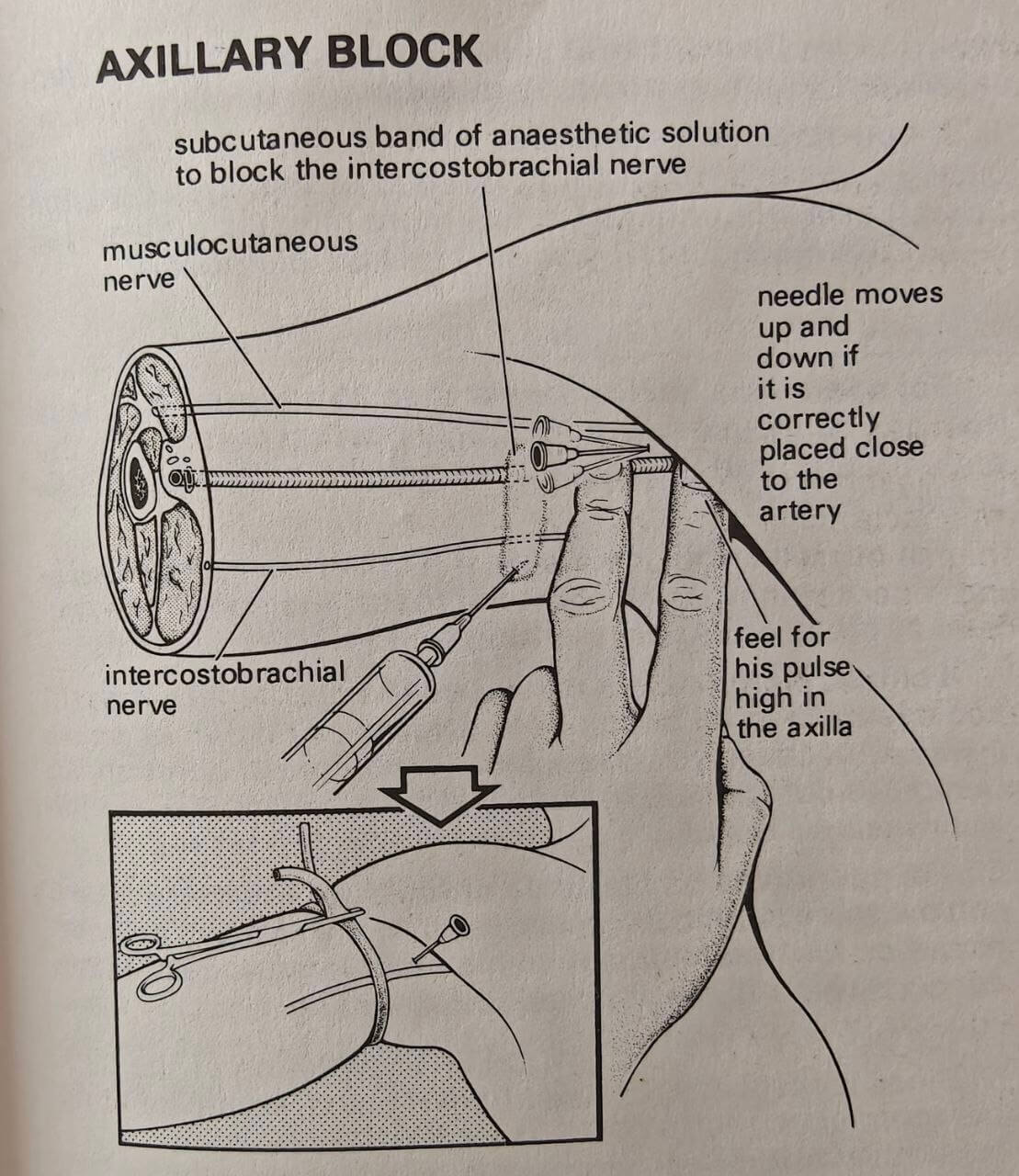
Method:
- Abduct the patient’s arm to 90 degrees and place it on the table
- Feel for the axillary pulse as high as possible in the patient’s axilla
- Keep your fingers on the axillary pulse and raise a small wheal above it
- Put a rubber tube as a tourniquet around the patient’s arm just below the wheal
- Push the needle, without a syringe, through the wheal which will immediately fall over, as it is not supported by fat
- Pick up the needle and push it towards the felt arterial pulse – you will feel resistance, followed by a “give” as you go through fibrous sheath protecting axillary nerves and vessels
- The needle should lie almost parallel to the artery. It will now stick out, held by skin and fascia. Meanwhile, compress the neurovascular bundle and depress it slightly downwards with your index finger
- If the needle is in correct position, it will jerk up and down due to proximity to artery, or the patient may feel paresthesia
- Aspirate and inject repeatedly and towards the end as you remove the needle, inject the last 3 ml of solution subcutaneously over the artery to block the intercosto-brachial nerve
Pitfalls:
- Failure of anesthesia on inner side of the patient’s arm (intercosto-brachial nerve)
- Failure of anesthesia of lateral side of the patient’s forearm (musculocutaneous nerve)
Reference: Primary Anaesthesia – Edited by Maurice King

Anesthesiology Resident (PGY-1) at Tribhuvan University Teaching Hospital, Institute of Medicine (TUTH, IOM). Her academic interests include perioperative medicine, regional anesthesia, and evidence-based practices in anesthesiology. She contributes scholarly articles on anesthesia to Epomedicine.