Skip to content
Epomedicine

Mnemonics, Simplified Concepts & Thoughts

Epomedicine

Mnemonics, Simplified Concepts & Thoughts

Axillary Artery Mnemonics

Epomedicine, Oct 16, 2017Oct 26, 2022

Origin of Axillary Artery: Continuation of Subclavian artery

Extent of Axillary Artery: Outer border of 1st rib to Lower border of teres major (terminates as brachial artery)

Relation to Axillary Vein: Lateral to Axillary Vein

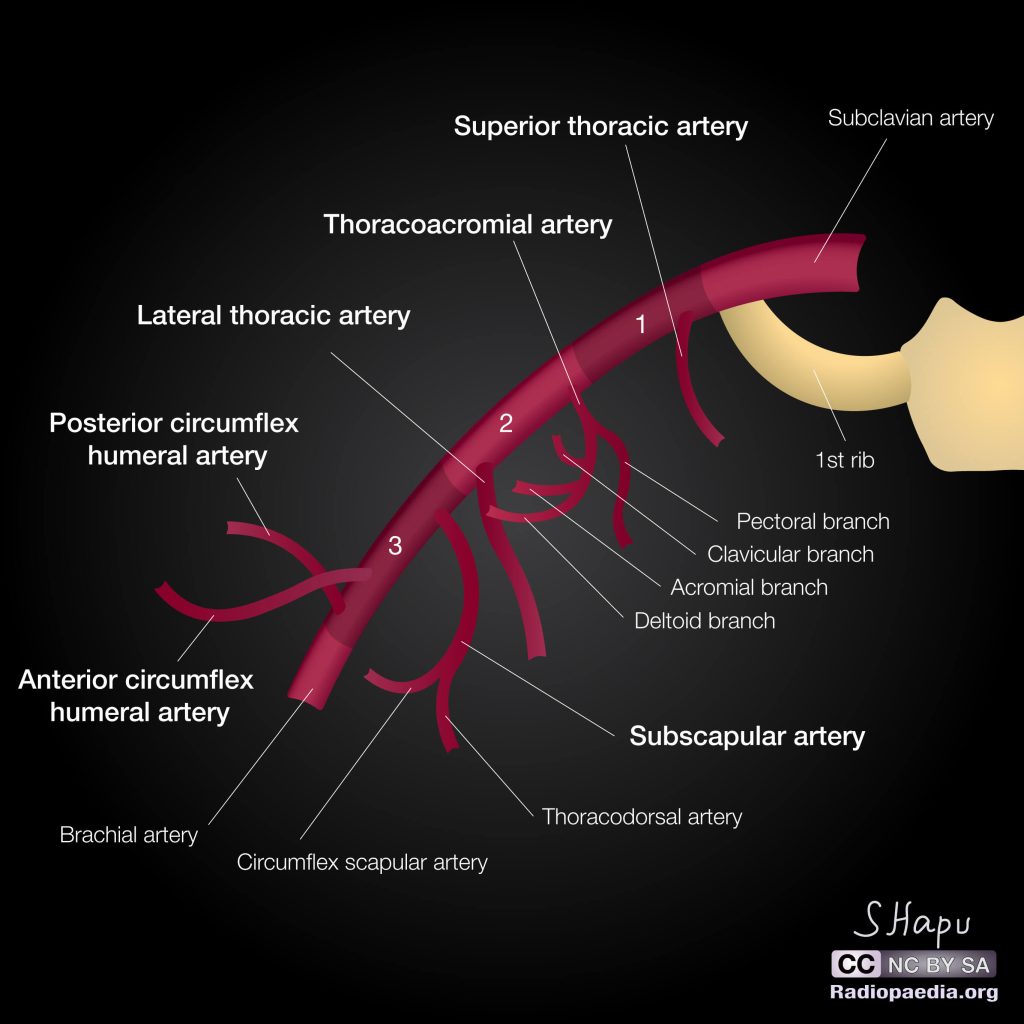
3 Parts of Axillary Artery: In relation to Pectoralis Minor muscle

  1. 1st part: Proximal
  2. 2nd part: Posterior
  3. 3rd part: Distal
axillary artery branches
“Radiopaedia – Drawing Segments and branches of axillary artery – English labels” by Sachintha Hapugoda, license: CC BY-NC-SA

Branches of Axillary Artery

Mnemonic:
1. 1st part gives 1 branch; 2nd part gives 2 branches and 3rd part gives 3 branches.
2. Remember S AL SAP

1. 1st part: S

  • Superior thoracic artery

2. 2nd part: AL

  • Acromio-thoracic artery
  • Lateral thoracic artery

3. 3rd part: SAP

  • Subscapular artery
    • Circumflex scapular artery travels through the triangular space
  • Anterior circumflex humeral artery (ACHA)
  • Posterior circumflex humeral artery (PCHA)
    • PHCA travels through the quadrangular space

Important muscular spaces in the shoulder can be remembered using a 2 hand, 2 finger intersection analogy as described here.

Further 4 branches of acromio-thoracic artery can be remembered using the mnemonic:

Mnemonic: ABCD

  1. Acromial
  2. Breast (pectoral)
  3. Clavicular
  4. Deltoid

  • Facebook
  • Twitter
PGMEE, MRCS, USMLE, MBBS, MD/MS AnatomyCardiovascular system

Post navigation

Previous post
Next post

Related Posts

PGMEE, MRCS, USMLE, MBBS, MD/MS

Heel Pad Syndrome vs Plantar Fasciitis

Apr 18, 2025Apr 18, 2025

Heel pad syndrome and plantar fasciitis both cause heel pain, but they affect different areas and have distinct characteristics. Further reading and differential diagnoses of heel pain: Heel Pain : Mnemonic Plantar Fasciitis Heel Pad Syndrome Definition Inflammation of the calcaneal origin of plantar fascia Traumatic irritation of the specialized…

Read More
PGMEE, MRCS, USMLE, MBBS, MD/MS

Arthrodesis Positions

Jul 26, 2022Jul 26, 2022

Arthrodesis is the surgical fusion of a diseased joint for the purposes of obtaining pain relief and stability. The bones are fused in a position permitting most useful function but lose their natural motion. Shoulder Flexion: 30° Abduction: 20° Internal rotation: 40° Elbow One side: 90° Both side: One in…

Read More
PGMEE, MRCS, USMLE, MBBS, MD/MS

Renal Counter-Current Mechanism Made Easy

Sep 11, 2021Sep 11, 2021

The term counter-current means flow in opposite direction. The renal counter-current mechanism comprises of: Flow of filtrate in opposite direction in nephron loop (down the descending limb and up the ascending limb of LOH or Loop of Henle) – that functions as a counter-current multiplier Flow of blood in opposite…

Read More

Leave a Reply Cancel reply

Your email address will not be published. Required fields are marked *

This site uses Akismet to reduce spam. Learn how your comment data is processed.

Pre-clinical (Basic Sciences)

Anatomy

Biochemistry

Community medicine (PSM)

Embryology

Microbiology

Pathology

Pharmacology

Physiology

Clinical Sciences

Anesthesia

Dermatology

Emergency medicine

Forensic

Internal medicine

Gynecology & Obstetrics

Oncology

Ophthalmology

Orthopedics

Otorhinolaryngology (ENT)

Pediatrics

Psychiatry

Radiology

Surgery

RSS Ask Epomedicine

  • What to study for Clinical examination in Orthopedics?
  • What is the mechanism of AVNRT?

Epomedicine weekly

  • About Epomedicine
  • Contact Us
  • Author Guidelines
  • Submit Article
  • Editorial Board
  • USMLE
  • MRCS
  • Thesis
©2026 Epomedicine | WordPress Theme by SuperbThemes